

Most restaurant operators don’t realize how much the wrong POS system costs them until it’s too late. The best POS systems aren’t just about processing payments faster. They’re about surviving internet outages without losing a sale, tracking inventory across three locations at once, and not getting buried in hidden fees halfway through year one. After reviewing dozens of platforms across the restaurant space, it’s clear that only a handful truly deliver on those promises. This guide covers five options worth your attention.
Behind the ranking
Every platform featured here was assessed using publicly available information gathered from official websites, software review directories, and verified customer accounts. The shortlist only includes options with a demonstrated track record in restaurant-facing point of sale software. → See the full research breakdown
- Orders.co – Cloud‑based restaurant POS system, best for unified ordering and delivery management
- GoTab – Best for large and mid-sized restaurants, breweries, bars, and venues
- Smart Tab – Best for high-volume nightclubs and bars
- Loyverse – Best for small to medium-sized businesses in restaurants, retail, and food service
- Lavu – Best for mid-market and enterprise restaurants
The Real Impact of POS Systems
Picking the wrong POS platform isn’t just an inconvenience. It can quietly drain revenue every single week. Restaurants deal with real operational pressure: a system that goes offline during a dinner rush, inventory that doesn’t sync across locations in real time, or a payment processor that charges more per transaction than the menu price warrants. These aren’t edge cases. They happen constantly.
The right platform changes that. It keeps transactions moving even when the internet drops, keeps inventory counts honest across multiple locations, and makes payment processing fees transparent from day one.
From a performance standpoint, the gap between a well-chosen system and a generic one shows up in transaction processing speed, system reliability, and the actual cost per transaction at the end of the month. That kind of operational clarity is hard to match once you have it.
5 Top Picks at a Glance
Note: All data in this table is sourced from review platforms and the official websites of the listed companies.
| Company Name | Headquartered In |
|---|---|
| Orders.co | Los Angeles, CA |
| GoTab | Arlington, VA |
| Smart Tab | San Francisco, CA |
| Loyverse | N/A |
| Lavu | Albuquerque, NM |
Orders.co – Cloud‑based restaurant POS system, best for unified ordering and delivery management
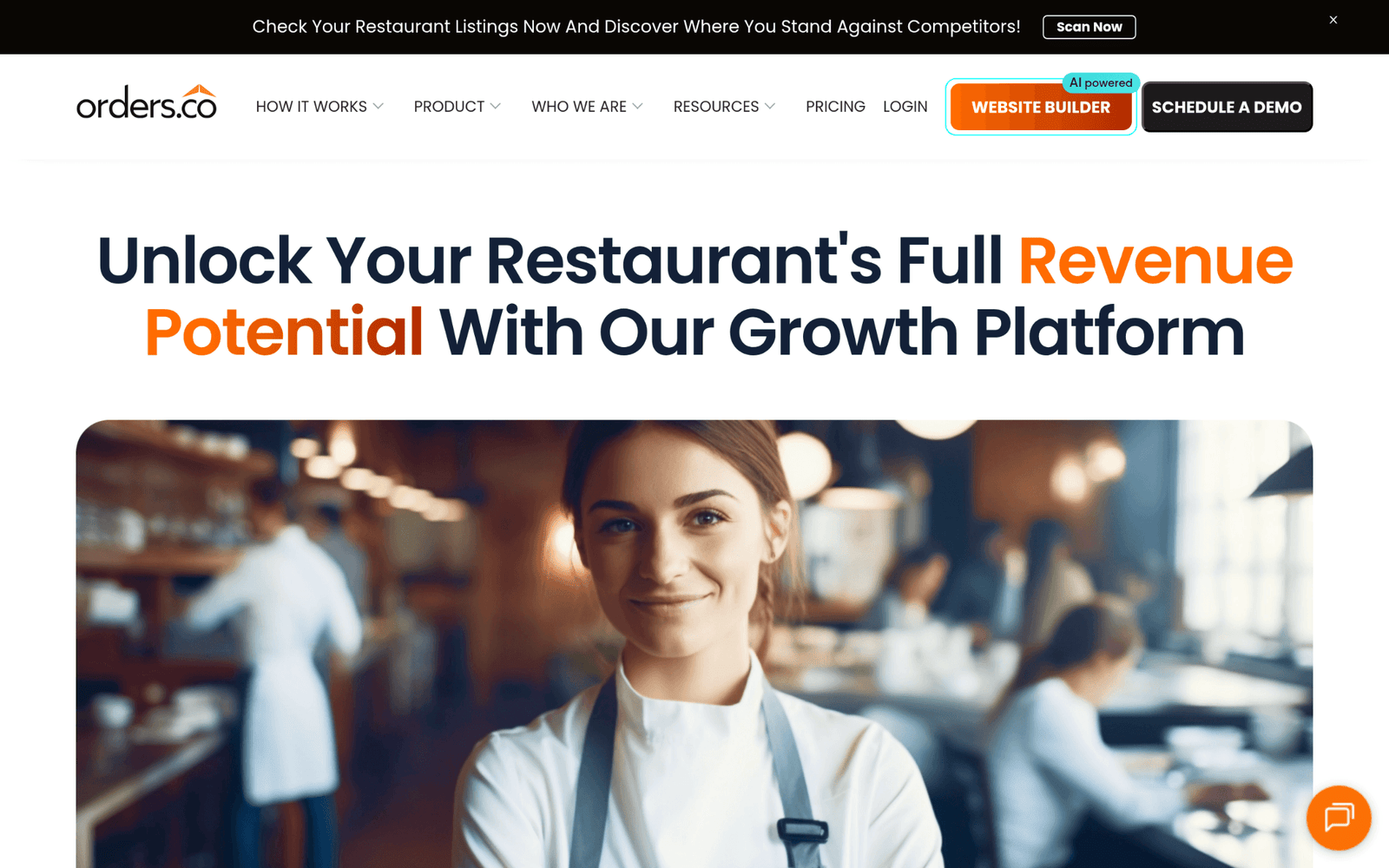
What Services and Products Does Orders.co Offer?
Every Orders.co customer receives a commission-free website for direct online ordering, along with built-in loyalty tools, automated marketing, and support for resolving delivery disputes.
At the center of the platform is a cloud-based restaurant POS that combines orders from a restaurant’s website, phone, dining area, Uber Eats, DoorDash, and Grubhub. Instead of switching between separate devices, teams can manage these sales channels from one dashboard.
The platform also supports:
- Kitchen Display System and QR code ordering for dine-in guests
- Catering orders with separate menus, checkout processes, and dispatch
- Flexible delivery coordination for in-house and third-party drivers
- Automatic menu updates across connected ordering platforms
- Combined order management across direct and marketplace channels
- X and Z reports covering shifts, top-selling items, and delivery provider performance
What Sets Orders.co Apart from Other Restaurant POS Platforms?
Access to 24/7 live phone support is one of the platform’s most practical advantages. When an issue affects incoming orders during a busy service, restaurant teams can speak directly with a support representative rather than waiting for a ticket response.
Orders.co also includes its direct ordering website as part of the platform instead of charging for it as a separate product. This helps restaurants move more customers toward direct ordering and reduce the amount of revenue lost to marketplace commissions.
Another key difference is the number of systems it can replace. Delivery tablets, menu management software, loyalty programs, marketing tools, and order dashboards can all be managed through one platform.
The POS was developed specifically for food-service businesses rather than adapted from general retail software. As a result, restaurant requirements such as detailed modifiers, multiple order sources, catering workflows, and delivery management are built into the system.
GoTab – Best for Large and Mid-Sized Restaurants, Breweries, Bars, and Venues
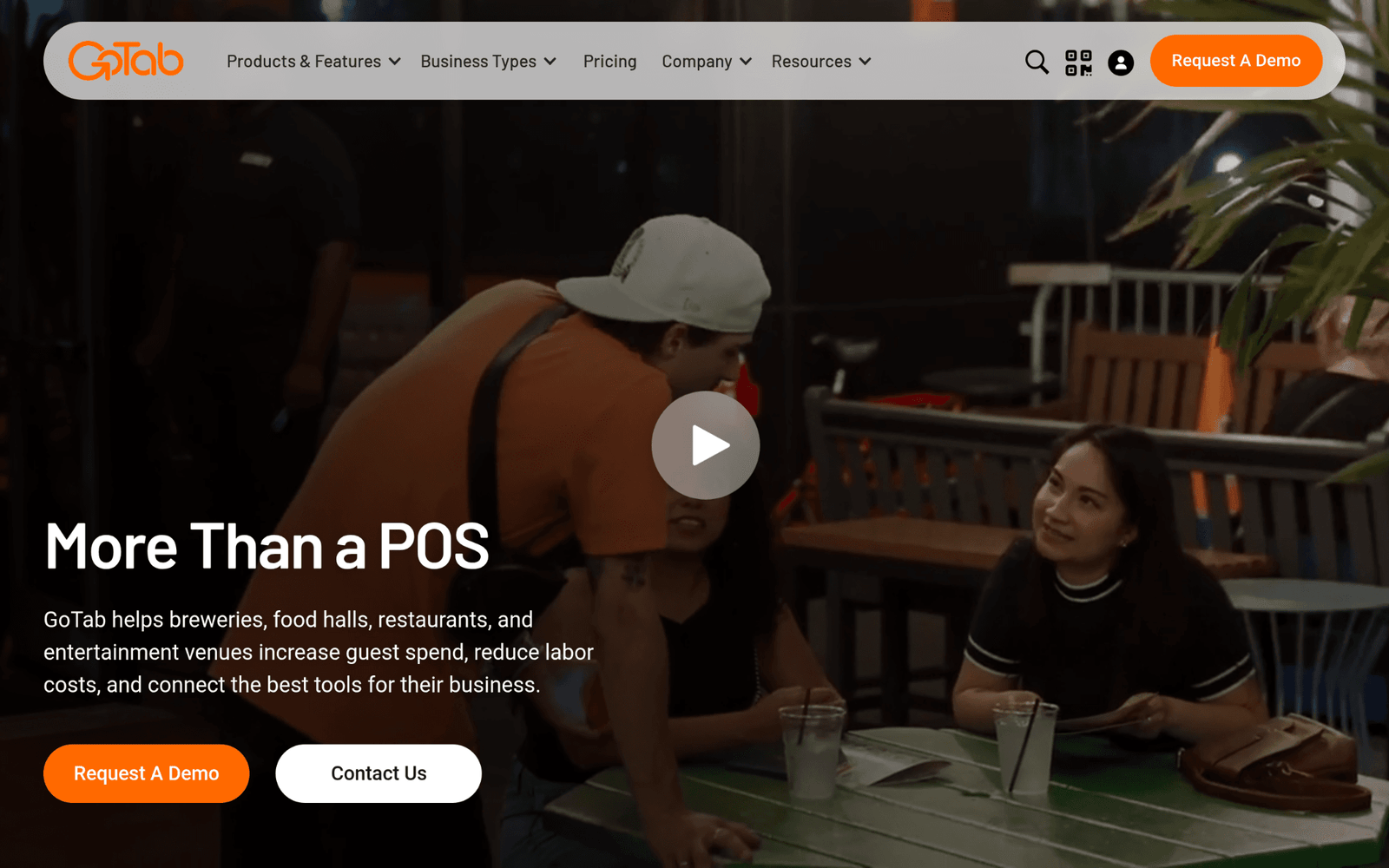
What Services and Products Does GoTab Offer?
GoTab is a restaurant commerce platform founded in 2015 that covers mobile point-of-sale, contactless ordering and payment, and kitchen management systems for restaurants, breweries, bars, and large venues. Patrons can order and pay via a server, their mobile phone, or a hybrid of both without needing to download an app. The platform runs on any internet-connected device, uses transaction-based pricing, and serves clients including Stone Brewing Co., Barcelona Wine Bar, and Topgolf.
What Sets GoTab Apart from POS Systems?
GoTab tackles a specific challenge for high-volume venues: keeping ordering and payment flowing across multiple service models without locking operators into specific hardware. Their hardware-agnostic setup and transaction-based pricing make scaling across a large venue or multiple locations far less painful than it sounds.
Real User Sentiment:
GoTab earned the 2021 Excellence in Customer Service Award from Business Intelligence Group, and that reputation shows in the reviews. Users across breweries and large venues consistently point to the flexibility of QR code ordering and the simplicity of their kitchen management tools. Venues that run complex hybrid service models tend to respond especially well to the platform.
Smart Tab – Best for High-Volume Nightclubs and Bars
What Services and Products Does Smart Tab Offer?
Smart Tab is a hybrid POS and business management system designed for nightclubs and bars that move fast. Founded in 2011 and based in San Francisco, the platform pairs on-site local servers with cloud infrastructure so operations keep running even when connectivity drops. Important features include ID-based payment profiles, custom table maps, biometric employee tracking, kitchen display systems, and multi-location enterprise management. It’s built by people who actually worked in nightlife (former bartenders, servers, and general managers), and that shows in the feature set.
What Sets Smart Tab Apart from POS Systems?
Nightclubs and high-volume bars need offline payment processing that doesn’t flinch mid-rush, and Smart Tab’s hybrid architecture is designed for exactly that scenario. Their flexible month-to-month pricing with no long-term contracts is a real differentiator for operators who aren’t ready to commit to a multi-year deal.
Real User Sentiment:
Users in fast-paced bar environments tend to point to reliability as Smart Tab’s strongest trait. The offline functionality gets called out repeatedly as the reason operators stick with the platform. In a venue where connectivity is never guaranteed, that kind of stability is what keeps the night running smoothly.
Loyverse – Best for Small to Medium-Sized Businesses in Restaurants, Retail, and Food Service
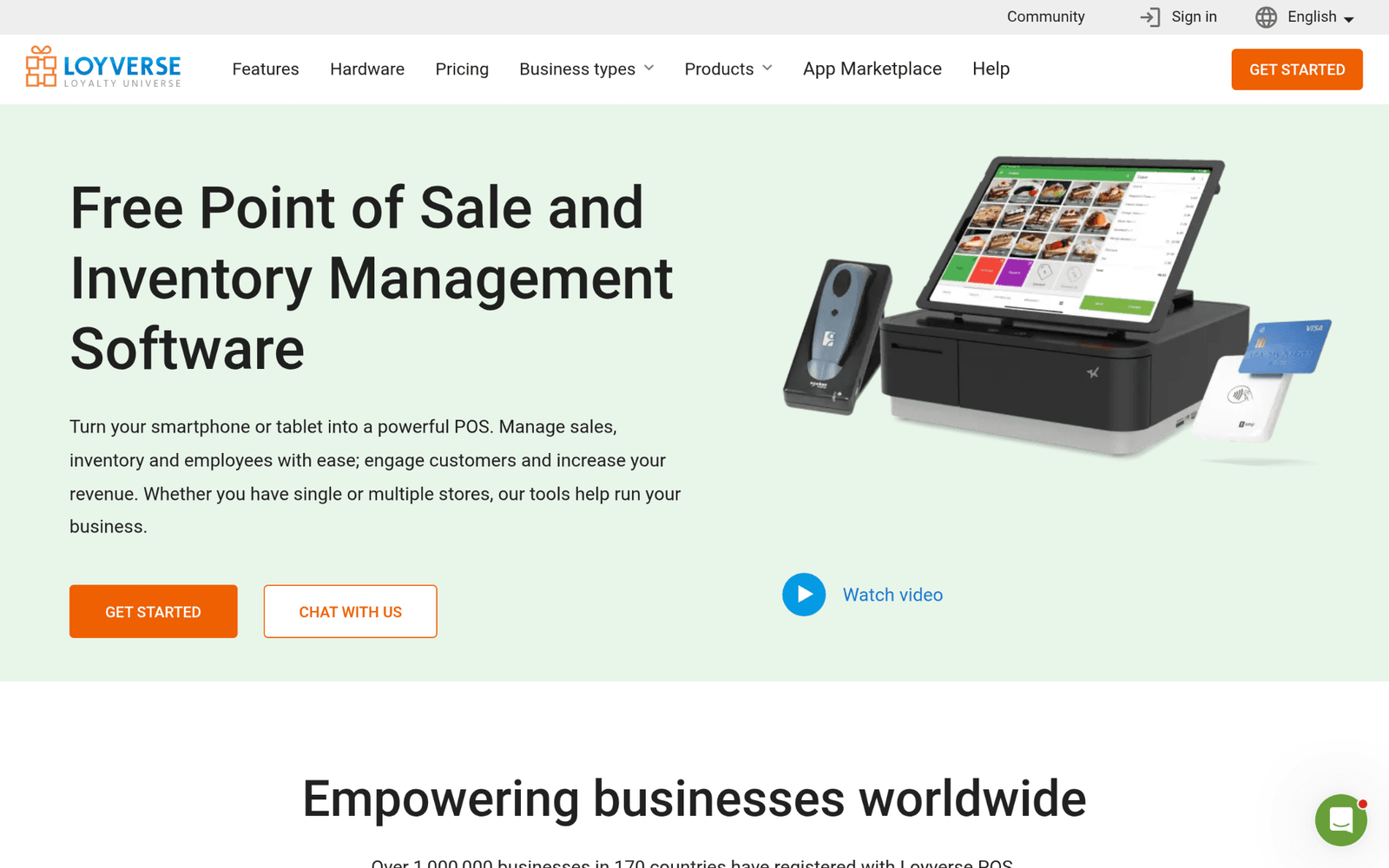
What Services and Products Does Loyverse Offer?
Loyverse is a mobile POS and business management platform that turns smartphones and tablets into full-featured point-of-sale systems. Founded in 2014, the platform covers sales processing, inventory management, employee management, sales analytics, retention programs, and multi-store management. The base app is free, with premium features accessible through their Back Office. With support for 30-plus payment processors across 170-plus countries, Loyverse is one of the more globally accessible options on this list (not always the flashiest, but consistently reliable).
What Sets Loyverse Apart from POS Systems?
Small and growing food service businesses often need a POS that works offline without charging extra for it, and Loyverse delivers that alongside a built-in loyalty program that most budget-tier platforms don’t include. Their mobile-first design means setup is fast, which matters a lot when you’re training new staff with minimal disruption.
Real User Sentiment:
Loyverse has picked up recognition from Capterra, G2, Trustpilot, and Crozdesk, and the patterns in those reviews are consistent. Users point to the intuitive interface and the zero-cost entry point as the two biggest reasons they chose it. The loyalty program feature turns out to be a pleasant surprise for operators who expected to pay separately for it.
Lavu – Best for Mid-Market and Enterprise Restaurants
What Services and Products Does Lavu Offer?
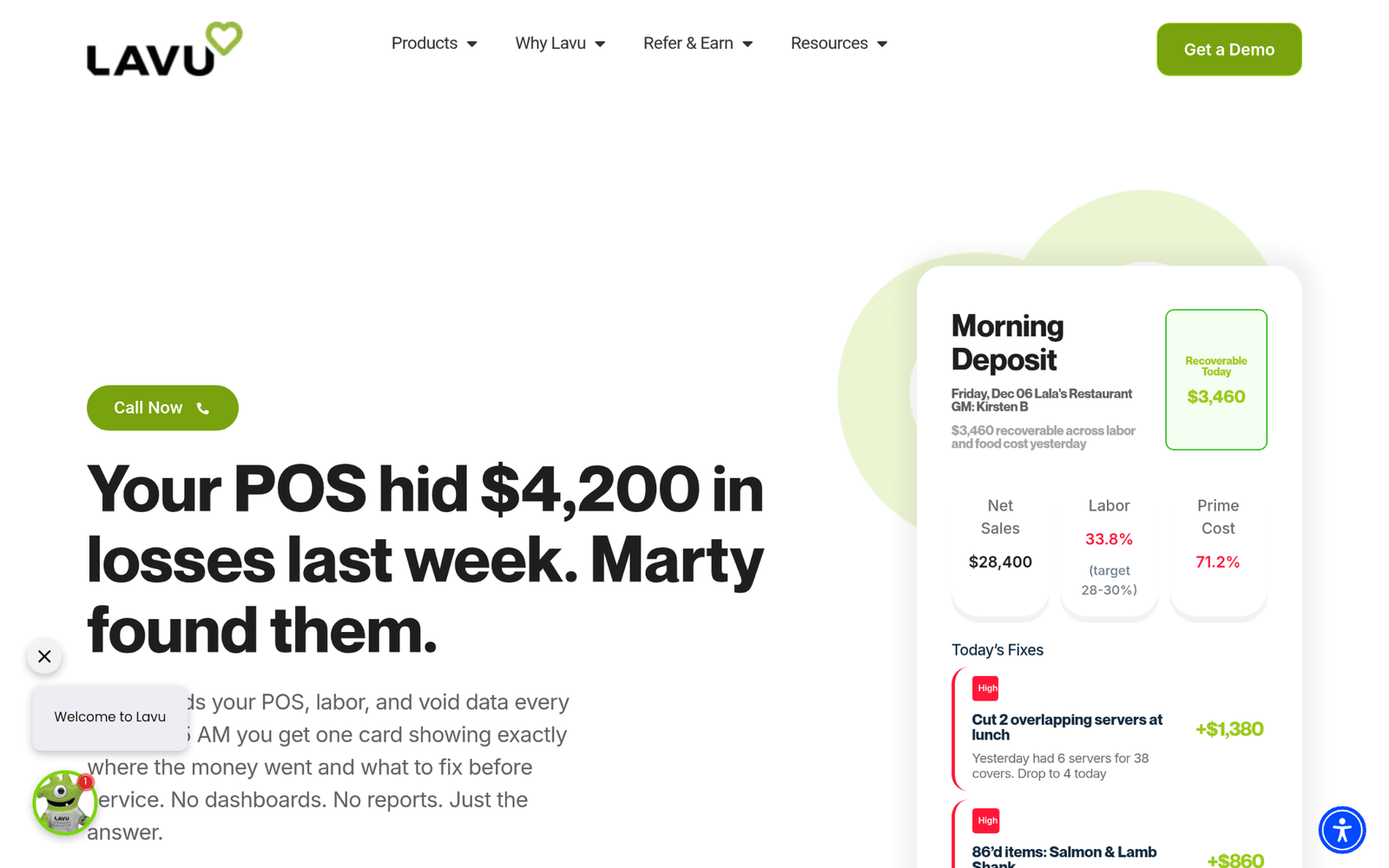
Lavu is a restaurant operating system built on an iPad-based POS with integrated payment processing, online ordering, loyalty programs, labor management, and inventory management. What makes Lavu genuinely different is Marty, their AI intelligence layer that connects POS, payments, labor, and reporting into a single source of truth. Marty includes six AI agents that cover marketing, menu pricing, labor scheduling, inventory, server coaching, and financial analysis. The company has processed over 1 billion orders and operates across 80-plus countries on six continents (real global scale, not just marketing language).
What Sets Lavu Apart from POS Systems?
Lavu was the first restaurant POS system built for iPad, and they’ve since grown into the largest mobile POS for restaurants globally, which gives them a depth of product experience that newer entrants can’t replicate. Marty’s nightly analysis of POS, labor, and void data gives operators a clear picture of where money went before service even starts the next day.
Real User Sentiment:
Lavu earned multiple accolades in G2’s 2025 awards cycle, and the verified reviews reflect strong satisfaction with operational reporting and ease of use. Users in larger restaurant groups tend to note how Marty cuts down the guesswork around labor scheduling and menu pricing. Mid-market operators, from what the data shows, find that the AI layer pays for itself faster than expected.
How These Were Chosen and Verified
The goal behind this research was to surface POS platforms that actually perform in restaurant environments, not just ones that look good on a product page.
Data Assembly and Organization
The process started by pulling together a broad list of restaurant-focused POS platforms from software directories, industry review sites, and published case studies. Each entry was logged with available details covering features, pricing signals, market focus, and geographic reach. This initial pass was about building a complete picture of what’s available in the space before any filtering happened.
The Shortlisting Pass
Platforms that lacked sufficient publicly verifiable information were removed early. Review patterns were analyzed across multiple platforms to identify whether feedback was consistent or inconsistent over time. Companies with thin review histories, unverifiable claims, or a mismatch between marketing language and actual user experience were cut at this stage. Only those with a clear, demonstrated presence in the restaurant POS space advanced.
Verification Pass
Claims made on each company’s official website were cross-referenced against real user reviews and publicly available case study results. Where a platform claimed a specific capability, evidence of that capability in real-world restaurant settings was looked for before accepting it. Platforms that couldn’t be verified through at least one external source were not included, regardless of how polished their product page appeared.
Industry Recognition and Authority
Award histories, mentions in third-party publications, and recognition from established software review organizations were factored in during this phase. Companies like GoTab, Loyverse, and Lavu have earned recognition from Business Intelligence Group, G2, Crozdesk, and GetApp, which signals that their performance holds up under scrutiny beyond their own marketing. That kind of third-party validation carries real weight in the evaluation.
Evidence Related to POS Systems
Each finalist was assessed for how directly their platform addresses the specific demands of restaurant POS operations. This included looking for dedicated feature pages covering offline functionality, multi-location inventory management, and transparent payment processing fee structures. Verified reviews that mentioned these use cases were prioritized. Platforms that could only show general point-of-sale capability without restaurant-specific depth were not carried through to the final list.
What to Look For When Choosing POS Systems
Not every POS system is built with restaurants in mind. Before committing to a platform, it’s worth slowing down and checking a few things that don’t always show up in the product demo.
- Industry and Domain Experience: Look for platforms built by teams with real hospitality experience. A system designed by former restaurant operators is going to handle edge cases, like a kitchen printer going offline mid-service, very differently from a generic tool.
- Features and Services: Check whether the platform covers offline functionality, inventory management across locations, and retention tools natively. Features that require third-party add-ons add cost and burden over time.
- Pricing Structure: Hidden fees in payment processing and subscription tiers are common in this space. Ask for a full breakdown of per-transaction costs, monthly terminal fees, and any charges for features that look standard but aren’t included in the base plan.
- Results Measurement: A good POS platform should give operators clear reporting on transaction processing speed, sales trends, and labor costs. If the reporting layer is thin, the operational visibility disappears with it.
- Industry Knowledge and Compliance: PCI DSS compliance and EMV payment standards aren’t optional. Confirm that any platform under consideration handles these requirements automatically so your team doesn’t have to manage them manually.
Final Take
Choosing the right POS system comes down to fit, not features. GoTab and Smart Tab excel in specific venue types. Loyverse punches above its weight for smaller operators. Lavu brings serious AI-driven reporting to mid-market and enterprise restaurants. Orders.co stands out for restaurants that want online ordering and customer engagement handled together. As restaurant technology keeps advancing, platforms that pair operational reliability with smart automation are going to pull further ahead of the pack.