
Packaging stops being “just the box” the moment a mid-sized company juggles dozens of SKUs across retail, ecommerce, and global markets. Freight margin shrinks, launches slip, and regulators ask questions your inbox can’t answer. A documented packaging system, one library of dielines, specs, and costs any qualified supplier can run tomorrow, turns that chaos into control. Over the next few minutes, you’ll see how to build it so one mislabeled carton never stalls growth again.
The portability stress test
Picture Friday afternoon: your go-to carton supplier files for bankruptcy. By Monday morning, can another converter open your dielines, pull the right board grade, and ship an indistinguishable box, without calling for tribal knowledge?
If you’re unsure, you have a dependency, not a design.
Why does that matter? In L.E.K. Consulting’s 2025–26 survey of 450 U.S. brand managers and packaging stakeholders, roughly 91 percent said they use more than one packaging supplier, with supply risk among the reasons alongside cost, lead time, and geographic coverage (LEK survey). Yet the hedge only works if every dieline, color target, and tooling spec lives in a shared, version-controlled library the whole team can reach. Tooling ownership must be spelled out, and at least one alternate supplier needs a vetted, ready-to-run file set. When disruption hits, you change lanes instead of stalling on the shoulder.
This isn’t alarmism; it’s scale insurance. Portability turns packaging from a fragile, relationship-bound craft into a repeatable business process that grows with your SKU count and sales channels.
Seven signals you’re running on dependency
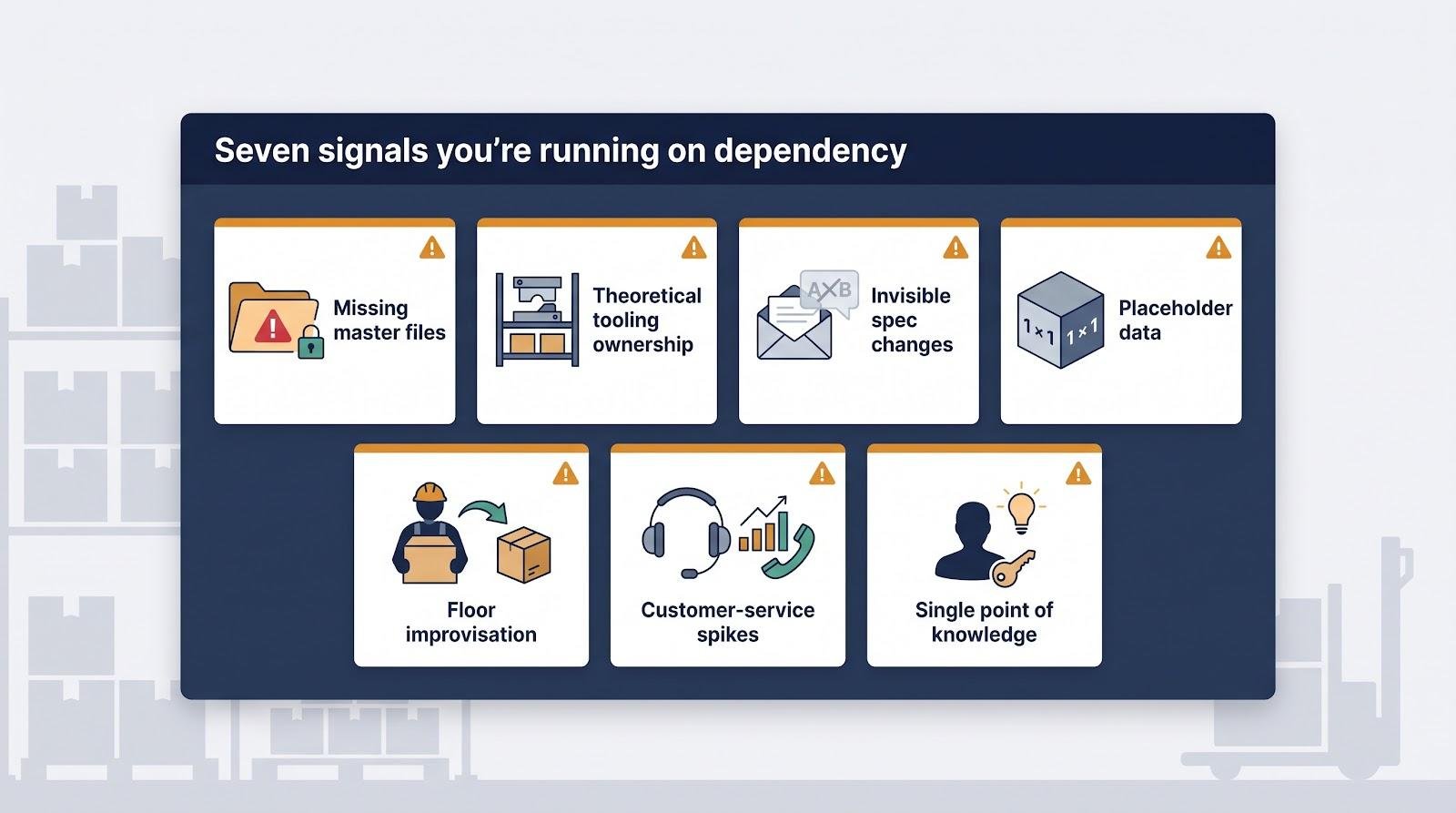
- Missing master files. The only editable dieline sits on a supplier’s server.
- Theoretical tooling ownership. The invoice says you own the die; the die never leaves the vendor’s shelf.
- Invisible spec changes. Critical tweaks hide in one person’s inbox or a private Slack thread.
- Placeholder data. Your ERP still lists “1 × 1 × 1” dimensions, so carriers bill DIM weight on guesswork.
- Floor improvisation. Operators swap box sizes mid-shift because no one documented the standard.
- Customer-service spikes. Returns rise after an untracked packaging change.
- Single point of knowledge. One name keeps coming up as the only person who “knows how.”
If any of these feel familiar, the next disruption isn’t hypothetical; it’s a calendar event waiting for a date.
Six traits of a real packaging system
A resilient packaging operation isn’t defined by one flashy machine or a clever dieline. It rests on six working traits that the strongest mid-market brands share:
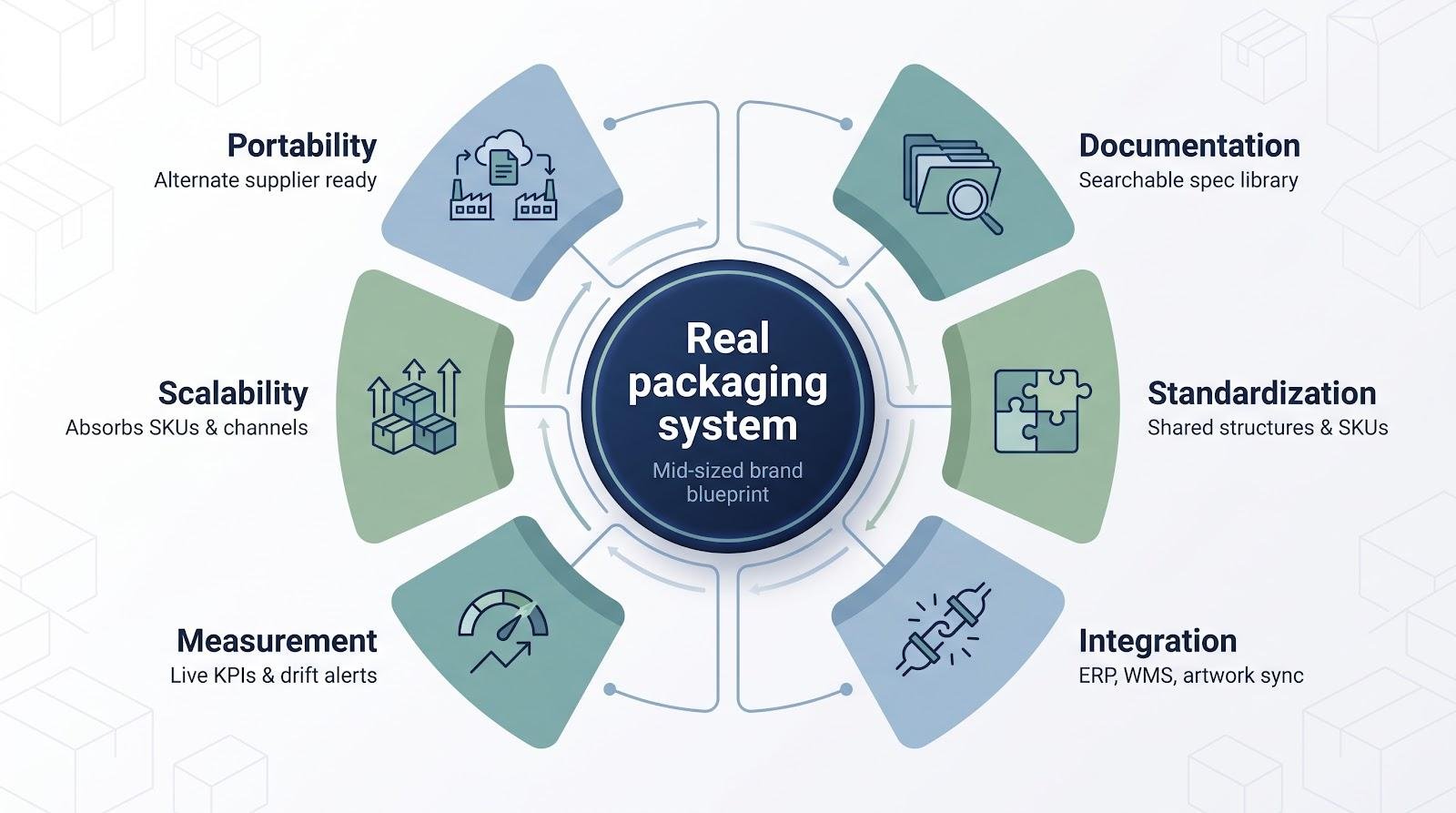
- Documentation. Every SKU, component, and revision lives in a searchable library: no flash drives, no mystery folders. According to PMMI’s 2026 From Complexity to Capability survey, 79 percent of respondents cited workforce knowledge loss, turnover, and efficiency loss as expected productivity drag.
- Standardization. Shared structures, materials, and tolerances mean new designs start 80 percent complete instead of from scratch.
- Integration. The library syncs with ERP, WMS, and artwork tools so finance, ops, and brand teams see the same numbers.
- Measurement. Cost per shipped order, changeover minutes, cube utilization, and damage rate update in real time so drift shows up before peak season.
- Scalability. The framework absorbs new SKUs, channels, or regulations without a ground-up redesign.
- Portability. A qualified alternate supplier can use the same files tomorrow and deliver an identical result.
Some providers already frame packaging this broadly. A notable example is Zenpack, which merges strategy, materials optimization, prototyping, direct-factory production, and logistics into a single managed pipeline that eliminates material inconsistencies and lowers inventory holding costs, a model that lines up neatly with the six traits above.
What a complete packaging system includes
Governance and ownership
A packaging system works only when someone is visibly accountable for its success. Start with a named executive sponsor who tracks packaging KPIs as closely as on-time shipments. Below that, assign a day-to-day process owner, the air-traffic controller who keeps specs current and approvals moving.
Why the formality? The PMMI survey above also showed that 79 percent of respondents expect productivity drag from knowledge loss and turnover. Clear ownership is the quickest way to close that gap.
Create a short RACI table:
- Who drafts or edits dielines?
- Who signs recycled-content claims?
- Who alerts the 3PL when an insert changes size?
Putting names next to tasks stops finger-pointing before it starts. Add an escalation rule so if a carton fails drop testing at 4 pm on Friday, everyone already knows the back-up plan; no midnight Slack scramble.
Solid governance also makes funding easier. When finance sees an accountable lead with tracked KPIs, requests for automated cutters or right-sized mailers become capital projects instead of wish lists.
Master data and specification library
Data is the system’s connective tissue. Give every component a unique ID tied to dimensions, board grade, weight, ink set, and tooling location. When marketing updates copy or a regulation adds a symbol, bump the revision number and let the history travel with the file.
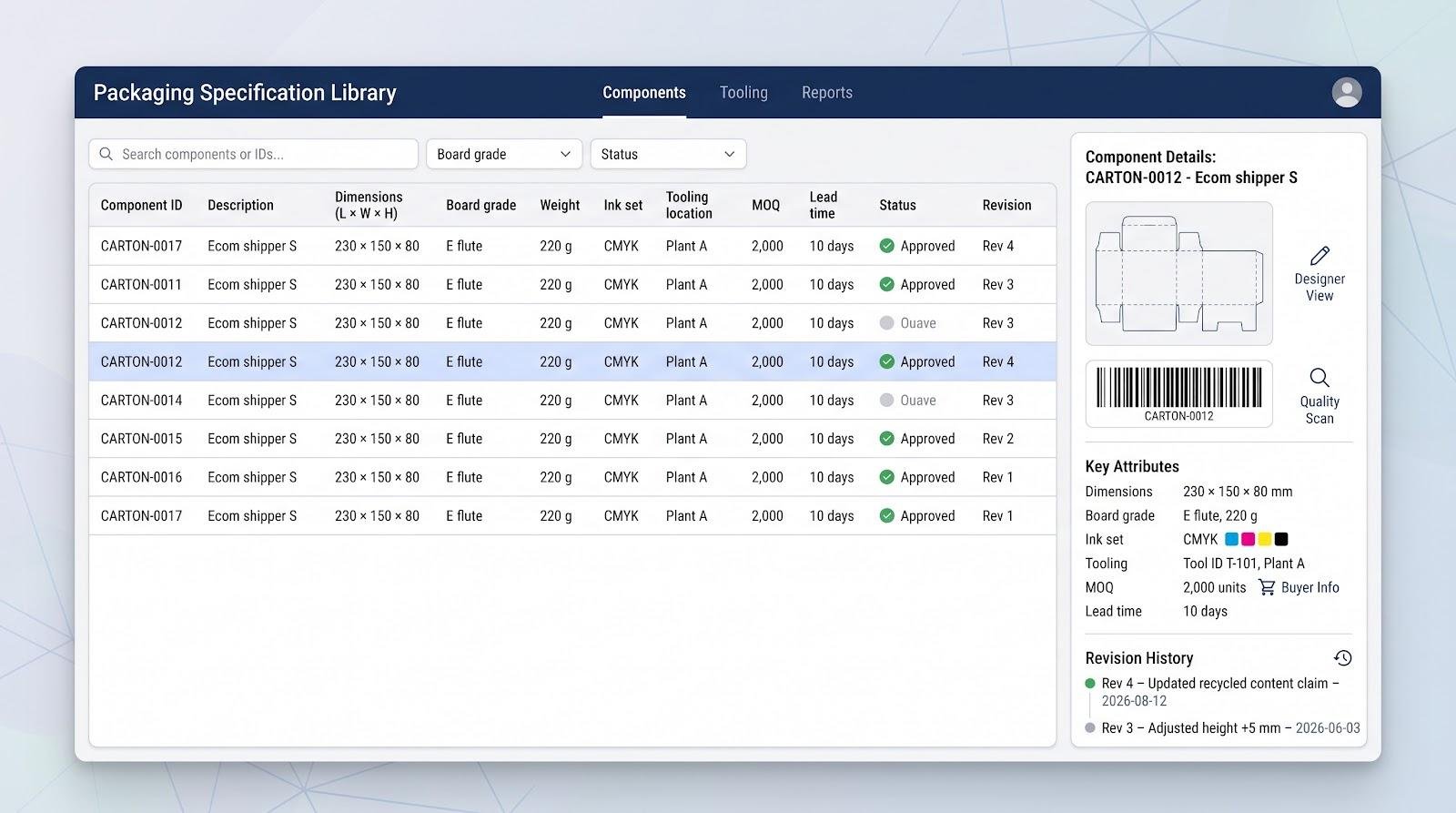
Housing the library in a structured platform keeps daily work simple: designers pull the latest dieline, buyers see MOQ and lead time before raising a PO, and quality scans barcodes on the line instead of digging through PDFs.
Clean data drives automation. Right-sized pack stations, dynamic cartonization, and damage prediction models succeed only when the numbers are correct. Bad inputs still yield air-filled boxes and unhappy customers.
Treat the library as living infrastructure. Schedule quarterly audits, lock edits behind approvals, and require suppliers to submit updates in machine-readable formats. Good data now costs less than charge-backs later.
Structural packaging architecture
Great packages share DNA. Group products into families first, then design a backbone each family can reuse.
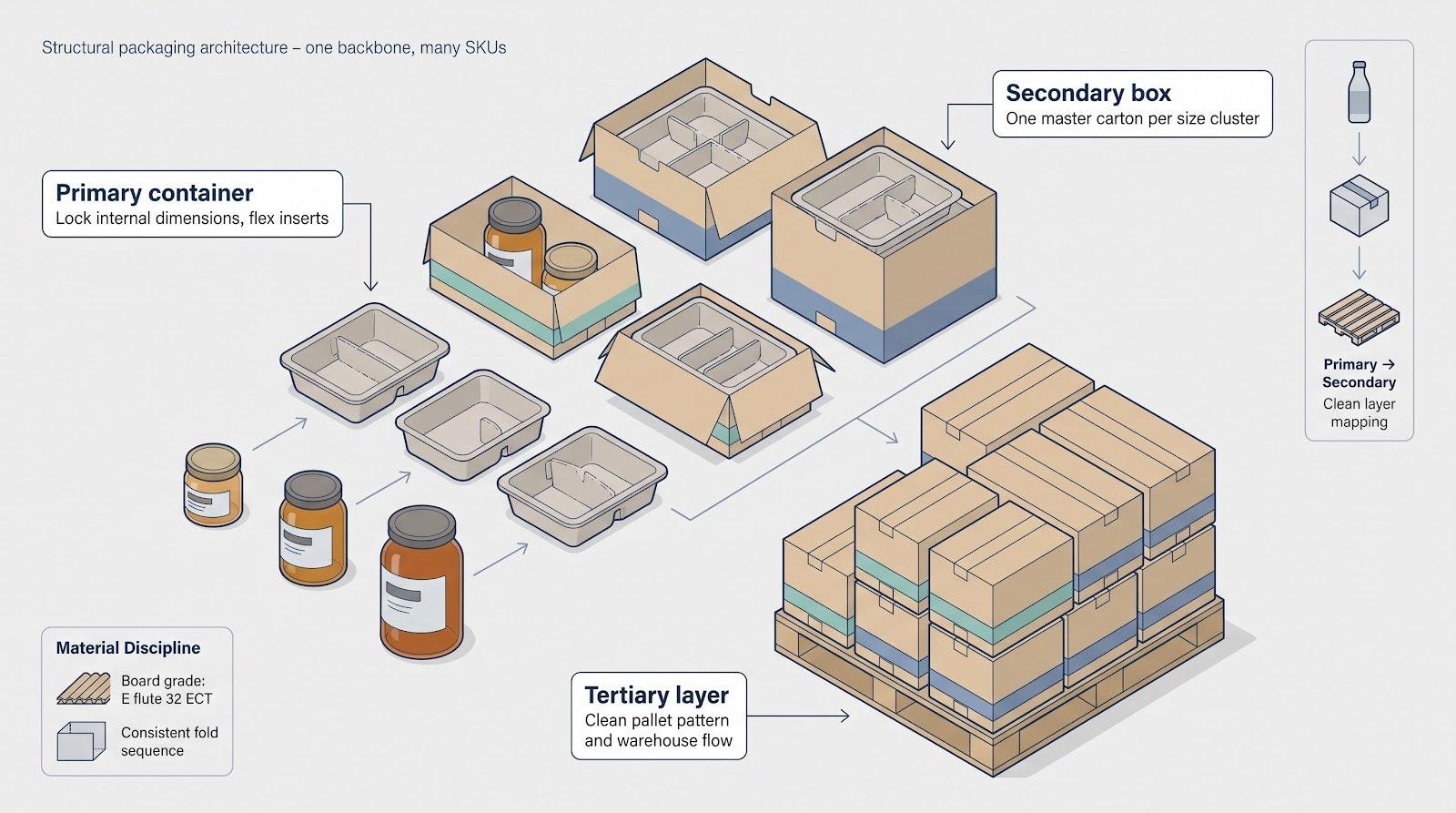
- Primary container. Lock internal dimensions for protection and fill level; build inserts or dividers that flex so new size variants don’t need a fresh die.
- Secondary box. One master carton per size cluster keeps corrugated SKUs low, simplifies pallet patterns, and speeds changeovers. When a seasonal flavor launches, it slips into the existing shell instead of reinventing the cube.
- Material discipline. Board grades and fold sequences stay consistent across the family, so automation crews dial in once and run all shift.
- Layer mapping. Primary, secondary, and tertiary layers nest cleanly, move through warehouse pick faces, and meet retailer shelf specs without extra fillers or tape.
A case study by Adept Packaging showed that a high-volume manufacturer consolidating its packaging portfolio achieved a 40 percent reduction in corrugate packaging formats and a 10 percent reduction in corrugate and inventory costs, proving that a common spine pays its own way.
A solid structural backbone trims tooling spend, cuts set-up time, and keeps freight costs predictable even as the SKU list grows.
Visual packaging architecture
Structure protects the product; visuals protect the brand.
Codify color first. Each Pantone or hex value carries a tolerance range your converter can hit on press, in different lighting, and on different substrates. When a seasonal sleeve needs a tweak, designers know the exact delta they can push without drifting into “close enough” land.
Typography rules follow. Font family, weight, and minimum point size live in the spec, so a Korean nutrition panel prints as crisply as the English one, with no last-minute font swaps that wreck kerning or trigger compliance headaches.
Artwork zones sit on the dieline. Copy, barcodes, and regulatory marks stay fixed; campaign imagery floats in the safe area, letting retailers scan and customers unbox a consistent story.
Finally, define variation rules: what can change for a limited-edition drop and what must stay locked for shelf recognition. Clear guardrails free designers to move fast without diluting the flagship look.
A disciplined visual system saves more than brand equity. It reduces rework, shortens approvals, and lets multiple print partners hit the same target on opposite sides of the globe.
Sourcing, production, and quality system
A clever dieline means nothing if the factory can’t hit spec on a rainy Tuesday. That’s why the system certifies suppliers before the first PO.
First comes material screening. Pull board, film, and inks from each plant and run the same drop, compression, and rub tests the line will see later. Pass rates go on the scorecard; misses trigger a corrective plan or a quick exit.
Next, lock golden samples. One set lives with the converter, another in your lab, and a digital twin sits in the spec library. When a shipment lands, QC checks color swatches, flute profiles, and fold accuracy against the master, not memory.
Formalize the corrective-action loop, too: if a pallet shows glue bleed or off-register print, the supplier logs root cause, fixes it, and reships under the same PO. No debate, no surprise invoices.
Finally, keep at least one alternate supplier qualified for every high-volume component. Supply-chain disruptions carry a real revenue cost, and a pre-qualified backup supplier is the direct mitigation when a primary plant goes offline.
Logistics and fulfillment system
Packaging earns its keep only when it moves through the warehouse quickly. Map each pick face and pack station so operators grab one clearly labeled carton family instead of hunting through a forest of look-alikes.
Cartonization rules in the WMS pull live product dimensions from the spec library and suggest the smallest approved shipper that still meets protection targets. When those dimensions are right, the system banks the savings automatically; when they’re wrong, carriers bill you for air.
At the pack station, standardized inserts click into place without knives or tape guns. That consistency trims seconds per order and eases ergonomic strain, small numbers that add up across thousands of picks a day.
Finally, throughput, DIM fees, and damage claims loop back to the packaging dashboard so design tweaks happen before peak season, not after returns flood in. A tight logistics link turns packaging from sunk cost into measurable performance gain.
Compliance and sustainability system
Regulators no longer treat packaging as an afterthought. Regulation (EU) 2025/40 became generally applicable on August 12, 2026, and California, Colorado, Maine, Maryland, Minnesota, Oregon, and Washington have enacted packaging-EPR laws with SKU-level weight reporting requirements.
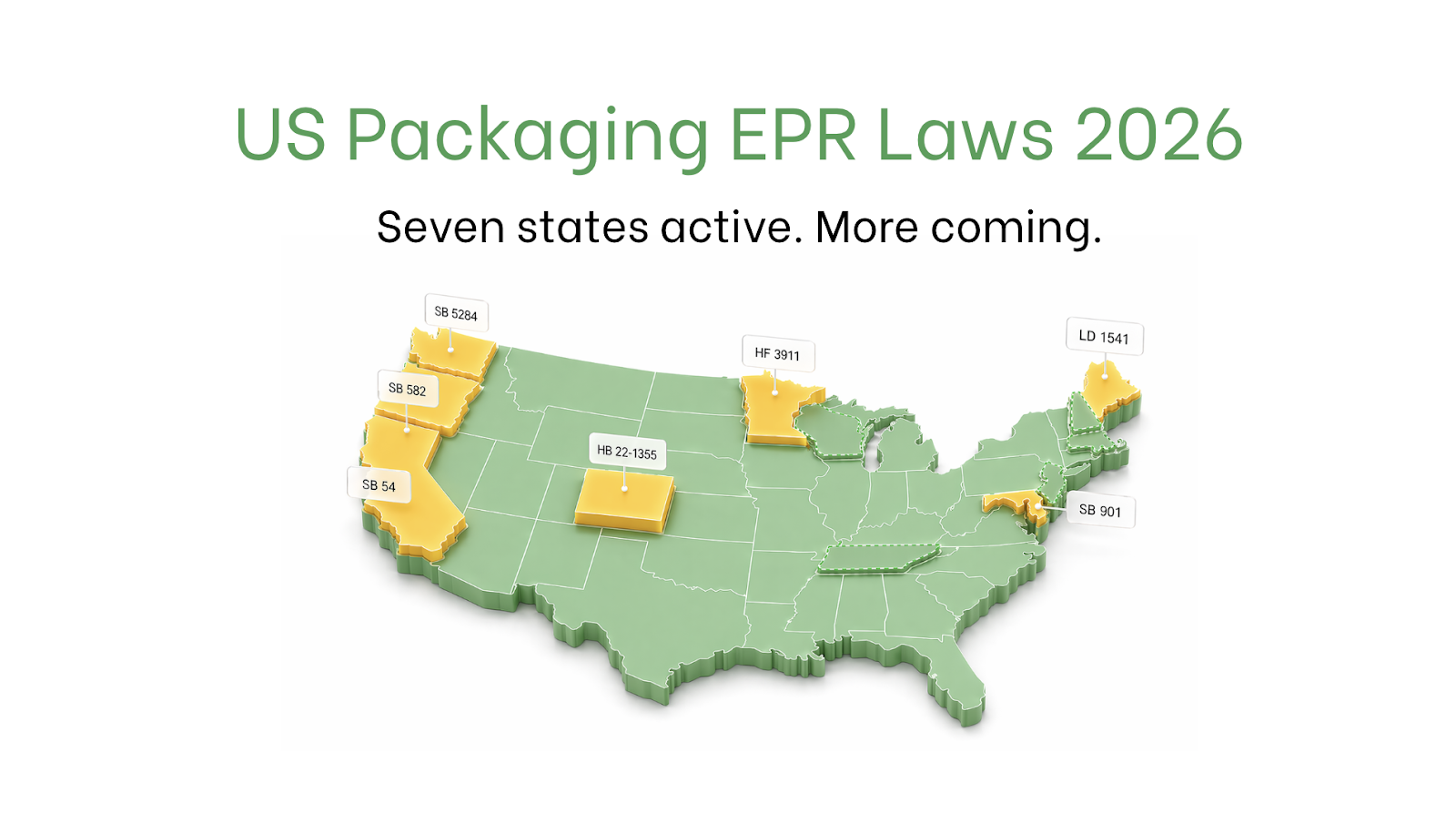
US packaging EPR laws: seven states active.
To keep pace, every component weight, resin code, recycled-content percentage, and certificate of conformity lives in the spec library. When a rule changes, you update one record, not twenty spreadsheets.
Each destination market is tagged in the ERP. At shipment, the system marries sales volume with packaging weight and exports the tables auditors expect, so finance sees exposure in real time instead of learning about penalties after the deadline.
Good compliance data doubles as sustainability proof. When marketing claims “25 percent recycled content,” the supporting lab certificates ride along. If a supplier falls short, alerts fire before the next print run, not after customers post unboxing videos.
The payoff is strategic freedom: you can launch into Germany or California without scrambling for last-minute declarations, and every eco-promise comes backed by numbers that withstand boardroom and courtroom scrutiny.
Measurement and continuous improvement
Good systems talk back. Real-time dashboards track cost per shipped order, changeover minutes, cube utilization, and damage rate while the line runs.
When a KPI drifts, the team calls a five-minute root-cause huddle, cheaper than a five-figure rush shipment. Monthly reviews widen the lens: freight versus DIM weight, inventory turns versus forecast accuracy, and first-pass artwork approval versus launch timelines. Those trends guide the next quarter’s design tweaks and capital plan.
Mark wins by retiring obsolete cartons, trimming filler, and freeing floor space, then invest the savings in the next round of right-size automation or supplier qualification. Continuous improvement isn’t a poster on the wall; it’s the pulse that keeps the system fit as SKUs, channels, and regulations pile up.
Why mid-sized companies reach the packaging inflection point
Complexity rises faster than packaging headcount
Growth rarely announces itself. One year you ship ten SKUs from a single warehouse; the next, marketing rolls out seasonal flavours, ecommerce opens, and a big-box retailer wants custom inner packs.
Most mid-size brands then face a math problem. Cway’s Packaging Artwork Approval Benchmark 2026 found that the average packaging artwork approval cycle takes 24 calendar days, leaving almost no room for tribal knowledge or spreadsheet gymnastics.
Workload isn’t linear. Each new SKU spawns its own artwork, inserts, labels, tests, and compliance records. Multiply that by multiple channels and countries and a tidy task list becomes a runaway queue.
At first, the team powers through on late-night proofs and rush freight. Eventually, even heroes falter: launches slip, expedite fees spike, and operators reach for “close-enough” materials that shred margins.
The tipping point isn’t revenue; it’s cognitive load. When the mental database in one engineer’s head can’t answer Which box fits this bundle? in under a minute, you’ve hit the inflection. That moment calls for a system, not another cup of coffee.
Omnichannel distribution creates conflicting requirements
Selling through retail, ecommerce, subscriptions, and marketplaces sounds like diversification; from a packaging lens, it feels like competing rulebooks. Retail buyers want high-gloss cartons that face left on a peg. Ecommerce needs crush-proof mailers that shave ounces and inches. Subscription customers expect easy-open experiences with monthly inserts, while marketplaces mandate scannable labels exactly where retail barcodes would never sit.
Unchecked, one SKU mutates into four packages, each with its own tooling, MOQ, and failure modes. That complexity raises cost and slows growth, and a unified structural backbone is what removes it.
A system calms the chaos. Design a core package family tough enough for parcel handling, then overlay channel-specific sleeves, labels, or inserts. One structural spine, many expressions. Material SKUs stay low, visual consistency stays high, and operations buy corrugated and film at scale instead of sprinkling micro-orders across half a dozen vendors.
Vendor sprawl hides ownership and accountability
Growth often breeds vendor collection: a converter for retail cartons, a printer for mailers, a liner broker, and a design studio for seasonal sleeves. Each solves a local headache while quietly creating a network problem. When a shipment arrives scuffed, the converter blames the art file, the designer blames the dieline, and the 3PL blames the flimsy board, leaving you with the expedite fee.
A real system keeps one specification, one tolerance set, and one scorecard every vendor must meet. Disputes fade because the data settles them. Converters run, designers create, logistics moves, and no buck-passing is required. Multiple suppliers boost resilience only when everyone follows the same documented rules; otherwise, vendor sprawl becomes cost sprawl.
The business case: how a packaging system creates value
1. It slashes the real cost of packaging
Most teams fixate on the invoice price of a box, just the visible tip of the cost iceberg. A documented system cuts far deeper:
- Material. Shared structures and right-sized cartons shrink corrugated SKUs, drive larger print runs, and secure volume discounts.
- Freight. Verified outer dimensions feed WMS cartonization, letting the system pick the smallest viable shipper. Amazon’s Ships in Product Packaging program showed that tighter spec data and right-sized cartons reduced average outbound packaging weight per shipment by 41 percent and prevented the use of more than 2 million tons of packaging material since 2015.
- Working capital. Fewer unique cartons mean larger, blended forecasts and tighter safety stock; cash once frozen in obsolete inserts can fund new launches instead of racking fees.
- Process cost. Cleaner specs shrink rework, shorten approvals, and end the “Where’s the file?” hunt. Labor minutes shift from decision-making to packing.
Add those slices together and box price becomes the smallest number on the total-cost chart.
2. It prevents packaging from becoming the bottleneck
Production only runs as fast as its slowest station. A standardized system balances filler speed with pack-out capacity. Shared cores and inserts click into place, turning hour-long changeovers into minutes, so lines keep humming and overtime melts away.
Planners see real pack rates, not brochure numbers, and schedule accordingly. Throughput rises on the same footprint, often matching the output of a second line without pouring new concrete, while capital once reserved for extra square footage can fund smarter automation instead.
3. It speeds up launches and market expansions
Launch delays usually trace back to packaging, not formulation. When dielines, regulatory copy, and supplier lead times already sit in a shared library, a new SKU can reuse about 90 percent of its components, which attacks the 24-day approval cycles Cway’s benchmark reports.
Engineers tweak one insert, designers swap graphics, and procurement orders within an existing MOQ tier. Reviewers comment on a single, version-controlled file instead of juggling half-a-dozen PDFs, so the first production run ships on schedule. Retailers set planograms confidently, and ecommerce pages go live with accurate dimensions and weights on day one.
Fast, repeatable launches turn packaging from gatekeeper to catalyst. Products reach shelves while the trend is hot, and finance books revenue weeks earlier.
4. It reduces supplier and employee dependency
When packaging know-how lives in one veteran’s head or on a single converter’s server, your supply chain balances on a matchstick. Vacations, resignations, or capacity crunches topple production overnight.
A system spreads that knowledge across documented specs, shared tooling, and qualified alternates. If Supplier A faces a materials shortage, Supplier B opens the exact die set and runs an identical lot. If your packaging engineer wins the lottery and leaves, the replacement logs in and sees revision history, test reports, and cost models in one dashboard.
Portability turns talent and vendor changes from emergencies into calendar invites. You choose the best partners instead of staying with the only partner who understands the tribal script.
5. It supports compliance and market access
Regulators now treat packaging data like financials; submit it clean or pay later. The regulations noted earlier demand SKU-level weight and material reporting.
A system makes those numbers push-button simple. Each carton spec stores weight and material code, while the ERP ties sales volume to destination market. Each month the dashboard exports the tables auditors expect, complete with revision history.
Because the data stays current, marketing can claim “thirty percent recycled fiber” and download the lab certificate in seconds. Operations can enter Germany or California without a last-minute scramble for translations and labeling rules.
Compliance shifts from an annual panic to quiet, continuous hygiene, and the brand gains markets competitors tiptoe around.
6. It turns sustainability into waste elimination
Sustainability isn’t a slogan; it’s an operating metric. Right-sized cartons cut corrugated tonnage and void fill in one move, lowering both carbon and carrier fees. Shared structures support larger print runs, which means fewer press clean-downs and less ink down the drain.
Because the spec library stores weights and resin codes, life-cycle analysts can model emissions at the component level. When the model flags a high-impact pouch, engineering swaps in a thinner film or recycled liner, then reruns drop tests before the next PO lands.
Savings and stewardship march together: less board, less diesel, fewer damage returns. Sustainability goals hit the ledger as real dollars, not aspirational posters.
Twelve signs you’re ready for a packaging system
Think back over the last quarter. If four or more of the warning lights below feel familiar, it’s time to trade heroic fixes for a documented system.
- Packaging is the current bottleneck. Finished goods back up while operators hunt for boxes.
- Labor scales with orders. Peak season means hiring temps instead of squeezing more output from the same crew.
- Changeovers outrun production. Hours go to swapping dies and hunting inserts, not packing.
- Quality swings by shift. Damage and returns spike when a different team tapes the cartons.
- Every new SKU needs a new box. Inventory slots and costs multiply with each minor variant.
- Critical files live in email threads. Finding the “latest version” takes more time than fixing the issue.
- Placeholder dimensions (1 × 1 × 1) still live in the WMS. Carriers bill dimensional weight on guesswork, not facts.
- Total packaging cost per order is fuzzy. Material, freight, and labor sit in separate GL codes.
- Obsolete cartons fill racks. Slow movers tie up cash and forklift aisles.
- One person or vendor holds the playbook. A single PTO request sparks “business-continuity” meetings.
- Regulator or retailer data pulls require spreadsheet marathons. Weights, recycled content, and certificates derail half a day.
- Peak-season déjà vu. Last year’s overtime and expediting play on repeat.
A packaging-system maturity model
Before investing, know where you stand. Most mid-market brands land somewhere on this five-stage ladder:
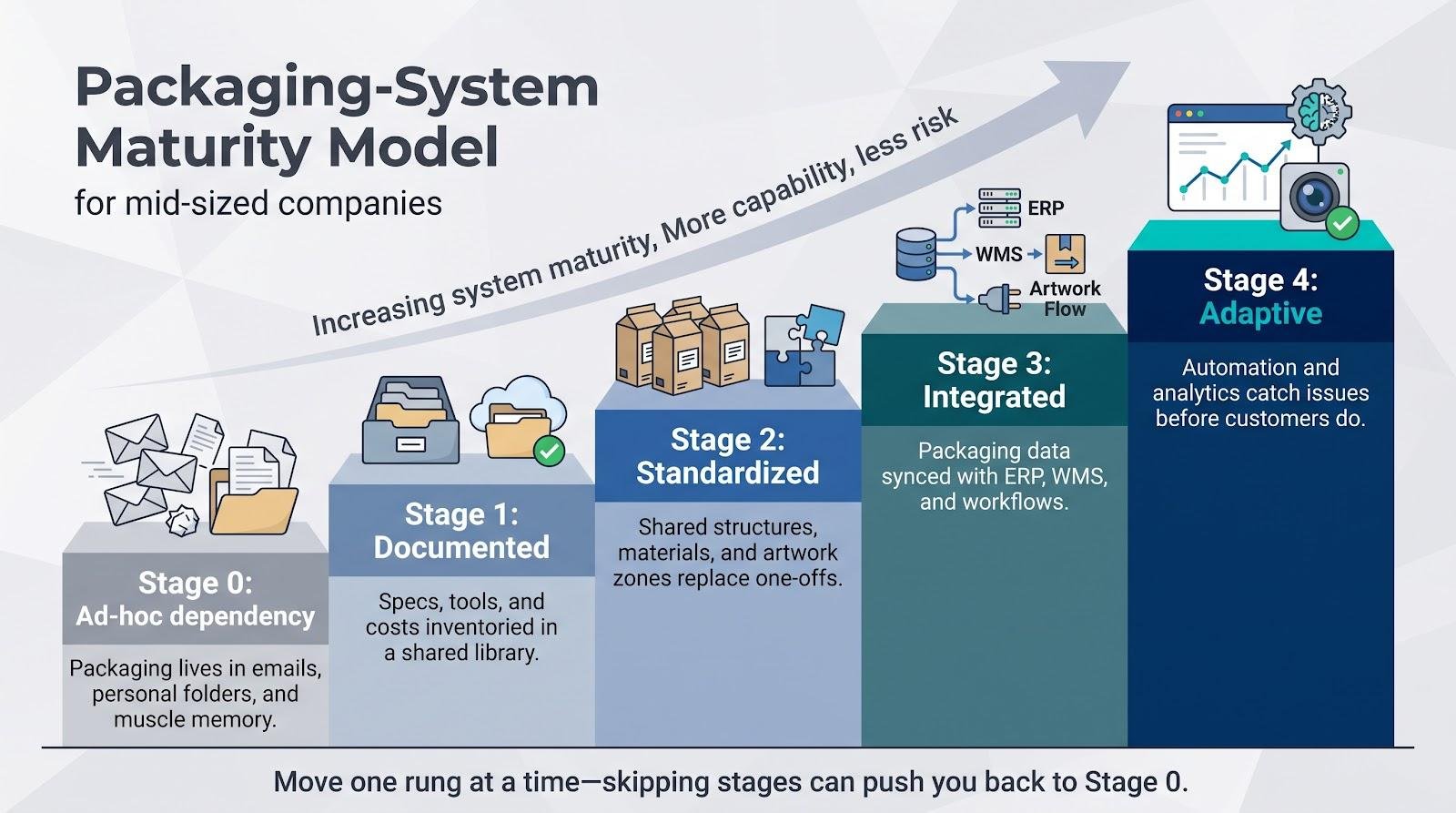
Stage 0: Ad-hoc dependency. Packaging lives in emails and muscle memory. One vendor guards the dieline, another tallies price, and no single list shows what’s in every box. You’re running on relationships and luck.
Stage 1: Documented. Every component, file, and tool is inventoried in a shared library. Costs, weights, and revision numbers finally sit side by side. Nothing on the floor changes yet, but tribal knowledge gains a backup drive.
Stage 2: Standardized. Shared structures, board grades, and artwork zones replace one-offs. Changeovers shrink, quotes simplify, and material SKUs often drop by half in the first year.
Stage 3: Integrated. Packaging data syncs with ERP, WMS, and artwork workflow. Cartonization logic pulls real dimensions, compliance reports build themselves, and supplier scorecards update in real time. The system now drives daily decisions instead of logging them afterward.
Stage 4: Adaptive. Right-size cutters, vision inspection, and predictive maintenance add another layer. Dashboards flag variance before customers notice, and AI suggests lighter materials that still pass drop tests. Packaging shifts from fixed asset to continuous-improvement engine.
Move one rung at a time. Skip a stage and cost, risk, and morale can tumble back to Stage 0.
Packaging automation is a component, not the system
Manual packaging
Manual work shines in low volumes, artisan finishes, and turbulent demand. Two trained packers can handle odd-shaped items, last-second promo inserts, or handwritten notes that no machine can reproduce.
The trade-off is variability. Throughput depends on who is on shift, quality drifts as fatigue sets in, and unit cost stays flat even when orders double. Manual remains ideal for pilot runs, pre-launch sampling, and hyper-custom kits, but it is too shaky for sustained scale.
Semi-automatic packaging
Semi-auto gear removes repetitive chores such as case erecting, bag sealing, and label printing while leaving human judgment for the odd items. Operators load blanks; the machine folds and tapes. Training takes hours, not weeks, and tabletop units slip into brownfield lines without rewiring. Consistency improves: each box squares true, labels land straight, and changeovers fall from 15 minutes to one.
Fully automatic packaging
Full automation pays when volume is high and SKU variety manageable. Cartons erect, load, seal, weigh, label, and sort with scarcely a human touch. Capital climbs, but so does repeatability. Vision systems reject defects in milliseconds, and predictive maintenance swaps bearings before vibration hints at trouble.
The catch? You must stabilize upstream processes first. Automating chaos only makes chaos faster and costlier. Dial in master data, standardize formats, and prove changeovers manually before letting robots take the load.
Build, buy, outsource, or use a hybrid model
Internal packaging team
Keeping every capability in-house gives you maximum control. Engineers own dielines, buyers negotiate board grades, and quality techs pull samples right off the line. Decisions happen at the next desk, not across time zones.
The price is payroll. A structural engineer’s salary, plus compliance specialists and test equipment, runs well into six figures a year. Fixed cost feels fine when volume climbs steadily but hurts when a retailer delays a launch and the team idles at 80 percent capacity.
If you ship a stable, high-volume portfolio all year, in-house talent pays back through faster feedback loops and tighter IP control. For most midsize brands, full internalization remains a luxury, not a default.
Multiple specialist vendors governed internally
Many mid-market brands keep strategy and specifications in-house while outsourcing converting, printing, and kitting to best-fit specialists. Capacity grows without ballooning payroll, and competitive bids keep prices honest.
Governance is the hinge. A single, documented spec set, plus a scorecard every vendor signs, prevents drift. If one supplier bumps flute height or tweaks cyan density, the data flags it before the shipment leaves the dock.
You gain dual-sourcing resilience and brand coherence, provided someone on your team owns the ruler and the rulebook.
Managed packaging partner
Some brands outsource the entire puzzle (strategy, design, sourcing, and logistics) to one managed partner. Done well, this compresses years of learning into a single contract: seasoned engineers, global purchasing power, and lab resources you could not build in-house.
Speed improves because one provider owns the entire critical path. Accountability sharpens too: if a lot fails drop testing, the same phone number fixes it.
Lock-in is the lurking risk. Guard against it with contract language that keeps data, tooling, and supplier contacts in your hands. A good partner behaves like an extension of operations, not a black box, and it frees you to focus on product and channel growth while experts handle the corrugate.