
Two applicants both describe themselves as empathetic and calm under pressure. Each gets a mock account record and a customer who has been charged twice. One acknowledges the problem, checks the record, explains what the policy allows and writes a clear case note. The other apologizes warmly, promises a refund the policy does not permit and leaves no note.
A work sample shows that difference before you hire. Instead of asking candidates to describe their patience or listening skills, you watch a realistic interaction and score specific actions. Decades of personnel research rank work sample tests among the stronger predictors of job performance, which makes them a natural fit for customer-facing roles.
This guide covers how to define entry skills, choose a format, compare platforms, build and score a scenario, and pilot the process.
Key Takeaways
- Test the skills an agent needs on day one, and teach company-specific rules after hire.
- Match the format to the channel: voice simulations for phone roles, chat simulations for text support.
- Interactive work samples show how a candidate handles a customer, not just which answer they would pick.
- Score accuracy and empathy separately so a friendly wrong answer stays visible.
- Pilot with current agents first, and keep human reviewers involved in every hiring decision.
Define What Agents Must Do on Day One
Before choosing a test, list what a new agent must handle before training and what you will teach after hire. Tie every assessment task to an entry requirement.
Essential entry skills. These are abilities candidates bring with them: listening for the real problem, asking a clarifying question, explaining a next step in plain language, staying composed with a frustrated customer and writing a note another agent can act on.
Trainable company knowledge. Refund thresholds, escalation paths and system shortcuts get taught after hire. The U.S. Office of Personnel Management cautions that a work sample may be inappropriate when the employer plans to teach the tested activities after selection. If a task depends on a policy, supply it, and assess how well the candidate reads and applies it.
The actual channel. Voice and chat draw on overlapping but distinct skills. An agent who explains well on the phone may write wordy chat replies. Chat carries its own pressures too, since a quick greeting means little if the conversation stalls afterward, a gap explored in this piece on live chat for customer experience. Decide whether the role covers voice, chat or both before you pick a format.

Match the Assessment Format to the Channel
Each format collects different evidence, so choose each one for a reason.
Knowledge and skills questions check discrete abilities, such as calculating a prorated credit, writing with correct grammar or reading an account table. They say little about how a candidate handles a live customer.
Situational judgment questions ask candidates to pick or rank responses to a short scenario. They show whether someone recognizes a good approach, but the answer was written by someone else.
Interactive work samples have the candidate do the job: speaking with a simulated customer or typing chat replies while using supplied information. You can see how they acknowledge the concern, investigate, explain the outcome and document the case.
| Role task | Evidence to collect | Format that shows it |
|---|---|---|
| Voice support | Listening, clear spoken explanation, pacing | Interactive voice simulation |
| Chat support | Concise writing, handling overlapping requests | Interactive chat or multitasking simulation |
| Either channel | Diagnosis, applying a policy, accurate notes | Work sample plus a written case note |
Pre-Employment Assessment Platforms for Call Center Hiring
Once you know the evidence you need, compare vendors on whether they can collect it. These five platforms take different approaches and are not ranked.
eSkill
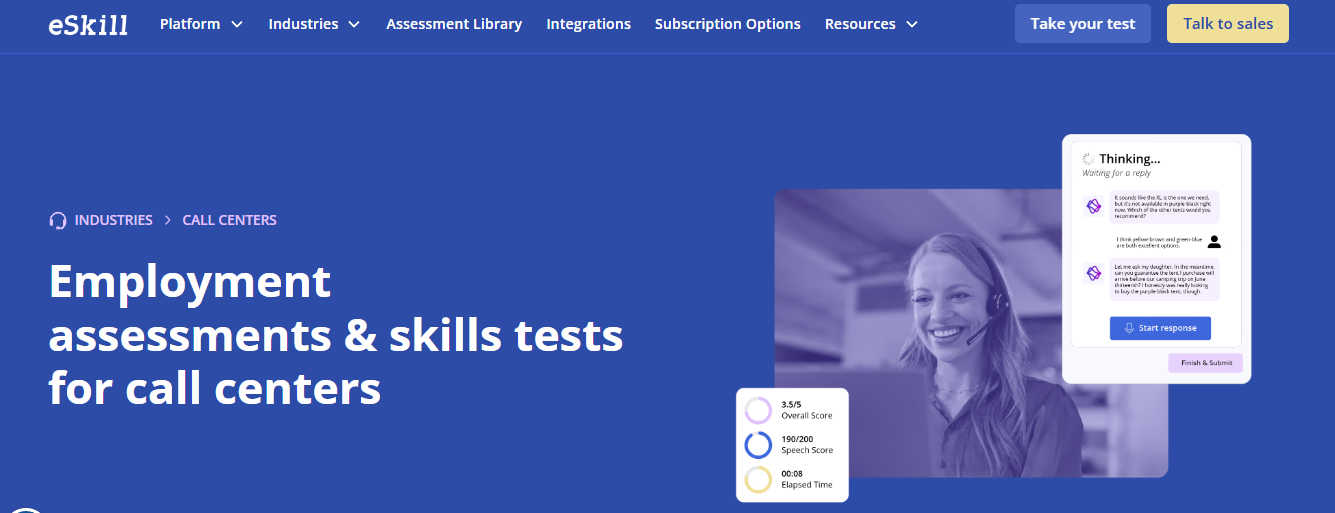
eSkill combines chat and multitasking simulations, video responses and situational judgment questions for call center hiring. Its Linea Sample work sample, launched October 26, 2026, lets you select a scenario, has candidates interact with a simulated customer by voice or chat, then grades them on accuracy, empathy, policy adherence and more. The simulations mirror on-the-job work and help identify qualified agents faster.
Harver
Harver’s Live Chat Support Simulation presents candidates with virtual customers raising support issues, with a new customer appearing every 30 to 60 seconds. It tests whether a candidate can manage overlapping chats while staying accurate, and the simulation can be tailored to a specific contact center role. Ask how closely it can reflect your own queue and policies.
TestGorilla

TestGorilla’s Customer Service (Multimedia) test mixes video-based and text-based questions designed for customer service representatives and call center agents. It suits quick screening across a large applicant pool and can be combined with language and personality tests. Confirm whether you need question-based screening, a live interaction or both, since each collects different evidence.
HireVue
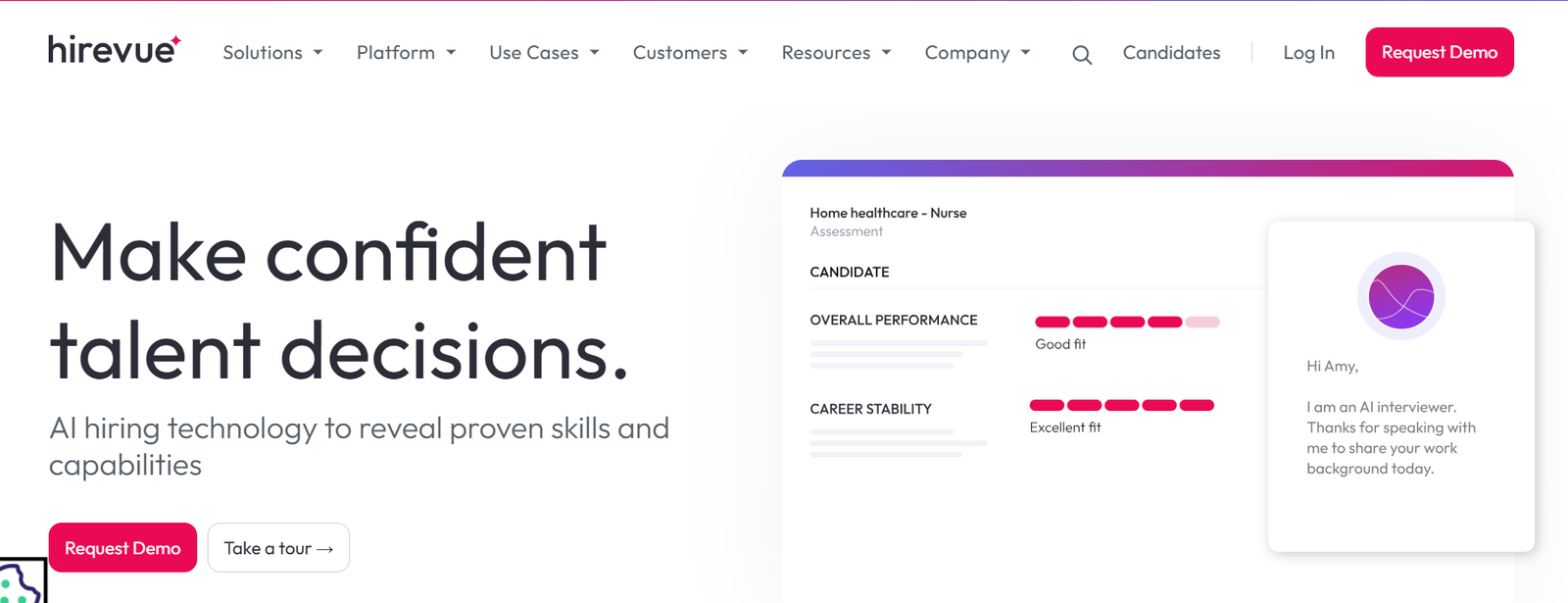
HireVue’s Virtual Job Tryout places candidates in tasks drawn from the job itself, giving them a realistic preview while generating assessment data. It is a separate product from HireVue’s video interviewing tools, so be clear about which one you are evaluating. Ask whether the tryout built for your role includes a customer exchange and what evidence it records.
Criteria
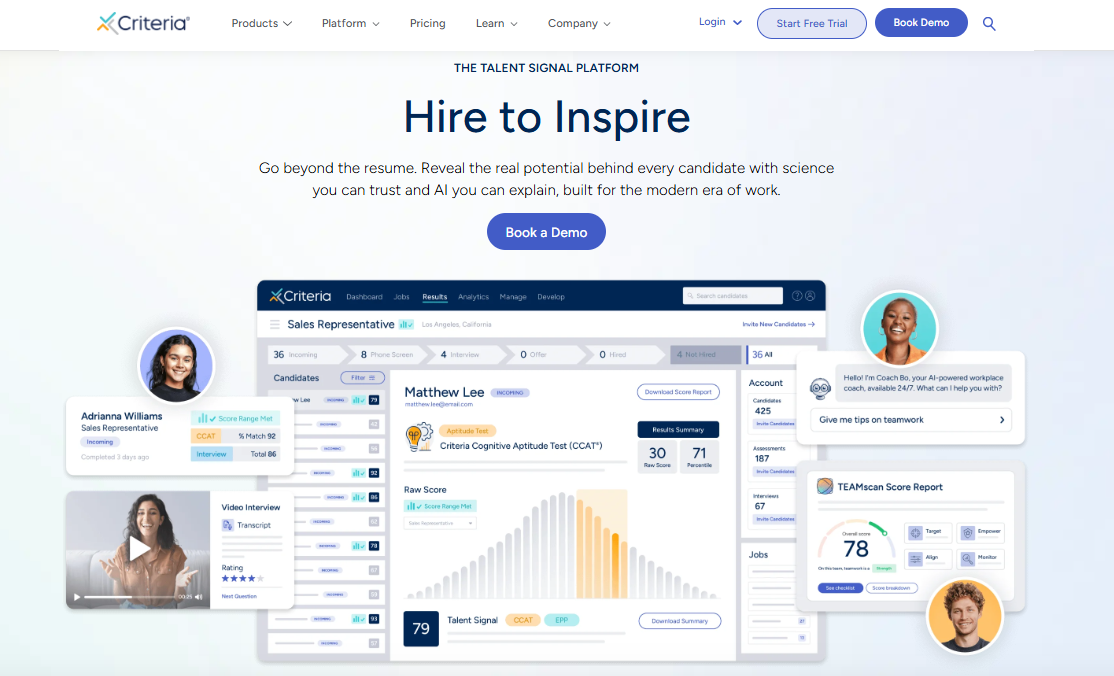
Criteria’s Customer Service Aptitude Profile measures characteristics linked to service roles, such as diplomacy, cooperativeness, patience and assertiveness. A trait profile shows tendencies rather than performance on a live call, so it works best alongside a work sample. Ask how its results would sit next to your simulation scores when you make a decision.
Use the same checklist for every vendor: view the scenario and instructions candidates will see, inspect the rubric and what each score means, request validation evidence for customer service roles, confirm accessibility and integrations, and get a written quote listing the formats included.
Build a Realistic Voice or Chat Work Sample
The scenario below is a fictional example, not a validated test item. Use it as a starting point.
- Select a scenario. Pick an interaction a new agent will face that does not depend on deep product knowledge.
- Run it by voice or chat. Give the candidate the policy sheet and account record, then start the simulated customer. Record which channel each candidate used.
- Collect evidence. Keep the transcript or recording and the case note, and score both against a rubric.
Scenario. A customer, M. Okafor, says they were charged twice for a monthly plan on the same day. They are annoyed and want the money back now.
Policy sheet. Agents may refund a confirmed duplicate charge of up to 100 units when both transactions show the same date and amount. Refunds take three to five business days. Larger or mismatched charges go to a billing specialist, who replies within one business day. Agents may not promise an immediate reversal.
Account record. Plan price: 45 units. Two 45-unit charges on the 3rd, at 09:12 and 09:14, both settled. No prior refunds.
What success looks like. The candidate acknowledges the frustration, confirms the matching charges, explains that a 45-unit refund will arrive in three to five business days and avoids unauthorized promises. The case note states the issue, the finding and the action clearly enough for another agent to follow.
Whether you use a platform or a colleague playing the customer over the phone, give every candidate the same information and keep the evidence for review.

Score Observable Behavior Consistently
A scorecard turns a recording into comparable evidence. This example uses four dimensions: accuracy, problem solving, empathy and communication. Treat policy adherence as part of accuracy so the same error is not counted twice.
| Dimension | Weaker response | Stronger response |
|---|---|---|
| Accuracy | Promises an immediate reversal or misreads the amounts | Confirms both 45-unit charges and states the three-to-five-day timeline |
| Problem solving | Guesses the cause without checking the record | Checks the record first and identifies the route the policy allows |
| Empathy | Ignores the frustration or agrees with every demand | Acknowledges the inconvenience, then moves to the facts |
| Communication | Uses jargon, a disordered explanation or wordy chat replies | Gives a short, ordered explanation and writes a usable case note |
Empathy means acknowledging the customer’s concern, even when the answer is no. Promising an unauthorized refund may sound kind, but it should lower the accuracy score. Scoring correctness and warmth separately keeps a friendly wrong answer visible.
Record typing speed and error rate separately, and use them only if they matter for the role.
Before scoring applicants, have two or three reviewers score the same sample independently, then compare results. Rewrite any description they read differently. If a platform produces automated grades, ask what evidence supports each score and how reviewers can see the underlying response. Grades should inform a hiring decision, not make it.
Keep the Assessment Fair and Accessible
Candidates need clear instructions, working technology and a way to raise problems.
- Clear instructions. State the expected duration, allowed materials, whether the session is recorded, whether AI is involved and who to contact if something breaks.
- Practice run. Offer a short warm-up before the graded interaction, and confirm microphone and browser requirements.
- Accommodations. Give candidates a clear way to request extra time or a screen-reader-friendly layout, and check that the change still lets you assess the required skill.
- Interrupted attempts. Decide in advance who reviews dropped sessions and when a retake is allowed. Keep technical failures separate from performance.
If the role requires being understood in a given language, assess intelligibility, not accent preference. In the United States, the Equal Employment Opportunity Commission’s 2007 guidance states that selection procedures must be job-related and suited to the employer’s purpose, so have your process reviewed against the obligations that apply to you.
Pilot the Process Before Expanding It
Test the process on a small scale first.
- Confirm the scenario reflects the role’s entry requirements.
- Run it with current agents or recent hires to catch confusing instructions and vague scoring descriptions.
- Use it with a first group of applicants, and review rating disagreements and technical problems after each round.
- Compare assessment results with structured interview notes, then with quality reviews of real interactions after training.
Track completion rates, reviewer agreement, post-training quality and candidate feedback. If a scenario rewards knowledge taught during onboarding, revise it. If reviewers keep disagreeing on a description, rewrite it and test again.
Conclusion
A candidate’s self-description tells you little about how they will handle a double-charged customer at the end of a long shift. A short, well-scored work sample shows it directly. Define the entry skills, match the format to the channel, score accuracy and empathy separately, and pilot before you scale. The result is a hiring process built on evidence you can review and defend.
FAQ
What is a work sample assessment for call center agents?
A work sample asks candidates to handle a realistic customer interaction, by voice or chat, using supplied information. Reviewers then score specific actions such as accuracy, empathy and documentation.
Are simulations better than personality tests for hiring agents?
They collect different evidence. Trait profiles show tendencies, while simulations show how someone actually handles a customer. Many teams use both, with the work sample carrying more weight for live-contact skills.
How long should a call center simulation take?
Keep it short enough to finish in one sitting, usually a single customer interaction plus a case note.
Should AI-graded scores decide who gets hired?
No. Automated grades are one input. Reviewers should inspect the underlying work and weigh it alongside interviews and other job-relevant evidence.