
Manufacturing has been the most attacked industry for five years running. IBM’s 2026 X-Force Threat Intelligence Index found that the sector accounted for 27.7% of all incidents X-Force responded to in 2025, with exploitation of public-facing applications (32%) the most common way in.
That pressure lands on teams that are usually small, spread across several plants and responsible for systems that cannot simply be taken offline. Managed detection and response (MDR) gives manufacturers 24/7 monitoring, investigation and response without building a full security operations center (SOC). The harder question is which provider fits an environment where an unplanned shutdown can cost more than the breach itself.
Top MDR providers for manufacturing in 2026
These are the MDR providers manufacturers most often shortlist in 2026, with the use case each fits best.
- ESET: Best for fast, human-led response across mixed plant and office estates
- CrowdStrike: Best for manufacturers standardized on Falcon
- Rapid7: Best for exposure-aware investigations across many sites
- SentinelOne: Best for AI-assisted response with tiered service levels
- Arctic Wolf: Best for ongoing operational guidance
- Sophos: Best for organizations already using Sophos security products
Key takeaway
For most manufacturers, the right MDR provider is the one that responds fastest without disrupting production. Prioritize documented response speed, clear rules for isolating plant systems and honest answers about where IT monitoring ends and operational technology (OT) security begins.
How we selected these MDR providers
This guide focuses on MDR services that manufacturing IT and security teams commonly evaluate, from single-plant operators to multi-site groups. We reviewed public service documentation, tier descriptions, warranty terms and analyst recognition as of November 2026. We did not deploy agents or simulate attacks, so the ranking reflects documented fit for manufacturing environments rather than a measured detection score.
Each provider was assessed on the same five questions: how fast it responds, who performs containment, how it handles mixed and legacy endpoints, how much telemetry it can take in from existing tools, and what financial or contractual protection it offers after an incident.
What makes an MDR provider manufacturing-ready?
Speed matters more in manufacturing than almost anywhere else. Mandiant’s M-Trends 2026 report puts the global median dwell time at 14 days, while the median handoff between an initial access broker and the next attacker group has fallen to 22 seconds. A provider that needs hours to act leaves little margin once an intruder is inside.
| Manufacturing MDR requirement | What to look for |
|---|---|
| Response speed | A published response time, 24/7 analyst coverage and pre-approved containment actions |
| Production-safe containment | Agreed rules for which hosts can be isolated automatically and which need plant approval |
| Mixed and legacy endpoints | Support for older Windows systems, engineering workstations and third-party agents already deployed |
| IT/OT boundary visibility | Monitoring of the networks, jump hosts and remote access paths that connect office IT to plant systems |
| Multi-site operations | One view across plants, clear escalation paths and reporting each site manager can use |
| Compliance and insurance evidence | Reports that support cyber insurance requirements and frameworks such as CMMC for defense suppliers and IEC 62443 |
A deeper look into the top providers
1. ESET: Best for fast, human-led response across mixed plant and office estates
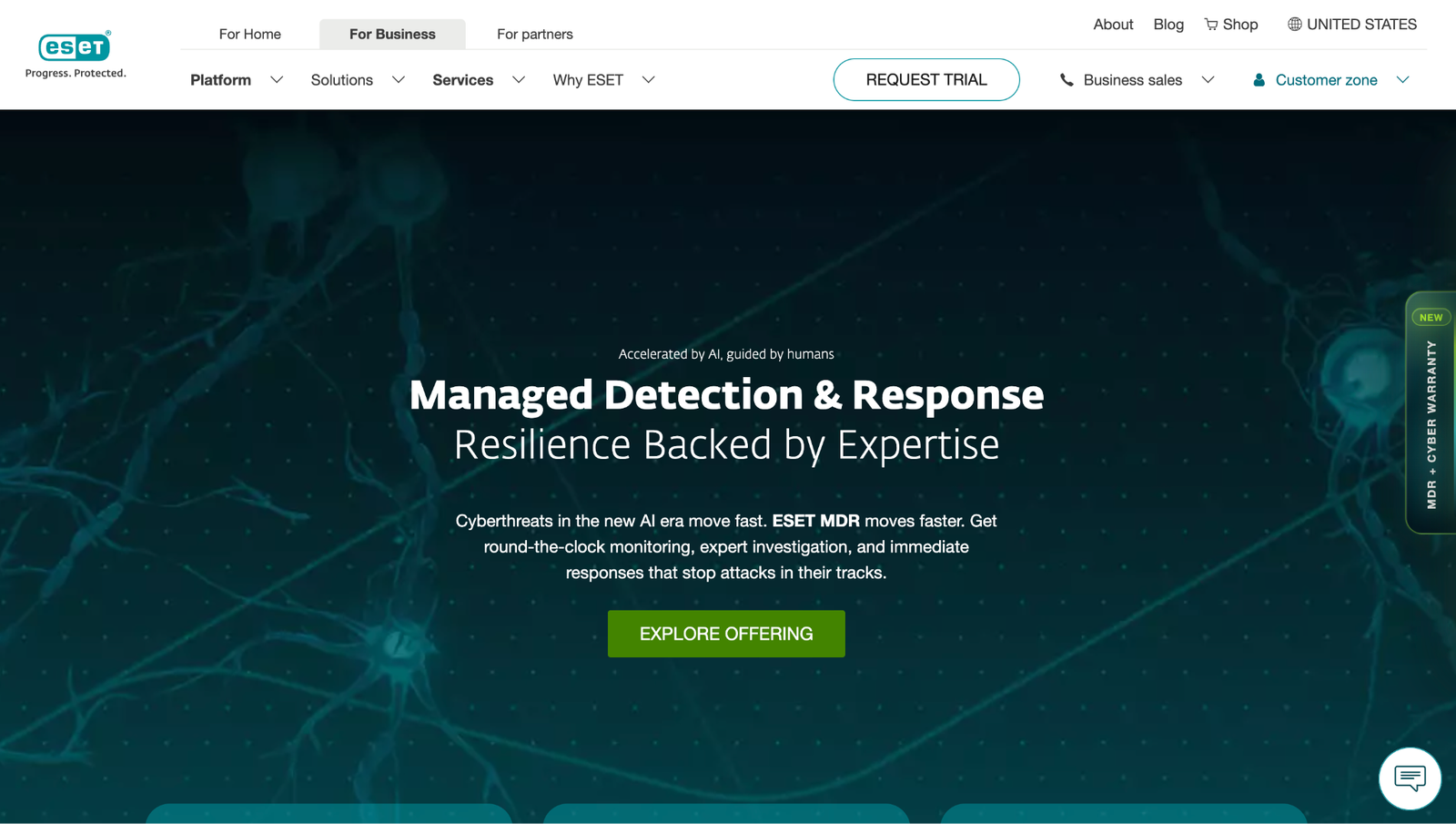
ESET runs a 24/7 human-led MDR service supported by AI and its own threat intelligence, with a six-minute mean time to respond the company positions among the fastest in the market. It supports cloud, on-premises, hybrid and air-gapped deployments for regulated sectors including manufacturing. Italian brake and clutch maker Raicam uses the service to monitor its production sites around the clock.
ESET MDR covers small and mid-sized organizations with continuous monitoring, threat hunting and active incident support, while ESET MDR Ultimate adds DFIR assistance and a dedicated incident response lead. Subscriptions bundle endpoint security, MFA, patch management and awareness training, support compliance with 18 regulations and, in higher tiers, include a Cyber Warranty. The service was named a Market Leader in KuppingerCole’s 2026 Leadership Compass for MDR.
Best fit: Manufacturers that want rapid, analyst-led containment with core security tools bundled into one subscription.
What to check: Which tier includes DFIR and the Cyber Warranty, and how containment rules are agreed per site.
2. CrowdStrike: Best for manufacturers standardized on Falcon
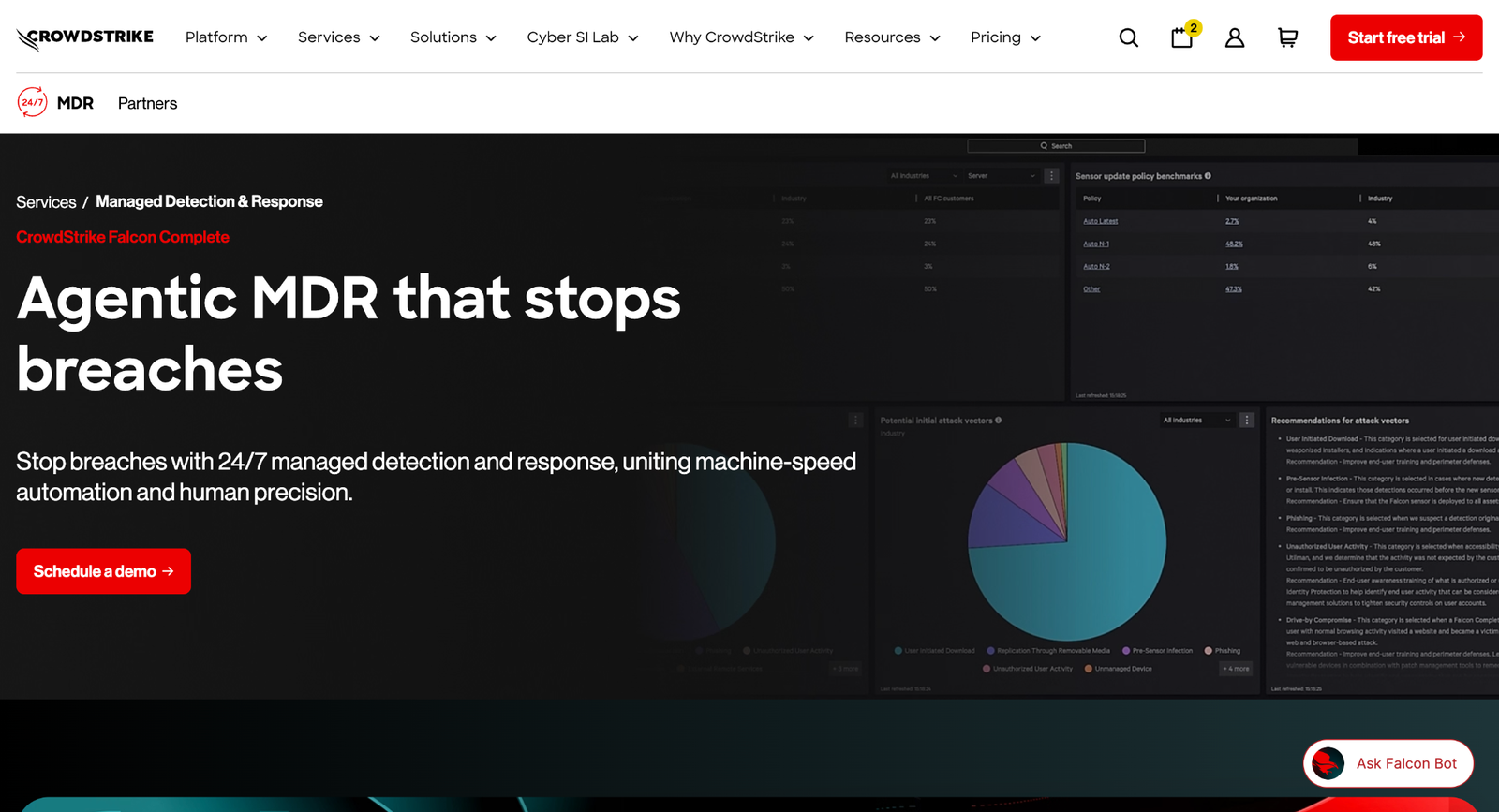
CrowdStrike Falcon Complete Next-Gen MDR delivers 24/7 expert-led detection, investigation and remediation on the Falcon platform. It extends beyond native endpoint, identity and cloud telemetry by pulling third-party data through Falcon Next-Gen SIEM. CrowdStrike was named an Overall Leader in KuppingerCole’s 2026 Leadership Compass for MDR and a Leader in the 2025 Forrester Wave for MDR.
Falcon Complete is backed by warranty coverage of up to USD 2 million. CrowdStrike also sells separate IoT and OT security capabilities, which matters for plants that want one vendor across both environments, but those are distinct products rather than automatic parts of the MDR service.
Best fit: Manufacturers already running Falcon agents across office and plant endpoints.
What to check: Warranty eligibility terms, Next-Gen SIEM licensing for third-party data and how OT coverage is scoped and priced.
3. Rapid7: Best for exposure-aware investigations across many sites
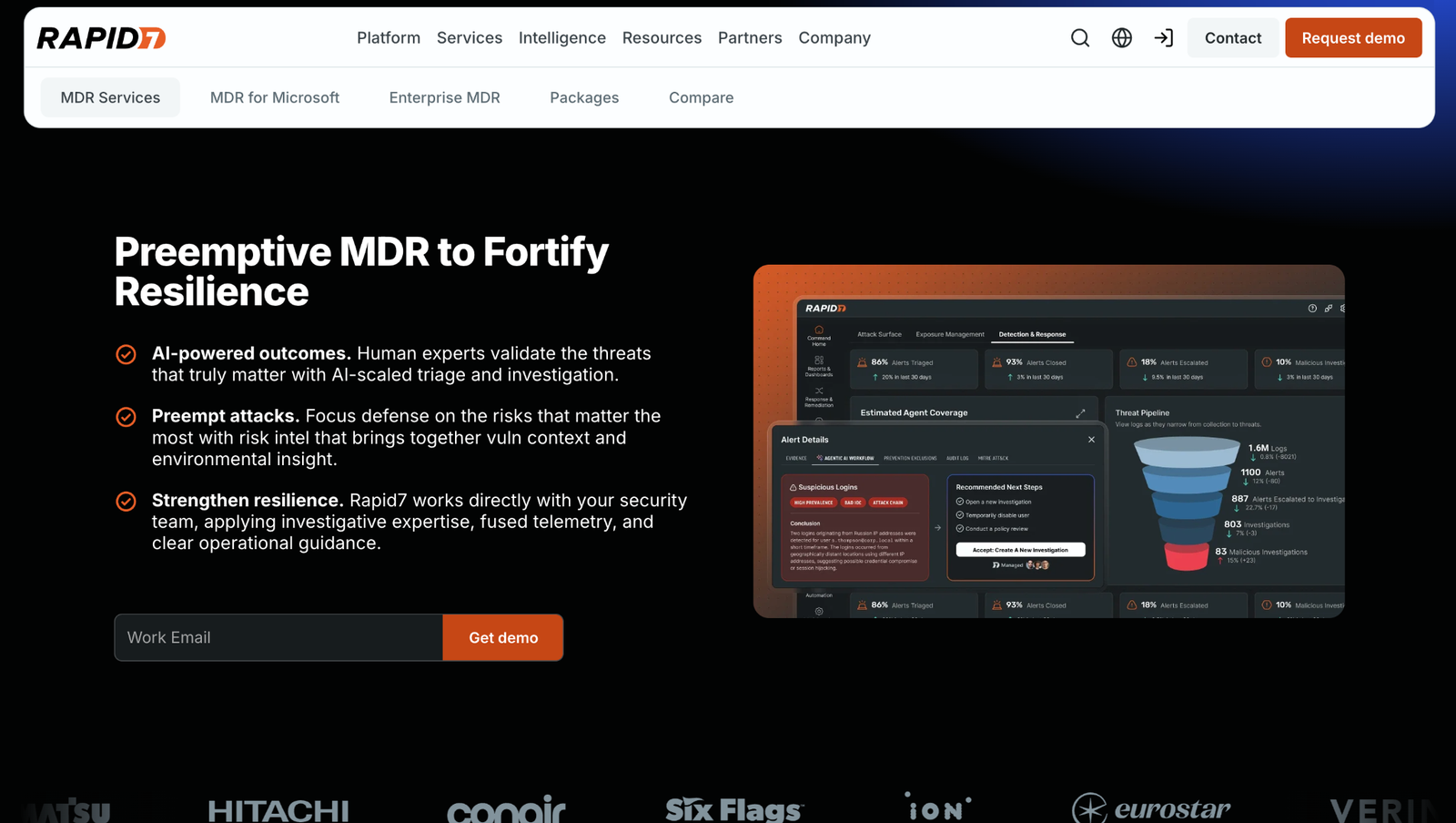
Rapid7 MDR combines 24/7 detection and response with vulnerability and asset-risk context, helping analysts prioritize threats against the systems most exposed. That approach suits manufacturers with large, uneven estates where patching is slow and some plant systems cannot be updated at all. Rapid7 states customers can ingest telemetry from more than 190 integrations.
Service is packaged as Essential, Advanced and Ultimate, priced against protected assets. Current package details place third-party ecosystem monitoring and a dedicated customer advisor in Advanced rather than Essential.
Best fit: Multi-site manufacturers that want investigations tied to exposure and patch priorities.
What to check: Which package covers third-party monitoring, advisor access and how unpatchable plant assets are handled in risk scoring.
4. SentinelOne: Best for AI-assisted response with tiered service levels
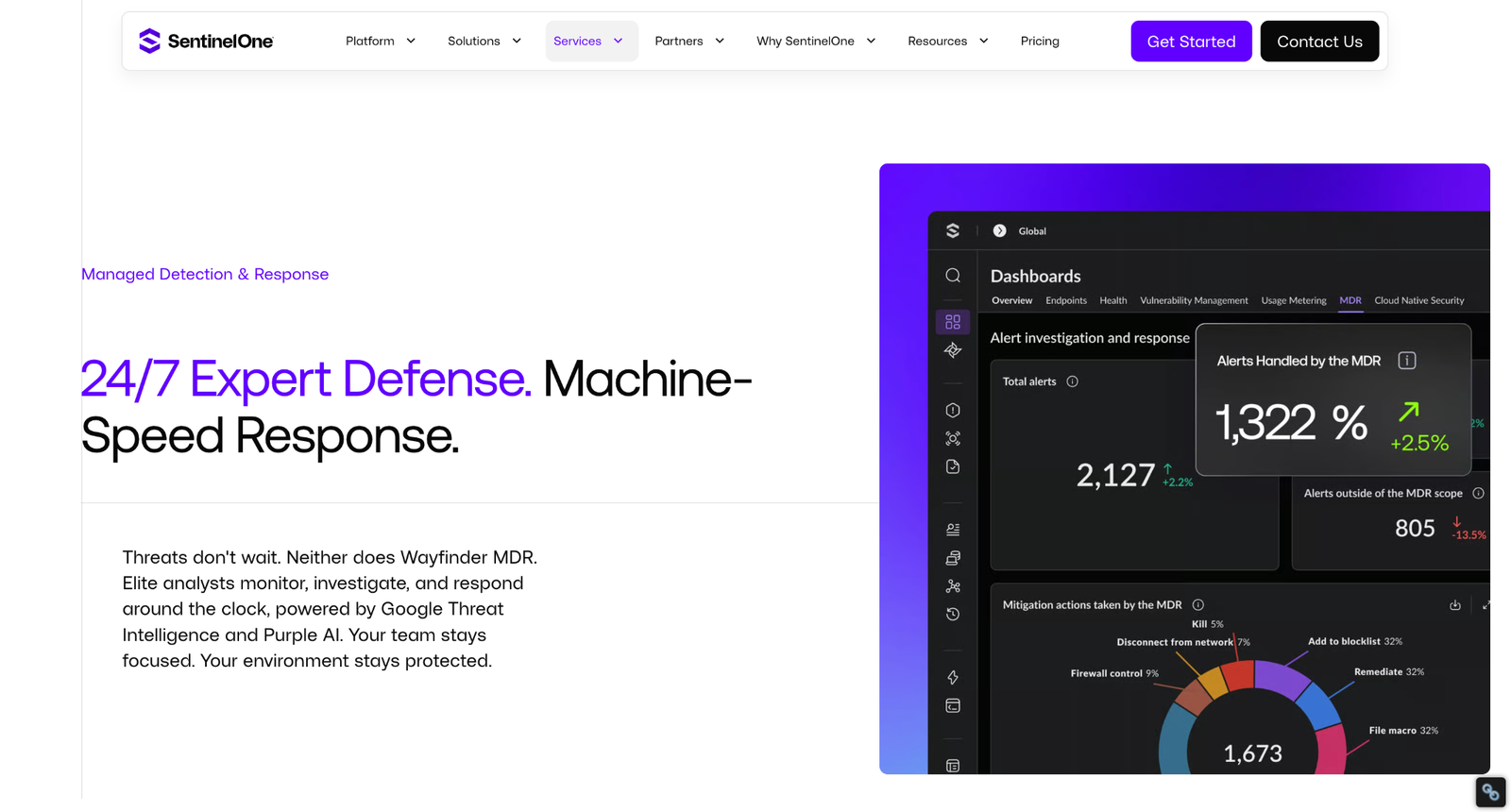
SentinelOne Wayfinder MDR provides 24/7/365 monitoring, investigation and response, with analysts supported by Google Threat Intelligence and Purple AI. SentinelOne reports an average mean time to detect of 3.3 minutes across customer environments, and the service includes a breach response warranty of up to USD 1 million covering Windows, Linux, macOS and cloud workloads.
The service comes in MDR Essentials and MDR Elite. Essentials covers endpoint and cloud, while Elite extends coverage to identity and supported third-party integrations. High-touch options such as a dedicated threat advisor, an Incident Readiness and Response partnership and full DFIR access are listed among the service levels.
Best fit: Teams that want AI-assisted triage on the Singularity platform with a clear upgrade path to full forensics.
What to check: Which tier includes the threat advisor and DFIR access, whether identity and third-party coverage requires Elite, and warranty conditions.
5. Arctic Wolf: Best for ongoing operational guidance
Arctic Wolf Aurora MDR pairs 24/7 monitoring with a Concierge Security Team that provides ongoing guidance, which suits manufacturers with lean IT staff. Its open XDR architecture supports more than 200 integrations, and recent additions include integrations for several industrial systems.
Aurora MDR is sold through Core, Plus and Total security operations bundles. The Security Operations Warranty reaches up to USD 3 million on a three-year Total bundle purchased with Aurora Managed Endpoint Defense. An MSP-exclusive Aurora MDR Connect tier is also available for manufacturers that buy security through a managed service provider.
Best fit: Manufacturers that want a long-term operations partner rather than alert handling alone.
What to check: Bundle entitlements, warranty conditions, log retention and which response actions are pre-authorized.
6. Sophos: Best for organizations already using Sophos security products
Sophos offers two tiers. Sophos MDR includes 24/7 monitoring, direct call-in support, threat containment and response guidance, while customers complete full neutralization themselves. Sophos MDR Plus adds full-scale incident response, a dedicated incident response lead and root-cause investigation.
Sophos says third-party integrations have been included with MDR subscriptions at no additional cost since November 2025, which helps plants running other endpoint agents. Full-scale response applies to systems with the full Sophos XDR agent. MDR Plus also includes a Breach Protection Warranty covering up to USD 1 million in response expenses for qualifying customers.
Best fit: Manufacturers already invested in Sophos products or Sophos Central.
What to check: Response limits on non-Sophos systems, data retention beyond the standard 90 days and warranty qualification.
How to choose an MDR provider for a manufacturing environment
The best provider for a plant is rarely the one with the longest feature list. It is the one that can act within minutes, understands which systems must keep running and documents every action clearly enough for insurers and auditors. MDR also works best alongside wider supply chain security practices, such as verifying supplier bank detail changes and requiring suppliers to report significant cyber incidents. Recent federal OT cybersecurity guidance also urges operators to segment IT and OT networks and keep manual fallback options ready, so ask how each provider’s response playbooks respect those boundaries.
| Evaluation area | Why it matters in manufacturing |
|---|---|
| Mean time to respond | Ransomware handoffs now happen in seconds, so minutes of response time matter |
| Containment ownership | Plants need to know who isolates a host and when production approval is required |
| Legacy system support | Older operating systems on the plant floor are common and often unpatchable |
| Telemetry breadth | Attacks move between office IT, remote access tools and plant networks |
| DFIR and incident response | Forensic help agreed in advance avoids delays during an active incident |
| Multi-site reporting | Each plant needs clear evidence of what happened and what was done |
| Warranties and insurance support | Financial backing and audit-ready reports reduce the cost of recovery |
| Tier transparency | Many critical features sit in higher tiers, so confirm exactly what is included |
Where MDR stops and OT security begins
MDR covers the IT side of a manufacturing business: office endpoints, servers, identities, cloud services and the engineering workstations and jump hosts that connect to plant systems. That boundary is where most attacks on manufacturers start, since public-facing applications and valid accounts remain the leading entry points.
Programmable logic controllers, industrial control systems and other OT devices usually need dedicated OT monitoring alongside MDR. The strongest setups connect the two, so an alert on the plant network reaches the same analysts handling the IT investigation.
Frequently asked questions
Who are the top MDR providers for manufacturing in 2026?
The six providers compared in this guide are among those manufacturers most often evaluate. The right choice depends on response speed, existing endpoint tools and how much forensic support is needed.
Why are manufacturers targeted so often?
Manufacturers combine valuable data, complex supply chains and low tolerance for downtime, which makes them attractive to ransomware and data theft groups. IBM found the sector was the most attacked industry for the fifth consecutive year in 2025.
Does MDR cover OT and industrial control systems?
MDR typically covers IT systems and the connection points into plant networks. Controllers and industrial control systems usually need dedicated OT monitoring, ideally integrated with the MDR provider’s investigations.
What is the difference between MDR and managed EDR?
Managed EDR focuses on endpoint alerts and response. MDR adds broader telemetry, proactive threat hunting, investigation and incident response support across the environment.
How fast should an MDR provider respond?
Faster is better, because attackers now hand off access within seconds of a breach. Ask each provider for its documented mean time to respond and what actions it can take without waiting for approval.
Do MDR providers offer breach warranties?
Most providers in this guide do, though limits, eligible tiers and conditions vary widely. Confirm which subscription level qualifies and what the warranty actually pays for before relying on coverage.