
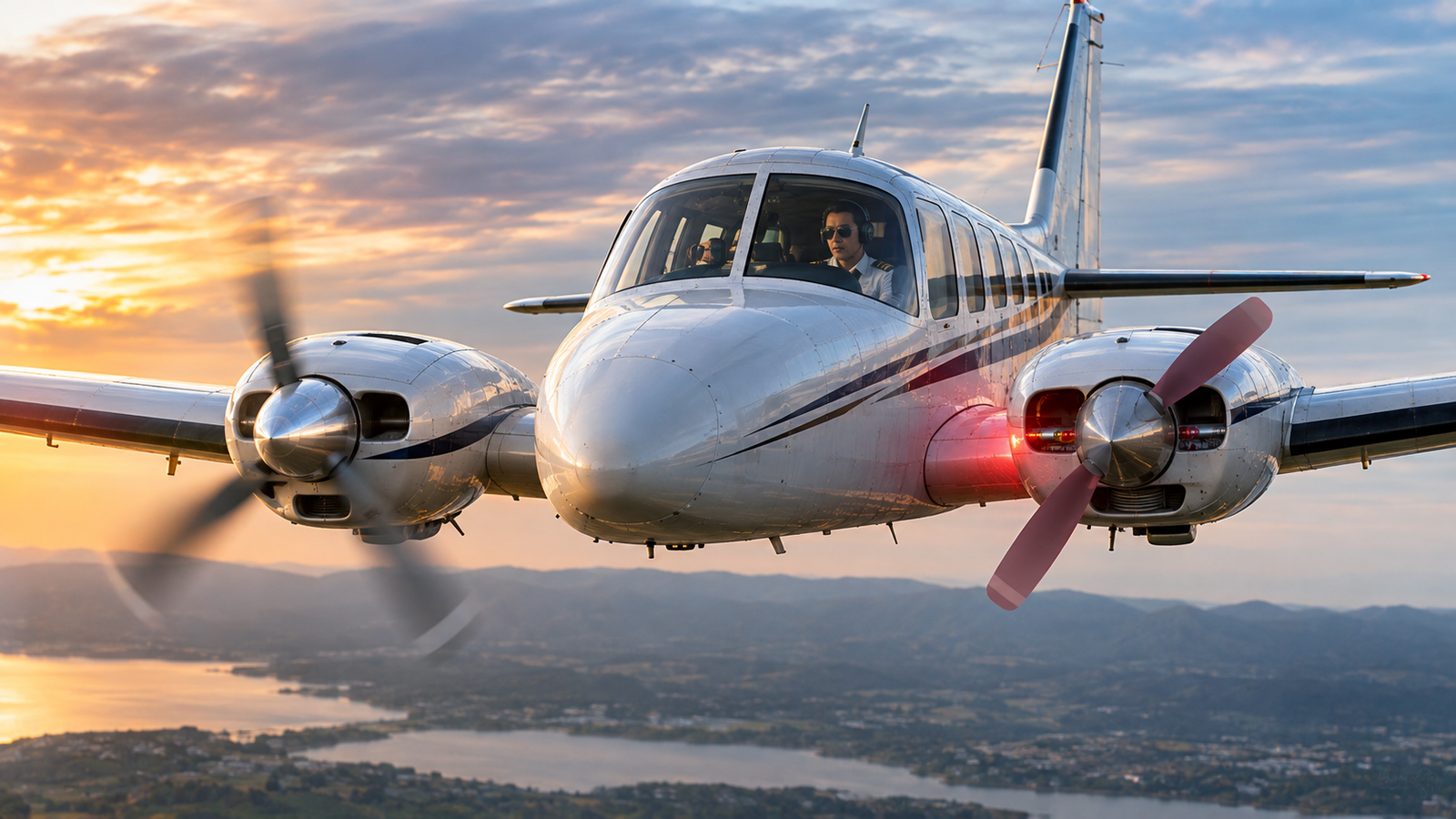
Most pilots assume a second engine simply means a second chance. If one quits, the other carries you home. That is only partly true, and the untrue part is exactly what engine failure training for a multi-engine rating is built around.
When an engine fails on a twin, the airplane loses about half its power but far more than half of its ability to climb. It also tries to yaw toward the dead engine. The pilot has to handle control and performance at the same moment, in the right order. Learning to do that calmly is the heart of the course.
Why Losing One Engine Is Harder in a Twin Than in a Single
In a twin, a failed engine damages both climb performance and directional control, which is why it is a different problem from an engine failure in a single-engine airplane.
The FAA’s Airplane Flying Handbook puts numbers on the first half of that problem. Losing one of two engines takes away 50 percent of the power, and climb performance drops by 80 to 90 percent. The handbook adds that in some cases a light twin may not be able to climb or even hold altitude on one engine.
The arithmetic behind that is simple. In the handbook’s example, each engine makes 200 thrust horsepower and level flight needs 175. With both engines running, there is a large surplus for climbing. With one engine, only 25 horsepower is left over. Climb depends entirely on that surplus, so it nearly disappears.
The second half of the problem is yaw. The working engine sits out on one wing, so its thrust pushes the nose sideways toward the dead side. The pilot must stop that swing with rudder, often firmly. An aviation magazine, AVweb, notes that an engine failure in a light piston twin, especially right after takeoff, can be more dangerous than a single-engine failure if it is mishandled. The extra engine only helps if you know what to do with it.
What Vmc Means and What It Does Not
Vmc is the minimum control speed: the lowest airspeed at which you can still keep the airplane pointed straight after a sudden loss of thrust from the critical engine. It is usually marked with a red line on the airspeed indicator.
Two points surprise new students. First, Vmc covers directional control only. The handbook is clear that nothing in the definition promises the airplane can climb at that speed. Second, the published number is not a fixed wall. It was measured under a narrow set of test conditions, and real flying often differs.
Four conditions push the real Vmc higher than the number in the book:
- More power on the working engine
- A propeller windmilling on the failed engine instead of being feathered
- A center of gravity toward the rear of the allowed range
- Flying with the wings level instead of leaning slightly into the good engine
The last one matters more than most people expect. According to the handbook, Vmc can rise by more than 3 knots for each degree of bank you remove below the 5 degrees used in testing, so control can be lost at speeds nearly 20 knots above the published figure with wings level.
The “critical engine” is the one whose failure hurts control most. On many twins where both propellers turn the same way, that is the left engine, because of how the propeller blades load unevenly.
How Engine Failure Training Works in a Multi-Engine Rating Course
Training usually moves in three steps: ground discussion, demonstrations at a safe altitude, and then realistic scenarios closer to the ground.
On the ground, you learn the extra speeds that exist only for twins. Vyse, the best climb speed with one engine out, is marked with a blue line. Vsse is the minimum speed at which an instructor should deliberately shut down or idle an engine. You also learn to read the performance charts for your particular airplane.
In the air, the signature exercise is the Vmc demonstration. At a minimum of 3,000 feet above the ground, the instructor has you idle one engine, set takeoff power on the other, and slow the airplane at about one knot per second. You add rudder as the controls lose bite, until the rudder runs out and the nose starts to swing. At that instant you reduce power on the working engine and lower the nose to regain speed. The point is to feel the edge of control in a safe setting so you recognize it later.
Stalls are the hidden danger here. A stall with one engine producing full power can flip into a spin, and the handbook warns that twins recover poorly from spins. That is why instructors end the demonstration at the first sign of buffet or a stall warning, and why simulated failures are not done below the safe single-engine speed.
The rest of the course builds on this base: feathering (turning the blades edge-on to the wind so the dead propeller creates minimal drag), flying a steady climb or level flight on one engine, and then an approach and landing with one engine inoperative.
The First Moments After an Engine Fails: Control, Configure, Climb, Checklist
The handbook breaks the response to a failure after takeoff into four areas, and the order matters.
- Control. Stop the yaw with prompt rudder and keep the airspeed above Vmc. Using aileron first, before rudder, adds drag and makes the yaw worse. A bank of 5 to 10 degrees toward the working engine can help at first, but only briefly.
- Configure. Run the memory items from your airplane’s checklist. Most call for Vyse, takeoff power, gear and flaps up, then identify, verify, and feather the failed engine.
- Climb. Once the airplane is under control, reduce the bank to roughly 2 degrees toward the working engine. This produces the least drag and the best climb the airplane can offer, though the exact figures vary by model.
- Checklist. Secure the failed engine only after the flying is stable. Rushing this step risks flipping the wrong switch.
The “identify” step teaches a useful habit. You work out which engine failed mainly from the rudder pressure needed to stay straight, not by staring at gauges. To verify, you pull back the throttle of the engine you suspect. If nothing changes, you have the right one.
The Takeoff Decision You Make Before the Throttles Move
Good multi-engine pilots decide what they will do about an engine failure before the takeoff roll starts, because there is no time to debate it afterward.
The handbook recommends picking a decision point in advance. If an engine fails before it, you reject the takeoff, even if the wheels are already off the ground, and land straight ahead. If the failure comes after it, with the gear up and enough climb performance, you carry out the engine-failure procedure and continue. As a general rule, if the gear has not yet been selected up, the takeoff should be rejected.
How much climb performance is enough? The handbook suggests that continuing is only realistic when the published one-engine climb rate is at least 100 to 200 feet per minute, and it cautions that gusts, thermals, engine wear, or sloppy technique can wipe out even 200.
The most dangerous choice is trying to keep flying when the airplane cannot. The handbook states that landing under control after a takeoff engine failure has a very high success rate, while attempts to stay airborne beyond the airplane’s ability often end in stall-spin accidents. Part of the training is accepting that putting it down straight ahead can be the right call.
How to Prepare Before Your First Multi-Engine Lesson
The add-on is a rating added to a certificate you already hold, and preparation pays off quickly because lessons are short and dense.
Under 14 CFR 61.63, the multi-engine add-on does not require a written knowledge test, according to Pilot Institute. The checkride still includes an oral portion, so you will be asked to explain what you have been practicing.
A few steps make the early lessons smoother:
- Read the engine-out chapter of the Airplane Flying Handbook and your airplane’s pilot’s operating handbook, and treat the manufacturer’s numbers as the final word.
- Learn the airspeed markings, especially the blue and red lines, before you sit in the cockpit.
- Practice the basics in your single-engine airplane: slow flight, steep turns, and clean rudder use.
- Ask your instructor how they brief a takeoff and what decision point they teach.
Training formats also vary. Some pilots spread lessons over several weeks, while others choose a compressed format, such as a one-week multi-engine add-on training course that pairs ground school with flight time. Neither is better by default. The right pace is the one that lets you retain the material between flights.
Common Mistakes Students Make With Engine-Out Flying
Most early errors come from habits that work fine in a single-engine airplane.
- Chasing altitude. Pulling the nose up to stop a descent bleeds off speed and can drop you below Vmc.
- Fixing the roll first. Reaching for aileron before rudder makes the yaw worse.
- Trusting the published Vmc as a safety cushion. Real Vmc moves with power, weight, balance, and bank.
- Hurrying the shutdown. The clean-up items rarely affect climb, but a wrong switch can turn a manageable problem into a worse one.
Frequently Asked Questions
How is an engine failure different in a twin than in a single-engine airplane?
A twin keeps one engine running, but it loses most of its climb ability and swings toward the dead engine. A single-engine airplane has no thrust but flies symmetrically as a glider. Twin pilots must manage both control and performance, which is why a separate class rating and specific training exist.
Does a second engine make flying safer?
Only when the pilot is trained and current. The FAA handbook says the redundancy of a multi-engine airplane improves safety only if the pilot is proficient. A well-equipped twin is capable, but engine-out skills, sound takeoff planning, and good judgment are what turn the extra engine into an advantage.
What is Vmc in simple terms?
Vmc is the slowest speed at which you can keep the airplane flying straight after losing the critical engine, using full rudder and a small bank. Below it, the working engine pushes the nose around faster than the rudder can respond. It is a control limit only, not a promise of climb.
Does the multi-engine add-on need a written test?
No separate knowledge test is required under 14 CFR 61.63, so the add-on is a practical-test rating. You still face an oral exam and a flight evaluation. Expect questions on engine-out aerodynamics, performance charts, V-speeds, and the systems on the airplane you trained in.
What does feathering a propeller do?
Feathering turns the propeller blades edge-on to the airflow and stops the propeller from rotating. That sharply reduces drag from the failed engine. A windmilling propeller can create as much drag as the whole airframe, so feathering is a key step in keeping the airplane controllable.
Putting It Into Practice
Learning to fly a twin with one engine is mostly about order and discipline: control first, performance second, paperwork last.
Before your first lesson, read the engine-out chapter of the handbook, memorize the speeds in your airplane’s manual, and ask your instructor to brief the decision point on every takeoff. If you can say out loud what you will do at each stage, the real thing becomes a sequence you have already rehearsed.