Banks and fintechs no longer get away with lineage that lives in spreadsheets and architecture diagrams. Supervisors now expect firms to show, on demand, how a figure in a risk report traces back to its source systems, and to prove that the path is current.
The pressure comes from several directions at once. The Basel Committee’s BCBS 239 framework, published in 2013, set out 14 principles for effective risk data aggregation and risk reporting. In May 2024, the European Central Bank published its Guide on effective risk data aggregation and risk reporting, which expects complete and up-to-date data lineages at the data attribute level as part of an integrated data architecture.
The ECB also listed deficiencies in risk data aggregation and reporting among its supervisory priorities for 2025 to 2027. The EU’s Digital Operational Resilience Act (DORA) has applied since 17 January 2025, adding requirements for ICT risk management across banks, insurers, investment firms and payment providers. In the US, SOX Section 404 still requires management to assess internal control over financial reporting, which depends on knowing where reported numbers come from.
AI has changed what lineage tools can do about this. The better platforms now parse SQL and pipeline code automatically, propagate sensitive-data tags downstream, and use AI assistants to draft mappings or explain transformations in plain language. The trade-off is that capabilities vary widely, and vendor claims are not always comparable.
This guide ranks seven platforms against the criteria that matter most to regulated financial institutions. Every feature, customer and figure below comes from the vendor’s own published documentation, so you can check each claim before shortlisting.
What to Look for in a Data Lineage Tool for Financial Services
Generic lineage features are not enough for a regulated firm. Use these six criteria to separate tools built for audit scrutiny from tools built only for engineering convenience.
1. Regulatory traceability. The tool should trace a reported figure back to its authoritative source and keep a record of how that path looked at a given point in time. Supervisors reviewing BCBS 239 compliance want evidence, not a diagram drawn the week before an inspection.
2. Column-level (attribute-level) depth. Table-level lineage shows that two datasets are connected. Column-level lineage shows which field feeds which calculation, which is what a risk or finance team needs when a capital ratio or exposure figure is challenged.
3. Coverage across legacy and cloud systems. Most banks run mainframes, on-premises databases and ETL tools alongside cloud warehouses, and more of their financial analytics now runs on cloud platforms. A tool that only reads modern cloud platforms will leave gaps exactly where the oldest and most sensitive data lives.
4. Impact analysis before change. Renaming a field or retiring a table can silently break a regulatory report. Look for tools that show downstream dashboards, models and owners before a change ships, not after a report fails.
5. Sensitive data tracking. Customer data moves into analytics, testing and AI systems faster than policies can follow it. Tools that propagate PII tags from a source column to every downstream asset make it far easier to answer privacy and audit questions. The same discipline matters outside production, since copies of customer data used for testing can inherit the same sensitive fields.
6. AI assistance with human review. AI can draft mappings, suggest connections and explain transformations, but regulated firms need a review step before anything becomes part of the official record. Check how each vendor stages and approves AI-generated lineage.
Rankings below reflect how well each platform covers these criteria based on its published capabilities, financial services references and deployment options.
The 7 Best AI Data Lineage Tools for Financial Services
1. DataHub Cloud
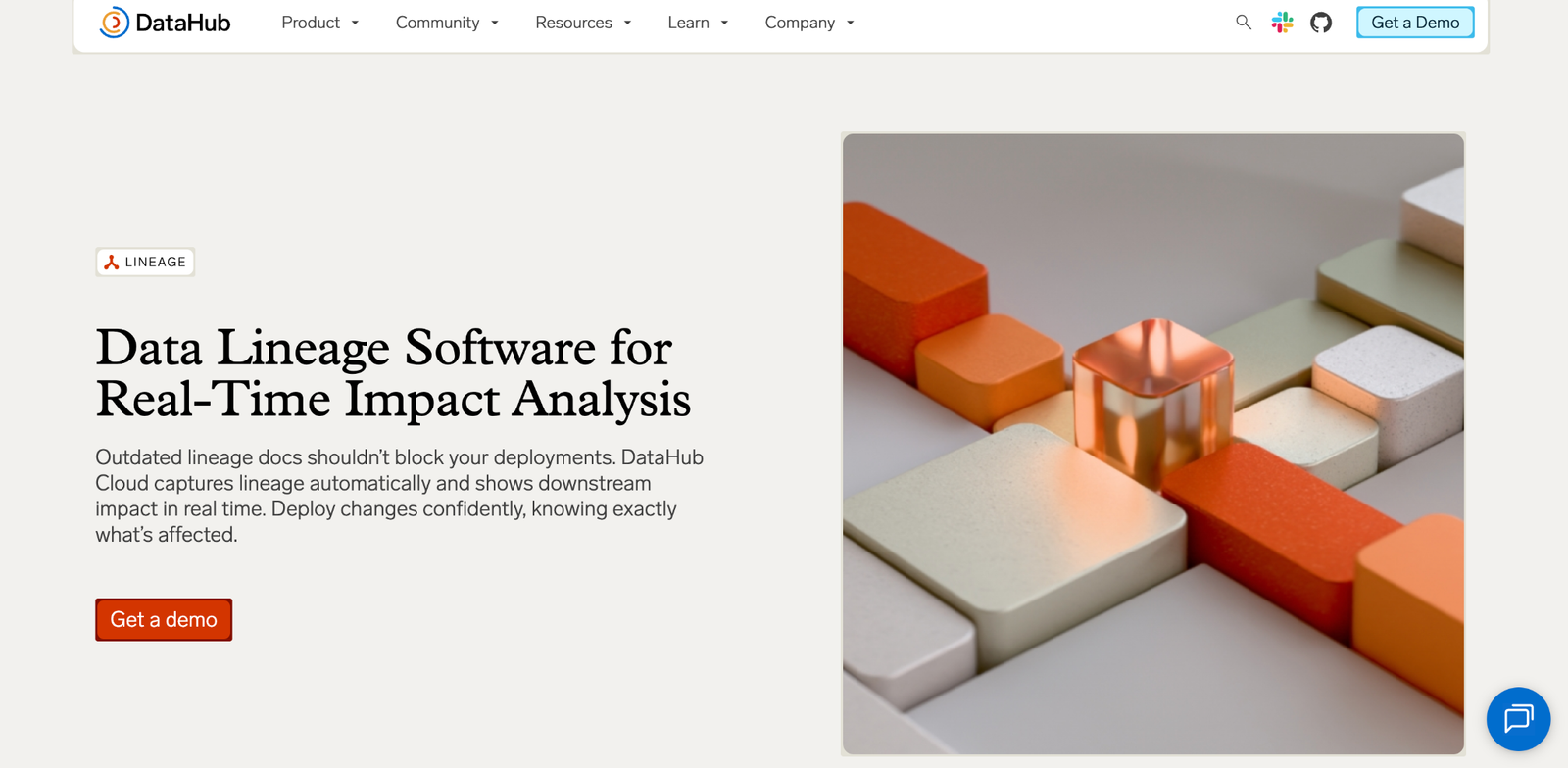
DataHub Cloud captures lineage automatically from databases, pipelines, data lakes, dbt models and BI dashboards, then stitches it into a single table- and column-level graph across platforms. It is the managed version of an open-source metadata project, and fintech Chime is a featured customer that uses lineage to connect data producers with the teams consuming their data.
Key features:
- Column-level lineage that shows how individual fields transform from source to dashboard
- Blast radius analysis showing dependent dashboards, models and owners before changes deploy
- Tags such as PII added at a source table propagate to dependent assets
Pros:
- Supports tracking of sensitive data flows and audit trails for compliance
- In an IDC study sponsored by the vendor, customers reported 58% faster resolution of data-related outages
Cons:
- No regulation-specific overlays for frameworks like BCBS 239 are described on its lineage page
- Lineage depends on configured ingestion connectors or OpenLineage events for each system
Pricing: Not published; demo and self-guided product tour available.
Best for: Engineering-led banks and fintechs that need automated, cross-platform column-level lineage with real-time updates.
2. Collibra Data Lineage
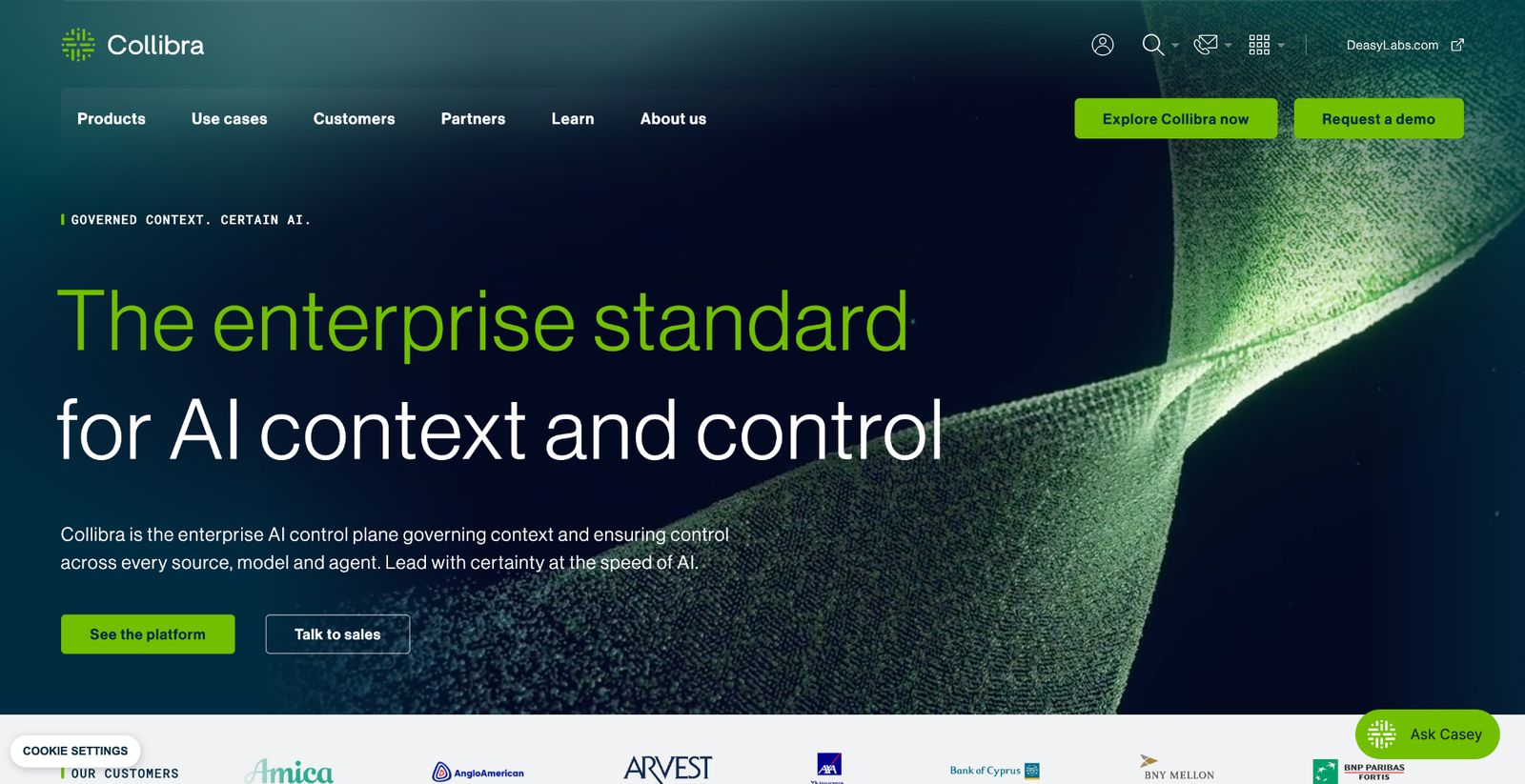
Collibra offers lineage as part of its wider data governance and catalog platform. It separates detailed technical lineage for engineers from a summarized business lineage view for analysts and data stewards.
Key features:
- Integrations with nearly 40 data sources, including SQL databases, ETL tools and BI platforms
- AI-powered lineage extraction that documents data flows automatically
- Automated support for the OpenLineage standard
Pros:
- Visual audit trail aimed at proving regulatory reporting data is accurate, complete and consistent
- Customer stories include BNP Paribas Fortis, Credit Agricole, Euroclear, DNB and Northern Trust
Cons:
- Native source coverage is narrower than platforms advertising 80 or more connectors
- Lineage is one module of a larger platform purchase
Pricing: Not published; sales-led.
Best for: Institutions that want lineage inside a governance program with business glossaries and stewardship workflows.
3. Solidatus
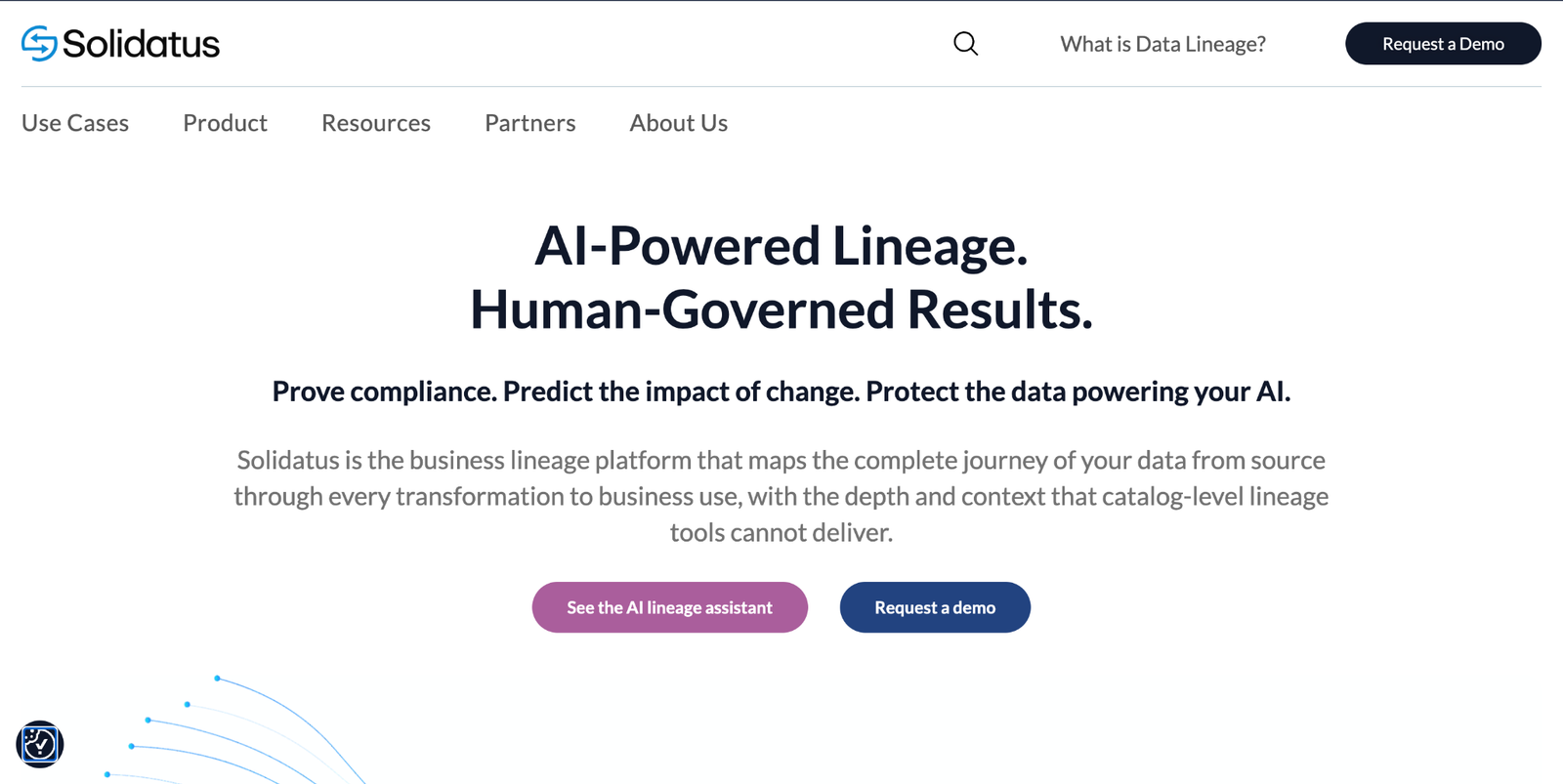
Solidatus describes itself as a business lineage platform for regulated enterprises. It maps data from source systems through transformations to business use, and adds regulatory and policy overlays on top of the technical map.
Key features:
- End-to-end lineage from high-level architecture down to column-level detail
- Bi-temporal version control, so teams can view past states of lineage for audit trails
- AI Lineage Assistant that drafts mappings and proposes connections, with every change staged before it goes live
Pros:
- Positions itself as audit-ready for BCBS 239, DORA, the EU AI Act and GDPR
- Named customers include LSEG, BNY, Deutsche Bank and HSBC
Cons:
- Built for large regulated enterprises, which may be more than a smaller fintech needs
- No public pricing
Pricing: Not published; buyers request a demo.
Best for: Global and tier-one banks that need regulator-facing lineage with historical audit views.
4. Atlan
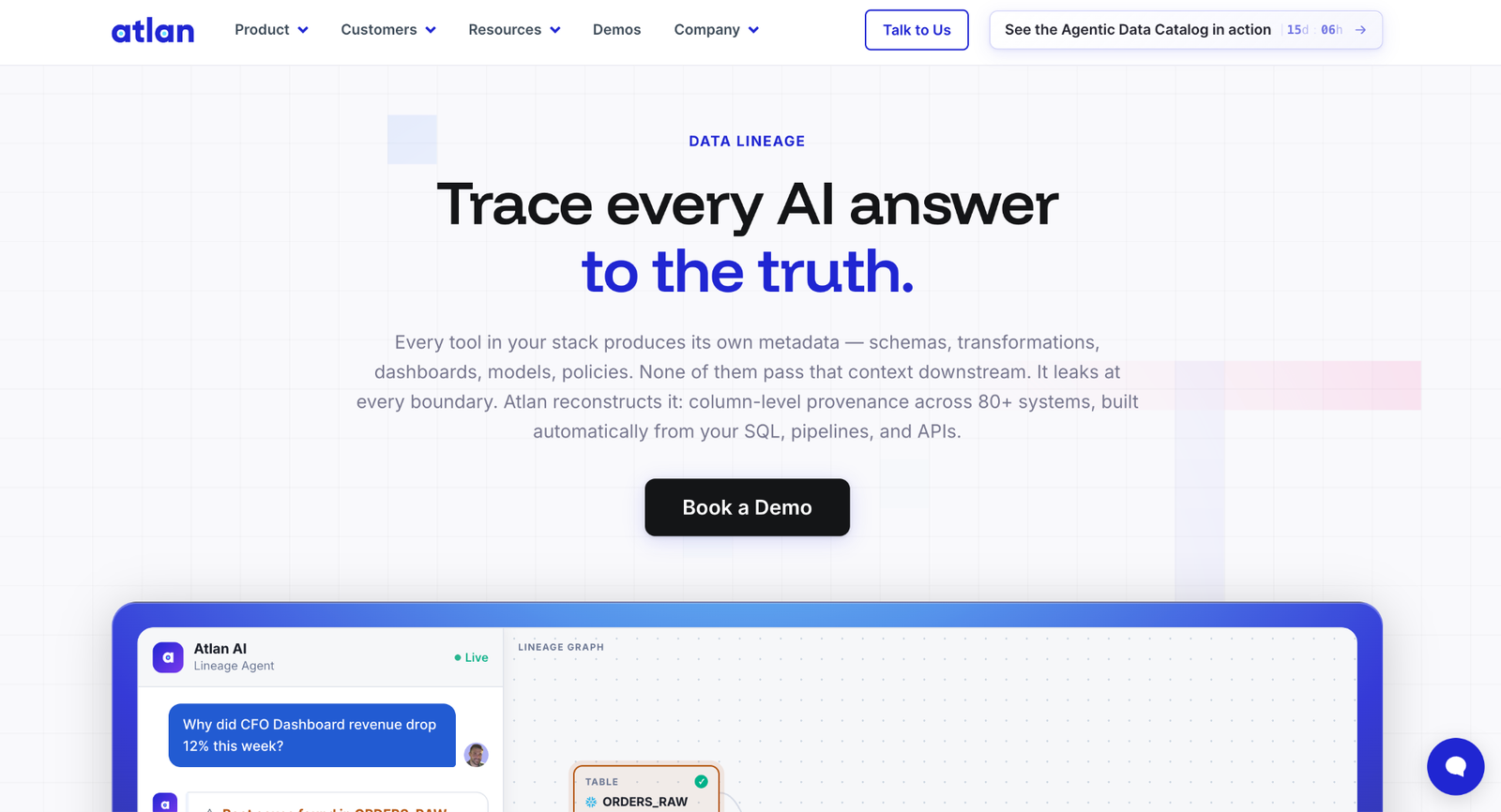
Atlan builds column-level lineage automatically from SQL, pipelines and APIs, and exposes it to both people and AI agents. Its lineage graph sits inside a broader active metadata platform used by several capital markets and payments firms.
Key features:
- Column-level provenance across 80+ systems
- Blast radius shown inside GitHub or GitLab pull requests before changes merge
- PII classifications propagate to every downstream asset, with bi-directional sync to Snowflake and Databricks
Pros:
- Finance customers include Nasdaq, Mastercard, Plaid and CME Group
- CME Group reports lineage across its on-premises Oracle databases within the first few months
Cons:
- Regulatory overlays for frameworks like BCBS 239 are not described on its lineage page
- No public pricing
Pricing: Not published; buyers book a demo.
Best for: Exchanges, payments firms and fintechs running modern cloud stacks that also want AI agents to check lineage before using data.
5. IBM watsonx.data intelligence (Data Lineage)
IBM acquired Manta, a dedicated data lineage company, in 2023. Its technology now runs as the Data Lineage capability within IBM watsonx.data intelligence, formerly sold as IBM Manta Data Lineage.
Key features:
- Automated data mapping for both structured and unstructured data
- Coverage across hybrid and multicloud environments
- Acts as an OpenLineage consumer, including custom lineage for proprietary and legacy systems
Pros:
- Long lineage heritage, with support for legacy and proprietary systems common in banking
- Lineage appears alongside data quality, business terms and other catalog metadata
Cons:
- Delivers the most value inside the wider IBM watsonx stack
- Buying lineage alone means evaluating a broader platform
Pricing: Quote-based through IBM.
Best for: Banks with hybrid estates and existing IBM investments that need lineage across older systems.
6. Ataccama ONE
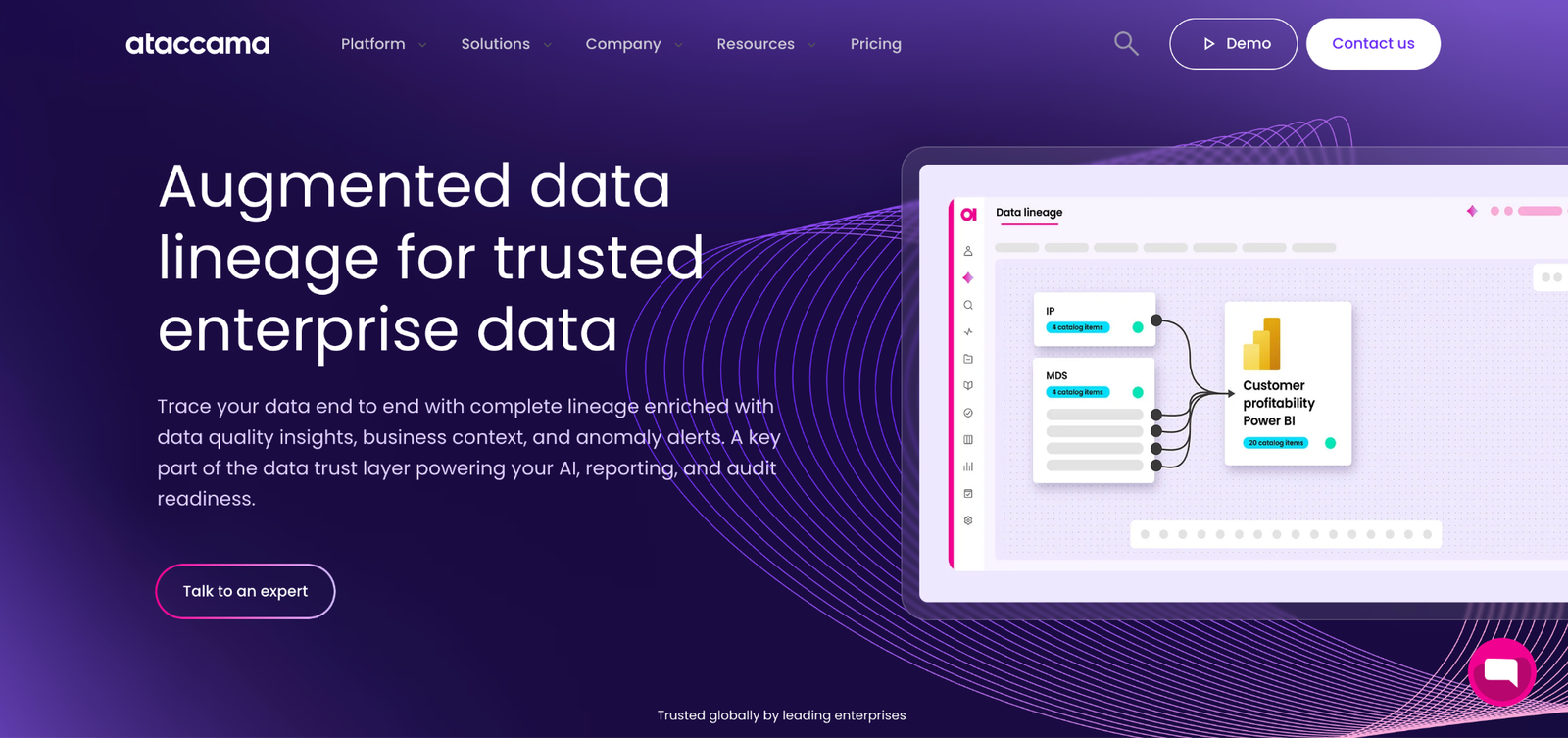
Ataccama combines lineage with data quality in one platform. Its scanners read metadata across sources, ETL jobs and destinations, then overlay quality and classification information on the lineage map.
Key features:
- Upstream and downstream tracing of BI figures in tools like Power BI or Tableau back to their origin
- ONE AI Agent that explains technical transformations in plain language
- Data quality overlay that flags drops in quality across tables
Pros:
- States that financial services firms use its lineage to meet BCBS 239 reporting frameworks
- Bank customers include Fifth Third Bank, Lloyds Banking Group and Judo Bank
Cons:
- Lineage is closely tied to the quality suite, which suits some buyers more than others
- No public pricing
Pricing: Not published; contact sales.
Best for: Risk and data governance teams that want lineage and data quality evidence in the same view.
7. OpenMetadata
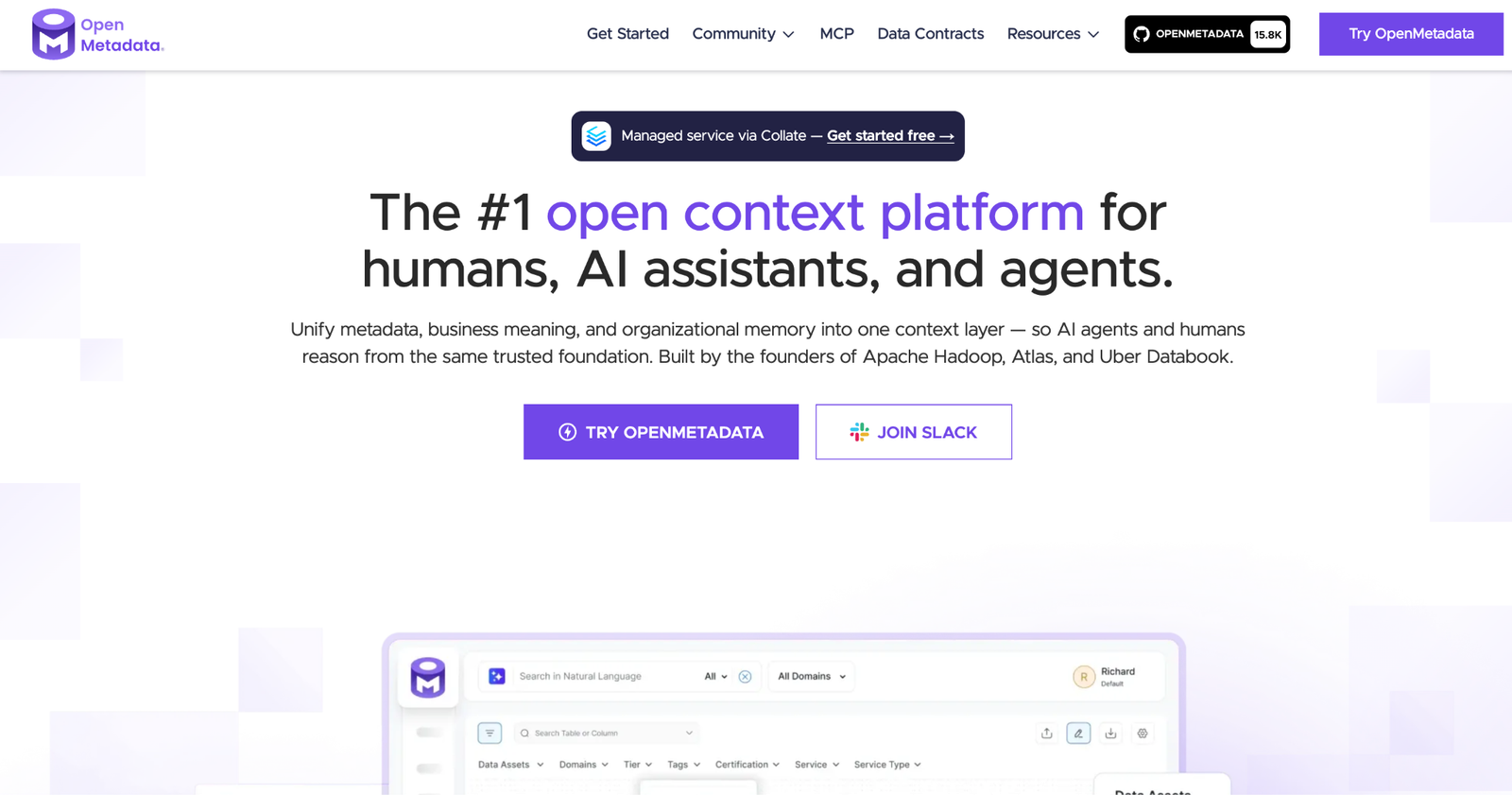
OpenMetadata is an open-source metadata platform released under the Apache 2.0 license. Collate, the company behind the project, offers a managed version for teams that do not want to run it themselves.
Key features:
- Column-level lineage across databases, dashboards and pipelines
- OpenLineage event ingestion and a no-code lineage editor
- Native MCP server that gives AI agents access to metadata
Pros:
- No license cost for the self-hosted platform
- Single platform for catalog, lineage, data quality and governance
Cons:
- No built-in regulatory reporting features
- Self-hosting requires engineering time, and dedicated support comes through Collate
Pricing: Free and open source; managed service available from Collate.
Best for: Engineering-led fintechs that want full control of an open-source stack.
How These Tools Map to Financial Services Requirements
Each tool’s strongest fit depends on the regulatory question you most need to answer.
For BCBS 239 and ECB inspections, Solidatus and Ataccama make the most explicit regulatory claims, and Solidatus adds historical views of how lineage looked at a past date.
For change control on regulatory reports, the third pick and Atlan both show downstream impact before a change ships, which reduces the risk of a broken report reaching a supervisor.
For privacy and sensitive data, the third pick and Atlan propagate PII tags to downstream assets, while Ataccama offers a classification overlay that locates attributes such as email and phone fields.
For legacy-heavy estates, IBM’s lineage capability and Atlan’s on-premises Oracle reference are the clearest signals of coverage beyond the cloud warehouse.
For cost-conscious teams, OpenMetadata removes license cost but shifts the burden to engineering time.
Frequently Asked Questions
What is the best data lineage tool for BCBS 239 compliance?
Solidatus makes the most explicit BCBS 239 claims, including end-to-end traceability from risk reports to authoritative sources and historical audit views. Ataccama also states that financial services firms use its lineage for BCBS 239. Whichever tool you choose, test it on one regulatory report end to end before committing.
Does the ECB require data lineage?
The ECB’s May 2024 Guide on effective risk data aggregation and risk reporting expects complete and up-to-date data lineages at the data attribute level as part of an integrated data architecture, and makes data owners responsible for managing lineage metadata. It builds on the BCBS 239 principles and is aimed mainly at significant institutions.
Why does column-level lineage matter for banks?
Risk and finance figures are built from specific fields, not whole tables. Column-level lineage shows exactly which source attributes feed a reported number, which is what an auditor or supervisor asks for when a figure is challenged.
Can open-source lineage tools work for a regulated bank?
They can cover the technical lineage, but they typically lack built-in regulatory reporting features and vendor support. Teams usually pair them with their own controls documentation or choose a managed version for support and security assurances.
How do AI features help with data lineage?
AI can draft lineage mappings, propose missing connections, explain transformations in plain language and let AI agents check provenance before using data. In regulated settings, look for tools that stage AI-generated changes for human review before they enter the official record.
What should a fintech prioritize over a large bank?
Fintechs usually run cloud-native stacks and change pipelines frequently, so automated capture, pre-change impact analysis and PII propagation tend to matter more than historical audit views. Large banks with mainframes and long inspection histories often weigh legacy coverage and regulator-facing reporting more heavily.