

There are many ways to differentiate yourself from other candidates, but a recognized qualification in a high-demand business area may help. It then becomes important to select appropriately.
There are broad professional exams, focused skills courses, and longer courses applying methods to practical projects.
You should therefore consider the responsibilities you would like to take on.
Contents
- Considerations according to desired area of responsibility
- Management and Strategy Institute: Change Management
- Society for Human Resource Management: General HR Knowledge and Judgement
- HRCI: HR Operations in US Businesses
- Prosci: Working on a Specific Change Project
- Summary Table of Key Features
- Maximising benefit of qualification
- Conclusion
Considerations according to desired area of responsibility
Research typical responsibilities for your desired roles. Most will not mandate any particular qualification, but some employers prefer or require certification, according to the US BLS.
Other considerations before purchasing a course:
- Is there any desired qualification stated in the advert? Meeting it is preferable to showing training in a similar area.
- Areas of responsibility: preparing for rolling out processes, understanding legislation and practice, or leading large-scale change.
- Eligibility to sit a course or examination; length of and method of study; how to pass; requirements for continuation.
All of the above are useful criteria, but their importance depends on the target role; duration alone should not decide the choice.
1. Management and Strategy Institute: Change Management
Anyone seeking techniques to bring others along with change may benefit from the Change Management Specialist (CMS) course. Subjects cover employee reactions, key stakeholders, handling objections, communication and coaching.
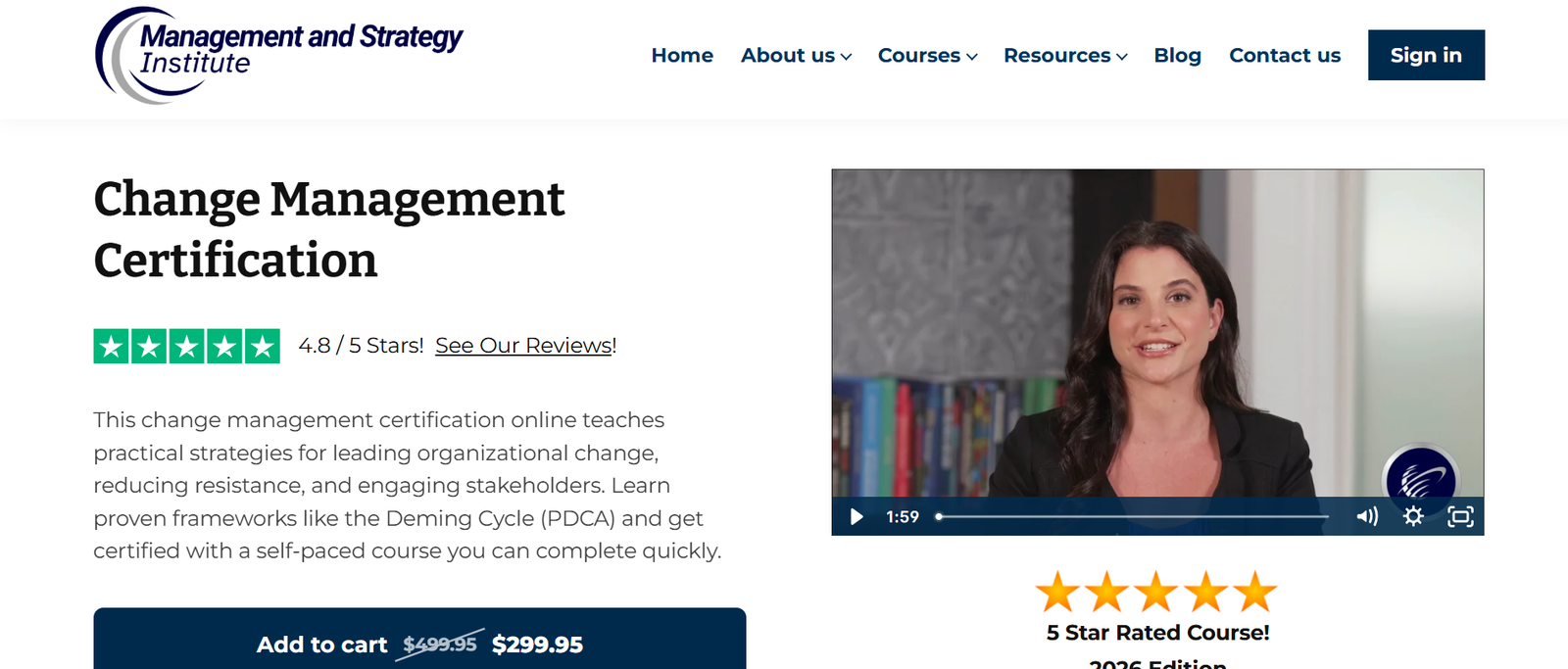
As with many Management and Strategy Institute courses, this combines a useful area of skill to learn with the convenience of studying over whatever time and periods suit the candidate. Applicable to many roles, including generalist and supervisory positions.
Highlights include:
- Application of a recognized sequence of steps (PDCA) to effect desired changes, and to continue making improvements. PDCA is widely promoted and used, for example by ASQ.
- All material available to watch or read online, culminating in an open-book examination of timed multiple-choice questions, also completed online. There are no prerequisites.
- Reasonable time to read the material and pass, estimated by the Management and Strategy Institute at 4-8 hours, allowing 12 months after purchase to do so.
- Certificate, badge, and small smartphone card, all electronic.
- No further action required after successful completion of the examination.
As a relatively basic illustration, the person responsible for ensuring all employees took advantage of an improved onboarding facility would benefit from the various suggestions as to identification and engagement of others likely to be impacted, and ways to review success and gain comments. Obviously she may have little to say as to the mechanics!
At the time of writing, the Management and Strategy Institute’s A+ rated standing, and Accredited Business status can both be seen on their BBB summary page. These are, of course, comments on the company, not indicators of the standard or quality of course content.
Therefore: well suited to a wide range of positions, where the holder may wish to further their skills and gain an appropriate qualification, but without a desire to incur continued cost and effort to retain it.
2. Society for Human Resource Management: General HR Knowledge and Judgement
People currently engaged broadly on “operational” matters, or wishing to begin such a career, may wish to gain SHRM-CP status. As befits a wide-ranging position requiring good judgement on varied matters of policy and practice, the exam comprises both knowledge and judgement elements.
Someone currently largely engaged in sourcing suitable candidates may therefore wish to test their general ability in a new post involving much employee interface and application of policy.
Clearly this demands quite a significant time commitment, studying to pass a wide-ranging professional exam. To retain the distinction, substantial PD is required triennially, or alternatively re-passing the examination.
So where a wide knowledge and understanding of “business as usual” functions would be advantageous and continuing study desirable, it would be sensible to consider this exam.
3. HRCI: HR Operations in US Businesses
HRCI, very applicable where an in-depth working knowledge and understanding of technical and operational HR matters governed by US laws and regulations is desired. Hence suitable if much of your role involves setting internal policies, interfacing with employees, and providing a range of services. Various topics fall under the general headings shown on their website, such as Rewards, Staffing and Information systems.

Potential candidates will therefore see that professional-level HR experience will be required before sitting the exam, 1 to 4 years depending on the level of education achieved. Again, the qualification can be retained over 3 years by accruing appropriate points or re-sitting.
So a suitable exam for the holder of a professional-level HR role dealing mainly with internal and employee-related matters, presumably primarily within the USA, and aiming for a similar position. It would be of decreasing benefit to someone based and employed mainly elsewhere.
4. Prosci: Working on a Specific Change Project
If the candidate wants to learn how best to lead and implement change using Prosci‘s established techniques, they can take a course and apply these to an actual business requirement. So there will be a fair amount of interaction and discussion with the provider, and with fellow delegates, as well as time spent preparing various inputs. This could relate to future installation and roll-out of systems, changes to business processes and so on, but could equally be based on a previous experience.
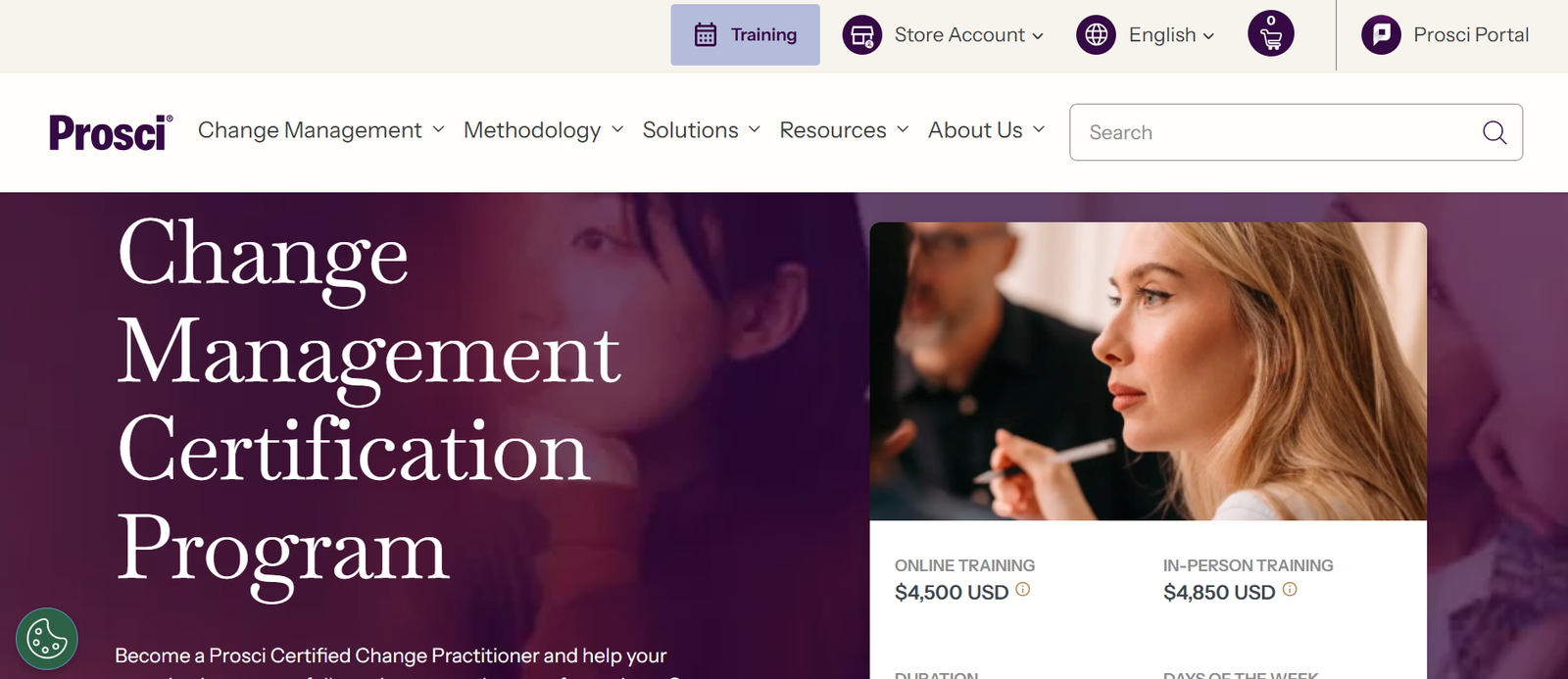
The principal difference here is the scheduled, facilitated format and project-based learning; around 3-5 days are involved, either face-to-face or over a series of scheduled online classes, with additional independent work expected.
Clearly appropriate to a senior person with responsibility to implement substantial changes to ways of working across a business or large part of it.
Summary Table of Key Features
| Management and Strategy Institute | Society for Human Resource Management | HRCI | Prosci | |
|---|---|---|---|---|
| Suitable for | Change management | General HR knowledge and judgement | HR operations in US businesses | Working on a specific change project |
| Completion of route to qualification | Online study and exam | Exam | Exam after suitable experience | Scheduled classes and assignments |
| Further action to retain | None | Recertify approximately every 3 years | 60 HR credits in 3 years or retake exam | No mandatory recertification |
Maximising benefit of qualification
Clearly, as far as possible, having relevant practical examples will strengthen any claim.
- Identify suitable instances: introducing a policy, improving and communicating a process to all, among many possibilities.
- You will want to highlight relevant decisions and actions taken by you, techniques and methods used, involving others appropriately.
- Have supporting information available to back up levels and degree of success, numbers of employees affected, actions to ensure uptake and so on. Avoid over-stating that all success was down to techniques studied.
- As always, it will help to reflect words used and areas required on the current vacancy.
Thus, someone involved in getting all staff to use a new process would want to detail the approach to gaining manager buy-in and support, methods to elicit and address issues raised, subsequent action and so on.
Conclusion
Obviously, you would wish to meet the requirements of a desired role, so the appropriate exam would be advisable if this was specified; and a long and demanding series of changes would benefit from extensive preparation.
Otherwise, the comparison suggests the Management and Strategy Institute would be very appropriate to broaden skills available to run smoother transitions throughout the business. The relatively short syllabus that can be fitted around other work, and only requiring an initial investment, also makes it attractive in demonstrating an ongoing commitment to professional development.