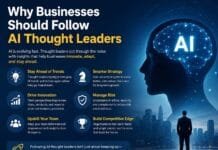

Business is changing. Fast. Companies once defined by products or location are being redefined by data, models, and automated decision layers. In an AI-first economy, the core offering often looks less like a boxed product and more like a learning system that improves over time. This shift is not hypothetical: large surveys show a rapid rise in AI use across organizations.
What “AI-first” actually means for business models
AI-first business models put artificial intelligence at the center of value creation. Automate core business processes: this means replacing repetitive human tasks with models that can handle routing, classification, forecasting, and even negotiation. Create data-driven revenue models: instead of one-time sales, companies monetize insights — subscriptions, usage fees, and outcomes-based pricing. Personalize customer experiences at scale: every interaction becomes an opportunity to learn and refine. These things together enable scalable growth. Simple idea; deep consequences.
New engines of revenue
Traditional product sales remain important. But AI enables new revenue streams that pivot on data and prediction. Pay-per-insight. API access to trained models. Outcome guarantees (e.g., “we’ll reduce churn by X% or you don’t pay”). Platforms bundle predictive analytics with human expertise. The result? Firms increasingly sell decisions, not just widgets. A large share of organizations now report using AI in at least one function, which lays the groundwork for these models.
Operational effects: efficiency and cost
Use AI to optimize operational efficiency and reduce operational costs. Automated scheduling, predictive maintenance, and demand forecasting cut waste. But this isn’t magic: many companies struggle to scale AI and convert pilots into steady value. A recent industry report found that most firms have yet to show clear, repeatable value from their AI efforts. That gap matters because it shapes which business models survive and which must be redesigned.
Modern business models also use math solvers—fast optimization engines that turn forecasts into action. They decide routing, pricing, and resource allocation by solving constrained optimization problems in real time. They come in both fully automated server-based and client-side math extensions for private users. Any math solver offers the ability to predict results based on data, rather than guessing. Any planning will be much more effective if it is based on data and cold calculations.
Transforming traditional industries
Sectors that seemed slow to change are rethinking themselves. Manufacturing shifts to predictive maintenance and dynamic pricing. Healthcare layers diagnostic models on top of workflows. Finance uses AI for risk scoring and faster settlements. These changes transform value chains: intermediaries vanish; new orchestration layers appear. The winners will be those who embed AI into product design and delivery, not those who bolt it on.
Data as both asset and liability
Data becomes the raw material of the business. The better the data, the better the model, the stronger the competitive advantage. But data is not free. Collection, cleaning, labeling, governance, and privacy compliance are costly. Firms are learning that owning data pipelines and high-quality labeled datasets matters more than merely buying flashy models. Gartner and other analysts note that many organizations are reworking their data and analytics operating models specifically because of AI.
Product design in an AI era
Design cycles shorten. Features become configurable model parameters. Continuous improvement replaces versioned releases. User feedback now often arrives in the form of model metrics — calibration drift, prediction latency, error distributions — not just bug reports. This pushes product teams to become data teams, and product managers to become model stewards.
Competitive advantage: speed, data, and talent
Competitive advantage in an AI-first world narrows to three things: who collects the best data; who moves fastest in deploying models safely; and who keeps the scarce talent. Speed is valuable but dangerous when it outpaces governance. Talent is mobile, and firms that combine engineering, domain expertise, and ethics in small cross-functional squads tend to outcompete siloed organizations.
Risks and why business models must be resilient
AI introduces new operational risks: model drift, regulatory scrutiny, biased outcomes, and adversarial attacks. Business models must therefore bake in guardrails. Redundancy, human-in-the-loop checkpoints, explainability layers, and robust monitoring become part of the offering. The companies that treat trust as a product feature will find easier routes to scale.
The economics: who pays, and how much?
Pricing becomes use-based more often than ownership-based. Customers pay for accuracy, speed, or time saved. That means sellers must instrument value carefully: measure outcome improvements, track cost reductions, and translate them into billable metrics. Some buyers will prefer capex (one-time model licensing); others will opt for opex (ongoing inference fees). Flexibility here becomes a competitive lever.
Scaling and organizational change
Scaling AI is about culture as much as code. Cross-functional governance, clear KPIs, and investment in data literacy are essential. Surveys show adoption is widespread, but scaling value remains difficult — only a minority of firms generate consistent, enterprise-wide gains from AI. Building a repeatable playbook matters: pilot, measure, standardize, and then scale.
Innovating digital services
AI enables new digital services: automated advisors, customized content generation, virtual agents that actually resolve issues, and predictive marketplaces that match supply and demand before either party knows there’s a need. These services change the unit economics of many industries and can convert one-time customers into long-term subscribers.
Longer term: predictable analytics and decision automation
Leverage predictive analytics not only to forecast but to automate decisions at scale. As models mature, decision latency shrinks and systems can execute more autonomously. This shifts the role of humans toward exception handling and strategy. But autonomy requires trust — and therefore strong observability, feedback loops, and clear accountability.
Closing: what leaders should do now
Think in systems, not features. Design offers around repeatable value (cost saved, revenue gained, time recovered). Invest in data pipelines and governance early. Experiment boldly but measure everything. Treat trust and safety as product features. And remember: in an AI-first economy, business model innovation is continuous — the firms that learn faster and operationalize responsibly will shape the next decade.