
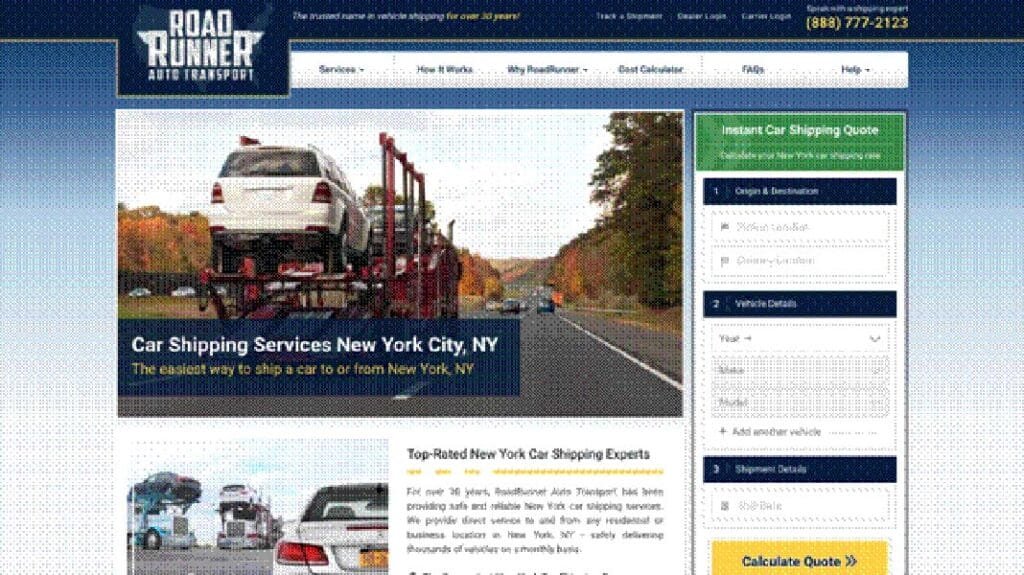
Shipping a car out of New York sounds simple until you actually try to book it.
Pickup zones get complicated, carriers won’t pull into certain streets, and quotes swing by hundreds of dollars between Monday and Friday.
Most first-timers looking into vehicle transport from New York don’t realize this until a driver calls saying his 75-foot rig won’t fit down their block.
The whole process has more moving parts than people expect.
Why New York pickups are different
Manhattan and parts of Brooklyn are the trickiest.
Narrow streets, low-hanging branches, and double-parked delivery trucks make full-size auto carriers impossible in plenty of neighborhoods.
Most drivers will ask you to meet them at a nearby parking lot, a wide commercial avenue, or just outside the city.
That’s not a scam.
It’s geometry.
A 9-car hauler physically can’t turn into a residential street with brownstones on both sides.
Queens and Staten Island are usually fine for door pickup.
The Bronx depends on the block.
If you’re in a dense neighborhood, plan to meet the driver somewhere a tractor-trailer can actually park.
What does car shipping actually cost from NY
Cost is the other thing people get wrong.
A quote in February doesn’t mean the same thing as the same quote in July.
Snowbirds move the market.
So do dealer auctions, university calendars, and the direction carriers are running empty.
A broker who quotes you $900 to Florida in peak season is either lowballing to lock you in or hasn’t checked the load board recently.
Real prices on busy lanes from New York usually land between $1,000 and $1,400 for standard sedans heading south.
West coast runs are typically $1,400 to $1,900.
These numbers shift constantly with fuel prices and seasonal demand.
Brokers, carriers, and why it matters
Most people booking online are dealing with a broker, not the actual carrier.
Brokers post your job to a national load board where carriers bid on it.
That setup isn’t bad.
Brokers handle the logistics, vet drivers, and chase down problems.
But it means the price you’re quoted is really the price they’re trying to attract a driver with.
If the number’s too low, no driver picks it up, your car sits in the driveway, and the broker eventually calls back asking for more money.
Always ask upfront whether the quote is the dispatch price or just the listing price.
Some of the bigger names in the space, like Road Runner, handle thousands of these moves a year and usually have a driver in the area already.
Smaller brokers can still get the job done well, but check reviews from the last six months, not the last six years.
Turnover in this industry is real.
Open or enclosed transport
Open transport is what most people get.
Your car rides on the same kind of two-level trailer you see on I-95, exposed to weather and road debris.
It’s cheap, fast, and fine for the vast majority of vehicles.
Enclosed transport runs roughly 40 to 60 percent more.
It makes sense for low-clearance sports cars, classics, or anything where a stone chip on the hood would ruin your week.
For a Toyota Camry going to North Carolina, open is the answer.
For a 1967 Mustang or a Porsche 911, enclosed is worth every dollar.
Timing your booking
Timing matters more than people think.
Booking a week out gives a carrier room to slot you into an existing route.
Booking 48 hours out usually means paying a premium or waiting a few extra days for a truck to come through.
New York is a high-volume origin, so trucks are usually available.
During holiday weeks, the first cold snap of fall, or right after a snowstorm shuts down I-95, expect delays.
Florida lanes get especially backed up between October and December as snowbirds head south.
Before the truck arrives
Document the car before it goes on the truck.
Walk around with your phone, photograph every panel in daylight, capture the odometer, and note any existing scratches.
The driver will fill out a bill of lading at pickup.
Sign it only after you’ve both agreed on the condition.
Do the same walkaround at delivery before you sign anything else.
Damage claims that aren’t recorded on the delivery BOL are nearly impossible to win later.
Keep your copy of the paperwork.
That single sheet is your only proof if something goes sideways.
The shortlist before you book
Get three or four quotes from different brokers.
Ask each one whether their quote is the dispatch price or the listing price.
Plan for a pickup window of two or three days rather than a single pickup time.
Don’t pick the cheapest broker on principle.
The cheapest quote is usually the one that ends up not happening.
A reasonable rate, a real phone number, and a contract you’ve actually read beats $100 off from someone who stops answering after they take your deposit.
Car shipping out of New York isn’t hard once you know how the pricing gets set and who’s actually moving the car.
The people who have a bad experience are almost always the ones who picked the lowest number on a comparison site and didn’t ask a single follow-up question.