
Parents now have five main tax-advantaged ways to save for a child: 529 plans, custodial Roth IRAs, the new Trump Accounts, Coverdell ESAs, and Series I savings bonds. Some grow tax-free, some only defer the tax, and each has different limits and rules. Here is how they rank, with 2026 numbers.
#1 529 education savings plan: strongest all-around for education goals
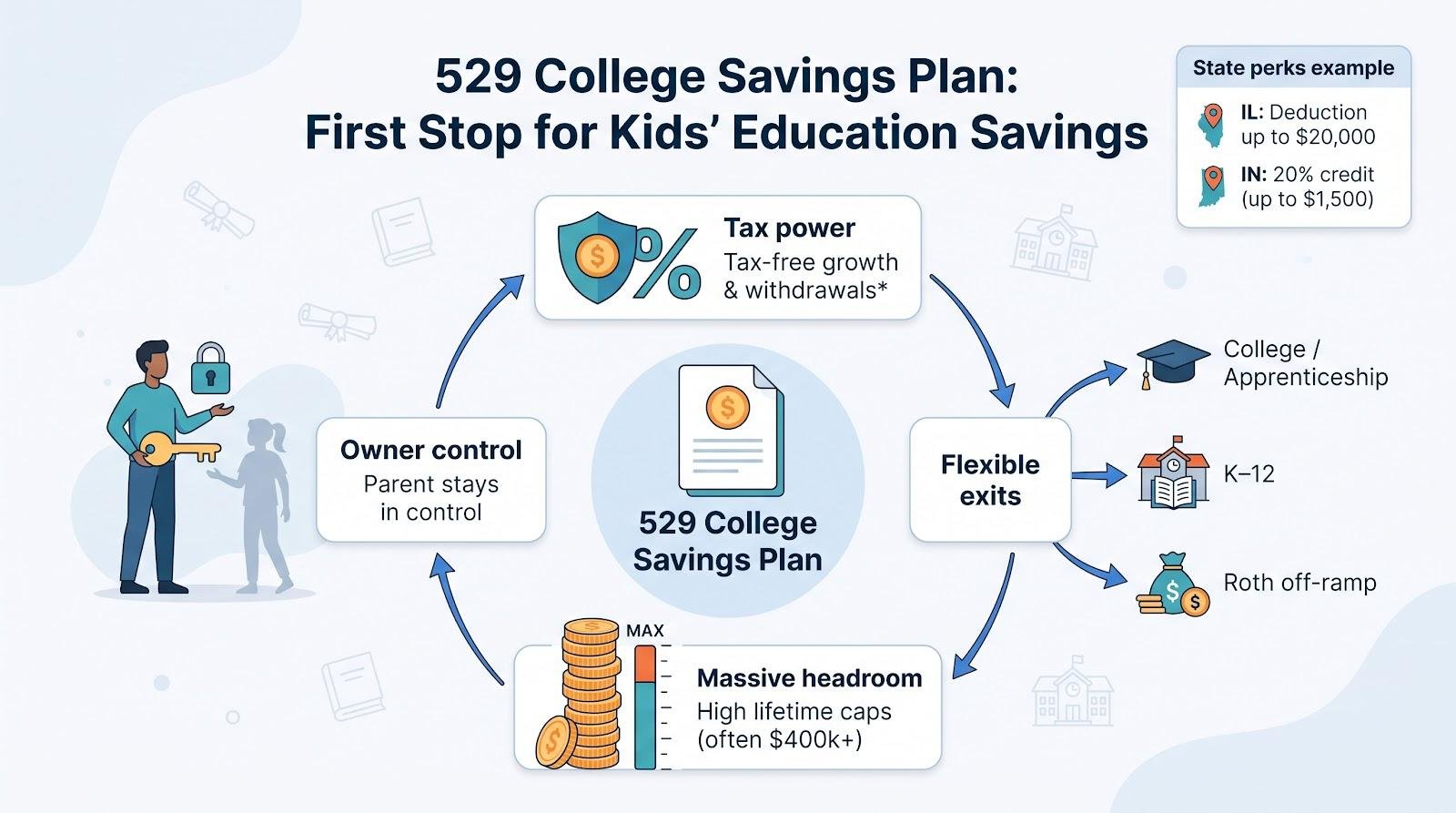
Illinois residents, for example, can open the Bright Start 529 College Savings Plan, which Morningstar named a Gold medalist for 2025. Its average annual asset-based fees are 0.24 percent, about half the 0.49 percent average for all 529 plans (ISS Market Intelligence, Q4 2025), and Illinois taxpayers can deduct up to $20,000 of contributions per year on a joint return.
- K–12 upgrade. The law signed July 4, 2025 doubled the annual K–12 withdrawal limit to $20,000 starting in 2026, added K–12 costs such as books, tutoring, and test fees, and added recognized postsecondary credential programs. Registered-apprenticeship costs have qualified since 2019.
- Roth off-ramp. Up to $35,000 lifetime can now move from a long-held 529 to the beneficiary’s Roth IRA, subject to the yearly IRA limit and the rule that the 529 must be open at least 15 years.
Why it scores highest
- Tax power. Earnings and qualified withdrawals avoid federal tax, and many states add a deduction or credit.
- Massive headroom. State maximum balances run from about $235,000 to $600,000 (Illinois: $550,000), and you can “super-fund” five years of gifts at once.
- Owner control. You stay on the account, so a restless teen can’t cash it out for a sports car.
- Flexible exits. Change the beneficiary, pay apprenticeship costs, or funnel leftover dollars into a Roth over several years.
State example
- Illinois: Deduct up to $20,000 per year on a joint return for in-state plans.
- Indiana: Credit equals 20 percent of contributions, up to $1,500 annually. A credit beats a deduction dollar-for-dollar, but watch for recapture if you roll to another state’s plan.
Rules to know
Non-qualified withdrawals trigger income tax on earnings plus a 10 percent additional tax, and some states take back earlier tax breaks if you roll the money to another state’s plan. Still, for any family with education on the horizon, a 529 remains the first place we’d park the next dollar.
#2 Custodial Roth IRA: powerhouse for kids who earn a paycheck
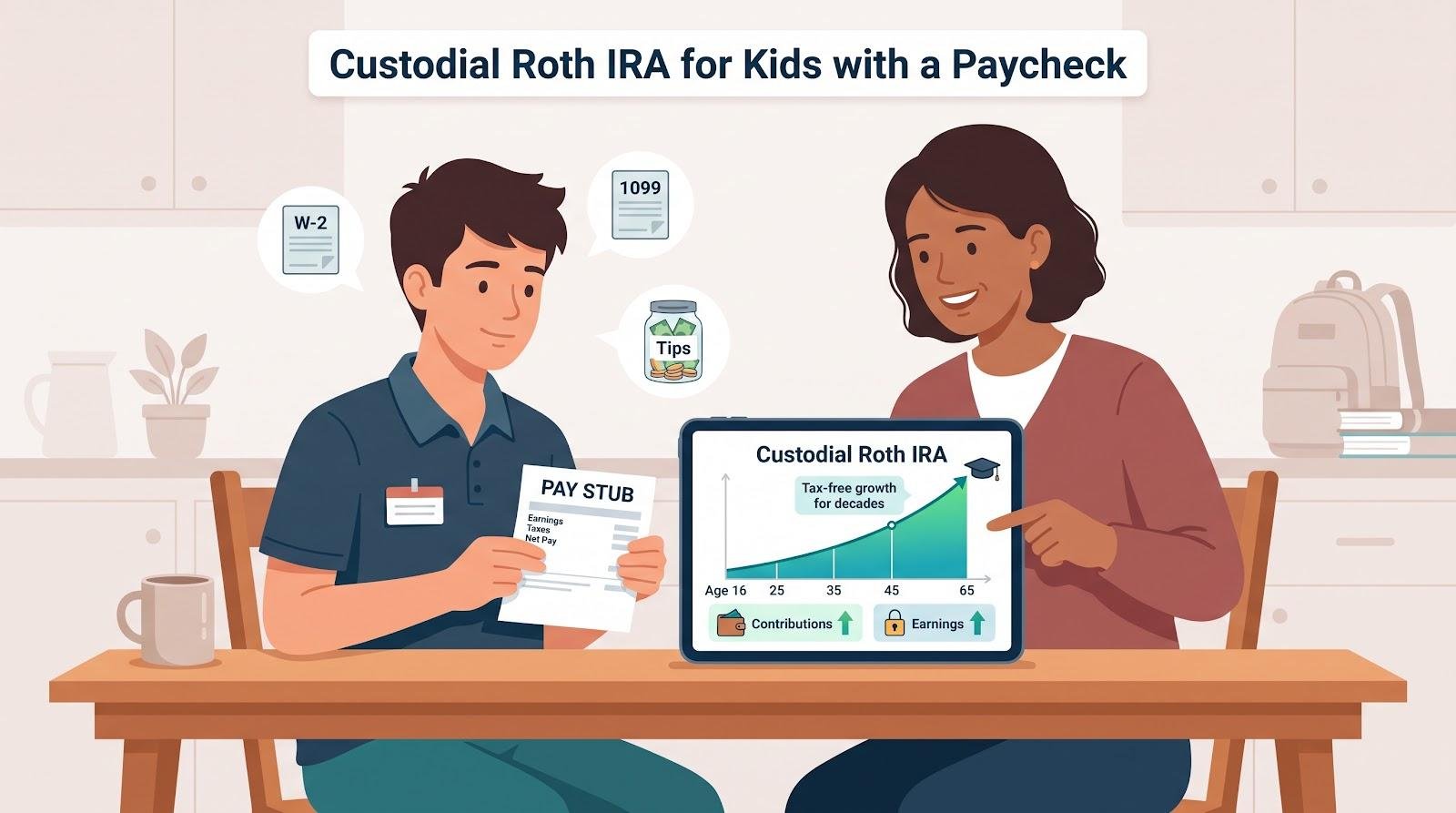
A first W-2 or 1099 opens a rare window: your child can stash up to $7,500 in 2026 (or their actual compensation, if lower) in a Roth IRA and let those dollars compound, tax-free, for decades.
Key rules
- Contributions cannot exceed the child’s earned income: wages, tips, or documented self-employment pay (IRS Publication 590-A). A parent can gift the cash, but the child’s pay stub or 1099 must match the contribution on paper.
- Regular contributions can be withdrawn anytime, tax and penalty-free. Earnings are different: they stay locked until age 59 ½ for a fully tax-free exit. If money comes out earlier for higher-education costs, the ten percent penalty is waived, but ordinary income tax on earnings may still apply.
Why it ranks second
- Tax power. Decades of federal tax-free growth on earnings.
- Aid friendly. Retirement accounts are generally excluded from FAFSA asset calculations.
- Investment menu. From broad index ETFs to age-based target-date funds, choice is nearly unlimited.
- Custodial control. You manage the account until your teen reaches the age of majority (18–21, state dependent), guarding against impulsive withdrawals.
Trade-offs
The annual limit is modest next to college costs, so pair the Roth with a 529 for tuition or a Trump Account to collect the federal seed. Together they form two tax engines that can run side by side for life.
#3 Trump Account: grab the free $1,000, then plan your next move
Congress added Section 530A “Trump Accounts” to the tax code in the law signed July 4, 2025, and first contributions, including the $1,000 federal seed deposit, could be made starting July 4, 2026; the side-by-side 529 vs. Trump accounts comparison notes that, unlike a 529, yearly family deposits cap at $5,000 and ownership shifts to the child at adulthood.
Bright Start 529 vs Trump Accounts comparison page screenshot
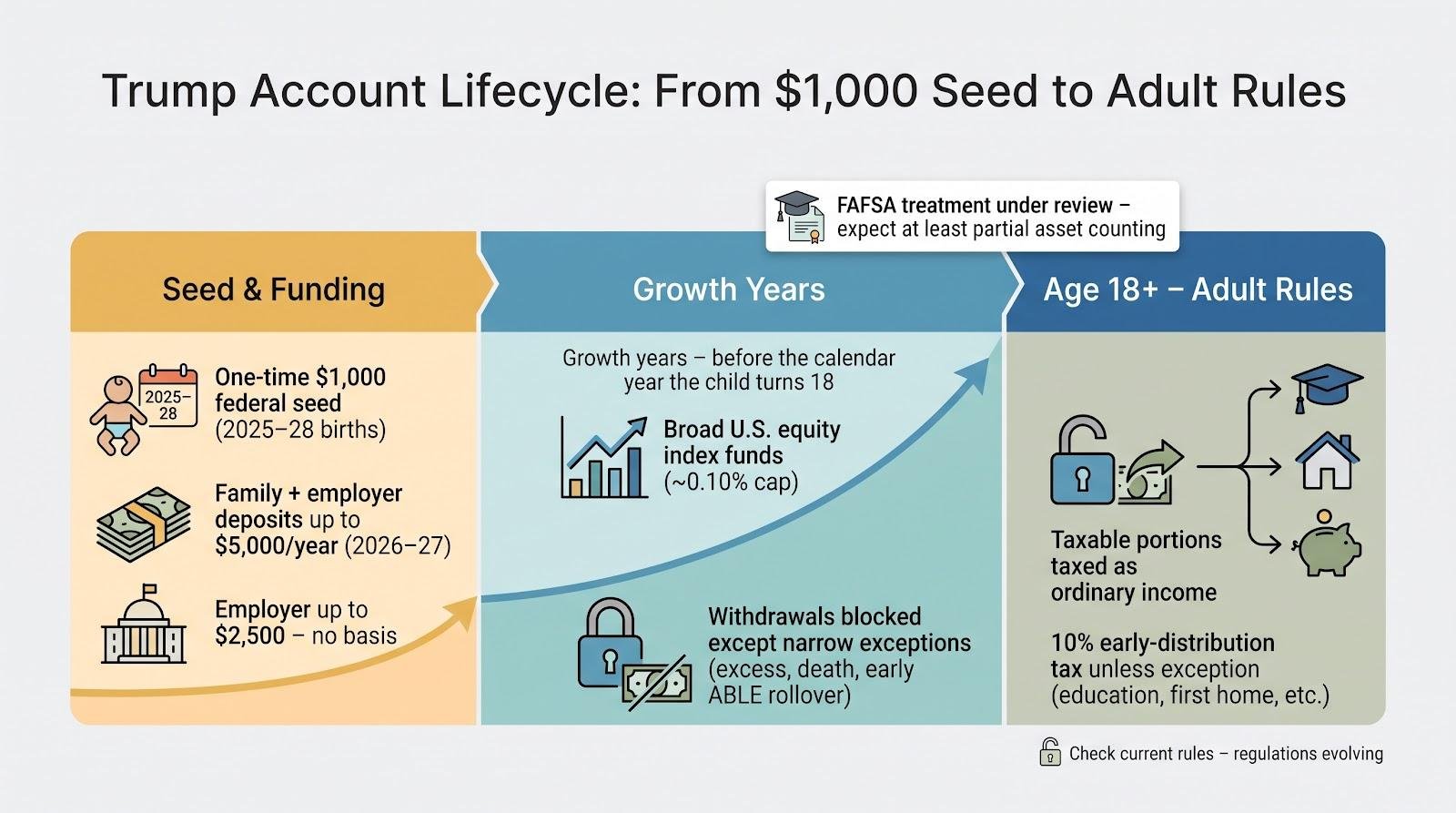
Free money first. U.S. citizen children with a Social Security number born from January 1, 2025 through December 31, 2028 can receive a one-time $1,000 federal deposit.
Family funding rules (2026–27)
- Up to $5,000 per year (inflation-adjusted) from family and employer sources; employer contributions are capped at $2,500 and do not create tax basis. The federal seed and contributions from charities and government programs do not count toward the limit.
- Only after-tax family deposits build basis; pilot, employer, and certain public deposits do not, so their earnings face tax later.
During the growth years (before the calendar year the child turns 18)
- Investment menu: funds that track a broad U.S. stock index, with no leverage and fees capped at 0.10 percent.
- Withdrawals are generally not allowed until the end of the year the child turns 17.
After the age-18 year
Growth-period limits lift and ordinary IRA rules apply: taxable portions come out as ordinary income, and the ten percent early-distribution tax can apply unless an exception (higher-education, first home, etc.) is met.
Financial-aid caveat
FAFSA treatment remains under review; plan for at least partial asset counting until final guidance arrives.
How to use it
- Open the account and lock in the $1,000 seed.
- Accept any employer match up to the annual cap.
- Direct extra college dollars to a 529, where qualified withdrawals stay tax-free.
- Treat the Trump Account as a long-term wealth booster that rolls into adult goals.
Regulatory note: Treasury and the IRS issued proposed Trump Account regulations in 2026 and have not finalized them. Check for updates before you make large deposits.
#4 Coverdell ESA: niche flexibility when you want total control
Coverdell Education Savings Accounts play a narrow role today: self-directed investing with tax-free education withdrawals, for families who accept a small annual cap.
- Contribution ceiling. Contributors may deposit $2,000 per beneficiary per year. Contributions halt after the beneficiary’s eighteenth birthday unless the child has special-needs status.
- Income limits. Eligibility phases out when modified AGI falls between $95,000 and $110,000 for single filers or $190,000 and $220,000 for joint filers; above those levels, new deposits are disallowed.
- Qualified uses. College costs plus a broad K-12 list with no annual dollar cap, including tuition, books, tutoring, uniforms, transportation, and computers. Funds generally must be used by age 30.
- Menu freedom. The account can hold individual stocks, sector ETFs, or CDs that a 529 cannot, and all growth remains tax-free for qualified expenses.
- A sidecar, not the engine. Build the 529 first to claim larger state and federal breaks; add a Coverdell only when an extra $2,000 of investment flexibility per year matters.
For households above the income cap, invite grandparents or a family trust below the threshold to fund this niche wrapper; otherwise, route the next dollar to the 529 or Roth.
#5 Series I Savings Bonds: slow and steady inflation fighter
Series I Bonds protect principal, track inflation, and provide a modest tax edge.
- Tax treatment. Interest is deferred until redemption or maturity, always free of state and local tax, and can be federally tax-free when the owner (age 24 or older) redeems in a year with qualified higher-education expenses, subject to MAGI limits. The bond must be registered to the parent, not the child.
- Purchase and liquidity rules.
- Buy up to $10,000 per person per year in electronic I Bonds.
- Minimum holding period: 12 months.
- Redeem before five years and forfeit the last three months of interest.
- Role in the stack. I Bonds rarely cover full tuition but act as ballast: principal does not drop in a market crash, and the rate adjusts with inflation every six months. Pair them with a 529 (tax-free growth) or a Roth (long-term compounding) for a smoother glide to that tuition bill or first-apartment deposit.
Register the bond in a parent’s name with the child as beneficiary to keep the college-tax break; a child-owned bond does not qualify.
Tax-free versus tax-deferred: how the wrappers really compare
Skip the tax math and you hand future dollars back to the IRS. Here’s the shorthand:
- Tax-free wrappers (529, custodial Roth, Coverdell) erase federal tax on qualified earnings, forever.
- Tax-deferred wrappers (Trump Account during its growth years, traditional IRA, taxable brokerage with unrealized gains) postpone the bill; earnings grow untouched, but ordinary-income or capital-gain tax comes later.
A quick numbers test
How far does $1 grow in ten years at a 7 percent annual return?†
| Wrapper | Tax during growth | Tax at qualified use | Ending value |
|---|---|---|---|
| 529 (qualified) | None | None | $1.96 |
| Custodial Roth (meets 5-year and age rules) | None | None | $1.96 |
| Trump Account (family dollars, 22 percent bracket) | None | Ordinary income on earnings | $1.75 |
| Taxable brokerage (15 percent long-term rate, annual drag) | Ongoing dividend and capital-gain tax | 15 percent on gains | $1.78 |
†Our math. Assumes reinvested earnings, no state tax, and that family Trump deposits create basis; seed and employer dollars fare worse because they have no basis.
What it means
When an expense is certain to qualify (tuition, apprenticeships, or retirement), choose tax-free space first. Use tax-deferred accounts for overflow dollars, very long horizons, or situations where free government deposits offset the later tax bite. If the goal feels unclear, blend the two: fund a moderate 529 for foreseeable schooling, then build a Roth or Trump Account for decades of flexibility.
Smart ways to stack these accounts
Money rarely arrives in tidy, goal-labeled envelopes, so think layers, not silos:
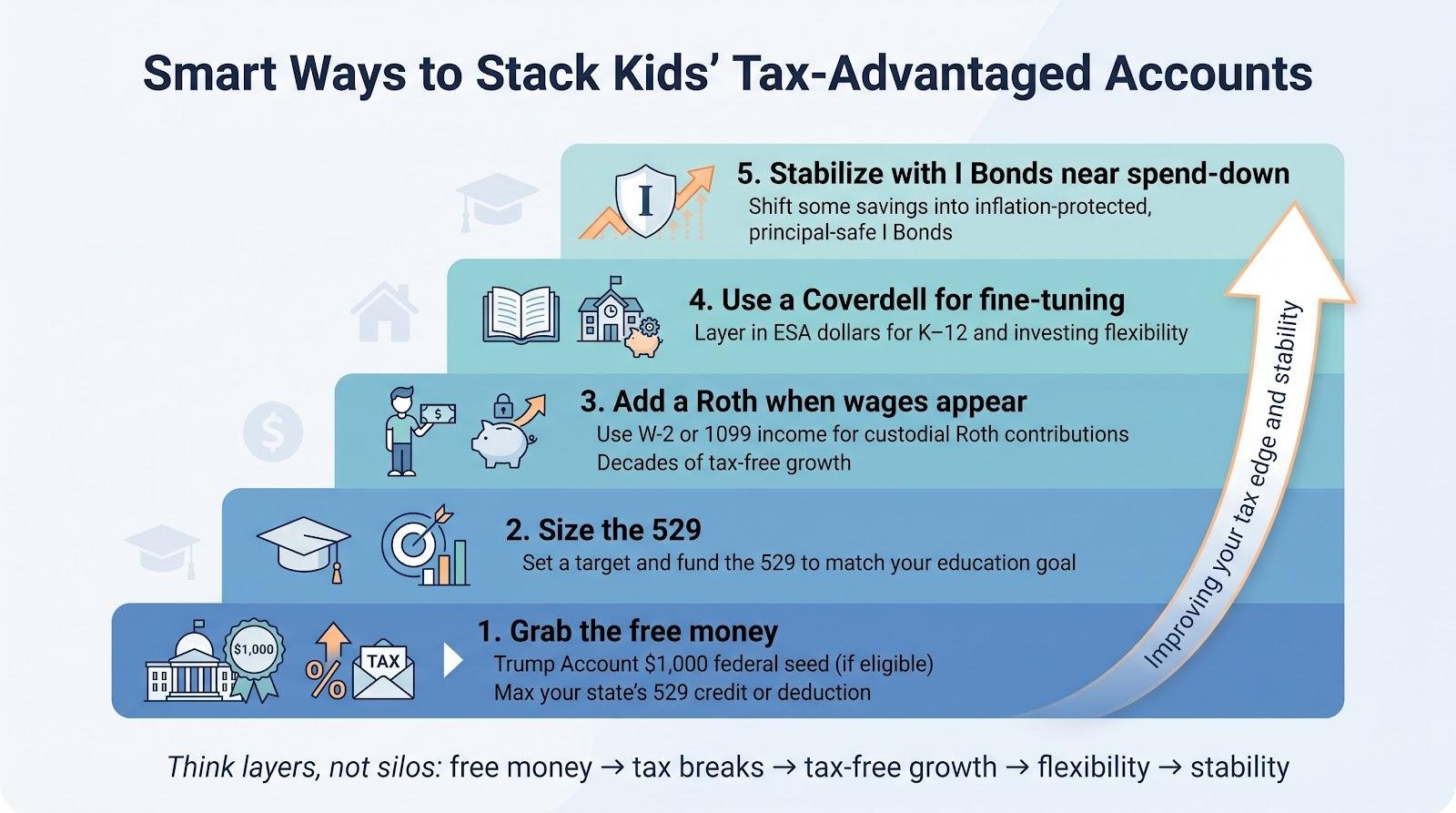
- Grab the free money.
- Open a Trump Account if your child qualifies; that $1,000 federal seed can compound for up to 18 years.
- Claim any in-state 529 perk. Indiana’s 20 percent credit, up to $1,500 per year, delivers instant cash back.
- Size the 529 to the expected bill.
Estimate the share you aim to cover (four full years or a smaller slice) and fund the plan until you reach that mark. Unsure about college? Target a lighter goal; credential, apprenticeship, and Roth-rollover rules preserve flexibility. - Add a Roth when wages appear.
Each dollar a teen earns (and you match) grows tax-free for more than forty years. Keep the pay stub as proof, and remember that basis can come out in an emergency. - Use a Coverdell for fine-tuning.
When grandparents fall under the ESA income limits, their $2,000 fits here for K-12 agility and self-directed investing. - Stabilize with I Bonds near spend-down.
Up to $10,000 per owner per year can move into inflation-linked bonds; hold at least 12 months and forfeit only the last three months of interest if you redeem before five years.
Follow that sequence: free money → deductible or credit → tax-free growth → niche flexibility → principal protection. The order keeps today’s taxes low while giving future you and your child more control.
Make state perks and gifting rules work in your favor
Federal breaks grab headlines, but state incentives and smart gifting can add thousands before you invest a dime. Remember: a credit cuts your bill dollar for dollar, while a deduction only lowers taxable income.
- Illinois example. Contribute up to $20,000 jointly to Bright Start and deduct the full amount from state taxable income, worth roughly $1,000 at the 4.95 percent flat rate.
- Indiana example. A $7,500 deposit earns a 20 percent credit, $1,500 back, because Indiana structures its incentive as a credit.
Read the fine print on recapture: if you roll money to another state’s plan, Illinois adds the earlier deduction back to your income, and Indiana can take back credits.
Gifting shortcuts
- Grandparents who live in a state with a 529 tax break can often claim it on their own state return when they contribute, even if the child lives elsewhere. Check your state’s rules.
- The 2026 annual gift-tax exclusion is $19,000 per beneficiary. Larger gifts can still sidestep gift tax with the five-year, $95,000 529 “super-fund” election.
- Parents can gift cash for a custodial Roth, but the child’s earned income must match the contribution.
- Coverdell contributor income limits apply to the giver, not the child, so a lower-income relative can fund the ESA if you are over the phase-out.
Layer these moves onto the earlier stack: snag the Trump seed, max your state’s 529 perk (or a relative’s), then direct earned-income dollars to a Roth and small extras to a Coverdell. Turning separate tax codes into teammates squeezes more value from the same dollars.