
A manufacturer can negotiate lower carrier rates and still watch its freight budget rise on flat volume. Fuel surcharges, accessorial charges, billing errors and shifts in shipment mix can all widen the gap between the rate on the contract and the total on the invoice.
Market pressure makes that gap harder to ignore. Cass Information Systems reported that its Truckload Linehaul Index, which tracks rates excluding fuel and accessorial surcharges, rose 0.9% from September and 9.9% year over year in October 2026. An index describes the market, not your contracts, but it is a good reason to check what you are actually paying lane by lane.
This guide compares six companies that help manufacturers analyze and reduce freight spend. Each takes a different route: lane benchmarking, freight audit and payment, procurement support, or finance-focused reporting.
Key Takeaways
- Freight spend analysis connects three records for each shipment: what moved, what the contract said it should cost, and what the carrier billed.
- Some providers focus on catching billing errors, while others focus on rates, carrier choice or finance reporting. Match the provider to the problem.
- A one-time assessment, ongoing invoice audit, procurement support and managed transportation are different purchases with different terms.
- Count savings only when finance can trace them to a contract, invoice or credit, and net out provider fees.
Quick Comparison
| Company | Documented focus | Entry point | Best for |
|---|---|---|---|
| TLI | Lane-by-lane rate benchmarking, carrier and mode mix, invoice accuracy | Assessment with no cost or obligation through the presentation call | Manufacturers that want a diagnostic before committing to ongoing support |
| Cass Information Systems | Freight audit and payment | Audit and payment services | Shippers focused on invoice accuracy and payment control |
| AFS Logistics | Freight audit, carrier negotiation and analytics | Service engagement | Manufacturers that want audit and procurement support from one provider |
| Trax Technologies | AI-based freight audit, cost allocation and accruals | Platform and services | Finance teams that need freight costs allocated to GL codes, SKUs or plants |
| Intelligent Audit | Freight audit, claims and transportation intelligence | Platform and services | Teams that want to query their transportation data conversationally |
| nVision Global | Freight audit and payment, benchmarking, rate procurement | Platform and services | Manufacturers with multimodal or global freight networks |
What a Freight Spend Analysis Covers
A spend analysis is a dated review of what you shipped, what you were charged and whether the two match. A few terms help when talking to providers. A lane is an origin-destination pair. An accessorial is an extra charge for services such as liftgate delivery, detention at a dock or redelivery. LTL, or less-than-truckload, means your freight shares trailer space with other shippers, and its price depends partly on weight and freight classification.
Before any provider can find savings, it needs shipment-level data. Useful fields include the shipment ID, ship date, origin and destination, carrier, mode, weight and dimensions, base charge, fuel surcharge, accessorials, final invoiced amount and delivery outcome. Joining these by shipment ID separates a negotiated rate reduction from a billing correction.
Classification also matters for LTL shippers. The National Motor Freight Traffic Association’s NMFC changes took effect on July 19, 2025, so outdated product dimensions or class records can lead to reclassification charges.
How We Chose These Companies
We reviewed each company’s published service pages and documentation, focusing on capabilities relevant to U.S. manufacturers: rate benchmarking, invoice audit, carrier procurement, finance reporting and data requirements. We did not test the services or interview customers, so treat this as a comparison of documented capabilities rather than a performance ranking.
6 Freight Spend Analysis Companies for Manufacturers
1. TLI
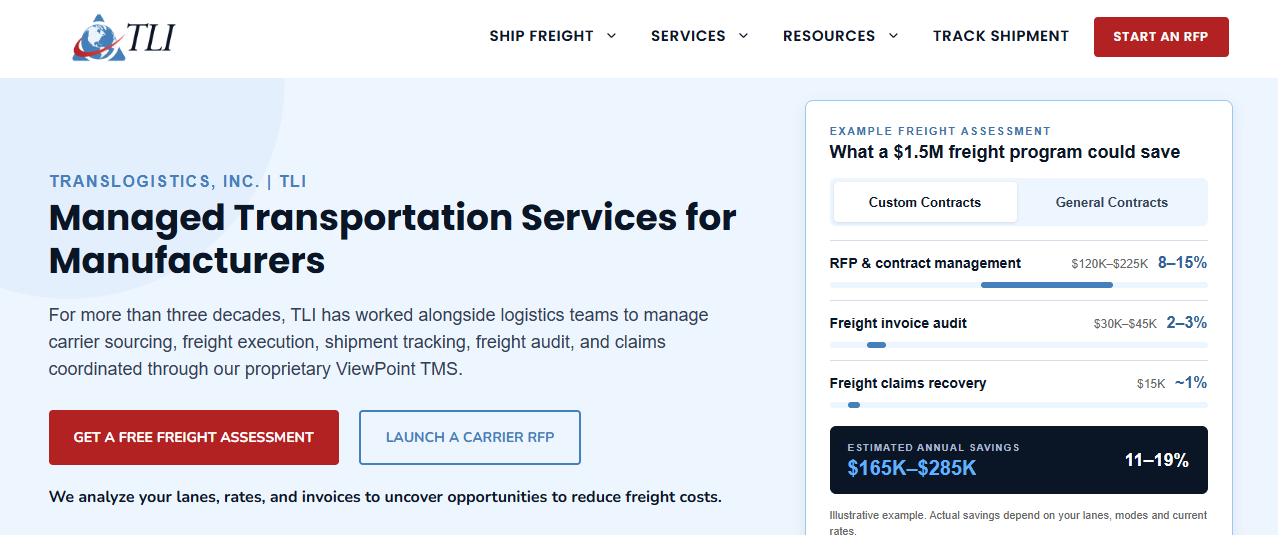
TLI’s freight spend analysis compares a shipper’s rates with today’s market on every major lane. The assessment carries no cost or obligation through the presentation call.
Key capabilities
- Lane-by-lane rate benchmarking against current market rates.
- Review of carrier and mode mix alongside invoice accuracy.
- Works from 6 to 12 months of shipment data or invoices, plus details such as dock hours and service requirements.
Best for: Manufacturers that want a structured diagnostic before deciding whether to change carriers, contracts or providers.
What to confirm: Savings estimates are illustrative and depend on your lanes, modes and current rates. Ask which findings come with the assessment and what needs a separate agreement.
2. Cass Information Systems
Cass focuses on freight audit and payment, and states that audit savings come from eliminating overcharges and duplicate payments. The company describes itself as a publicly traded financial holding company that applies bank-level controls to funds and data.
Key capabilities
- Freight invoice audit against contracts and rates.
- Duplicate protection, including its MatchPay tool, which cross-references invoice details, shipment records and historical patterns.
- Payment processing and data for reporting and accrual accuracy.
Best for: Manufacturers whose main problem is invoice accuracy and payment control across many carriers.
What to confirm: How exceptions are flagged and approved, how funds are held and released, and what accounting outputs finance receives each month.
3. AFS Logistics
AFS is a third-party logistics provider that combines freight audit and payment with transportation management and analytics. It manages shipper-carrier negotiation and rate optimization for LTL, and offers parcel services that include rate audits, contract management and data analytics.
Key capabilities
- Freight bill audit and payment.
- LTL and parcel carrier negotiation and rate optimization.
- The AFSmart technology suite, which handles quotes, bills of lading, shipment confirmation and claims.
Best for: Manufacturers that want audit, procurement and reporting support from the same provider.
What to confirm: Which services and integrations are included, which cost extra, and who prepares the source data. Ask for an example showing how one shipment and its invoice appear in the reports.
4. Trax Technologies
Trax offers AI-based freight audit and transportation spend management. It audits freight invoices across modes, currencies and regions, then uses the normalized data for cost allocation and accruals.
Key capabilities
- Automated audit of every freight invoice across modes and regions.
- Match Manager, which connects shipment data to carrier invoices.
- Cost allocation to GL codes, SKUs, customers, lanes or business units, with Logistics IQ reporting.
Best for: Finance teams that need to explain monthly freight changes or allocate freight costs to plants and product lines.
What to confirm: Data requirements, implementation responsibilities and licensing. Ask for a demonstration that follows a sample invoice into budget, allocation and accrual reports.
5. Intelligent Audit
Intelligent Audit has built freight technology since 1998, expanding from track-and-trace software into claims management, electronic invoicing, global freight audit and payment, and transportation intelligence. Its newest tool, Yosi, adds a conversational way to explore transportation data.
Key capabilities
- Global freight audit and payment.
- Claims management and transportation intelligence reporting.
- DeepDetectAI, which learns what normal looks like for each shipper’s network to flag unusual patterns.
Best for: Teams that want freight audit combined with analytics that non-specialists can query.
What to confirm: Ask the provider to show how an answer from Yosi or DeepDetectAI traces back to the underlying shipment and invoice records.
6. nVision Global
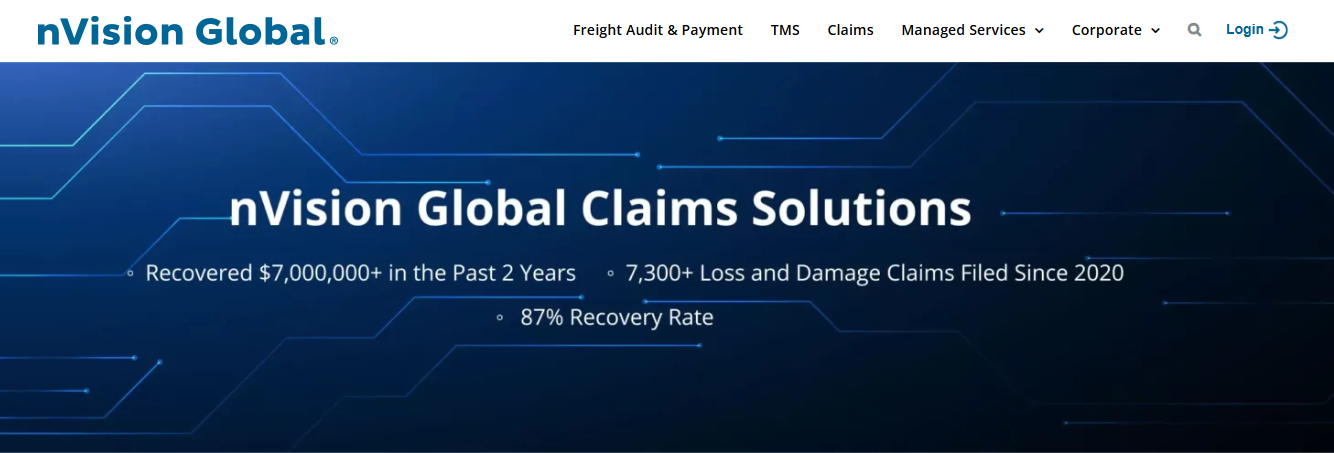
nVision Global provides freight audit and payment alongside transportation management, business intelligence, rate procurement, benchmarking and claims management. Its nSure AI Data Capture tool is trained on millions of freight bills to improve data accuracy.
Key capabilities
- Freight audit and payment across modes.
- Benchmarking and rate procurement support.
- Business intelligence reporting and claims management.
Best for: Manufacturers with multimodal or international freight that need audit and analytics in one place.
What to confirm: Which services fit your network, how pricing is structured for your shipment volume, and how invoice data reaches your ERP or accounting system.
How to Choose the Right Provider
Start with the problem you need to solve. Unexpected invoice charges point to audit. Recurring detention or other accessorials point to operational fixes at docks or with customers. Rates that no longer match your freight profile point to a rebid or renegotiation.
Then give every shortlisted provider the same test package: an anonymized lane with shipment history, the contract that priced it and an invoice your team disputed. Ask each one to trace its findings back to those records. Finance and shipping should both be able to follow the explanation.
Get commercial terms in writing before comparing proposals. Ask about assessment charges, implementation, transaction or management fees, minimum commitments, termination terms and data export. Confirm who can contact carriers, change routing or approve a payment, and keep those approval rights with your team.
Track Savings That Finance Can Verify
Review results monthly with cost and service side by side:
| Monthly measure | What it tells leadership |
|---|---|
| Total freight spend | What finance reports before explaining the change |
| Cost per comparable shipment | How unit cost changed within similar lanes and modes |
| Accessorial frequency and cost | Whether operational fixes are reducing extra charges |
| Confirmed billing corrections | Amounts corrected through audit |
| On-time delivery and damage | Whether cost changes are affecting service |
| Net savings after fees | Realized benefits minus provider and implementation costs |
Separate each month’s change into volume, shipment mix, rates, fuel and exceptions. Total spend can rise while cost per comparable shipment falls. Report billing corrections, negotiated rate reductions and operational improvements separately, and track credits through to receipt rather than counting every disputed charge as recovered cash. Clear dashboards help here, and advanced data visualization in logistics can make cost drivers easier for leadership to act on.
Conclusion
The right freight spend analysis partner depends on where your money is leaking. Audit-focused providers catch billing errors, procurement-focused providers address rates and carrier mix, and finance-focused platforms explain where freight costs belong.
Build a shipment-level baseline first, test providers against the same records, and agree with finance on how savings will be counted. That way, any reduction you report can be traced to a real contract, invoice or credit.
FAQ
What is freight spend analysis? It is a review of shipment, contract and invoice records to find where freight costs come from and where they can be reduced without hurting service.
How much shipment data do providers need? It varies by provider. Some assessments ask for 6 to 12 months of shipment data or invoices, so choose a period that covers your seasonal patterns.
What is the difference between freight audit and spend analysis? Freight audit checks each invoice against the contract to catch errors. Spend analysis looks across all shipments to find patterns in rates, carriers, modes and accessorials.
Do freight audit savings count as rate reductions? No. Audit corrections recover money you did not owe. Rate reductions lower what you owe going forward. Report them separately.
Should finance be involved in choosing a provider? Yes. Finance needs to agree on how savings are measured and confirm that reports fit its accrual and allocation process.