
When evaluating proxy providers, most buyers look at price, pool size, and speed. Geography rarely makes the shortlist. That’s a mistake — especially for businesses that handle sensitive data or operate in regulated sectors.
Where a proxy company is incorporated, the laws it operates under, and the data protection standards it follows all affect what happens to traffic that passes through that network.
The Data Privacy Angle
Not all countries treat digital data the same way. Some jurisdictions require providers to log user activity and hand it over on request. Others have weak or unenforced privacy frameworks. Switzerland falls into a different category entirely.
The Swiss Federal Act on Data Protection (FADP) sets strict rules around personal data handling — stricter in several ways than the EU’s GDPR. For businesses concerned about what proxy providers do with their traffic metadata, Swiss incorporation isn’t just a selling point. It’s a material difference.
What Neutrality Actually Means for Infrastructure
Switzerland’s political neutrality has a practical digital parallel: it positions the country outside major geopolitical surveillance frameworks. Providers operating under Swiss law aren’t subject to the kinds of government data requests that apply in other jurisdictions.
For intelligence-gathering tasks, competitive research, and any operation where discretion matters, this jurisdiction gap has real weight.
High-Bandwidth Infrastructure
Switzerland ranks consistently among the top countries for internet infrastructure quality. High-bandwidth backbone connections translate to:
- Lower latency on data-intensive requests
- More stable connections during concurrent sessions
- Faster response times for real-time scraping tasks
When large volumes of data need to move quickly and cleanly, the underlying infrastructure quality of the provider’s origin country matters.
Ethical IP Sourcing Under a Stricter Legal Standard
Evomi operates as a Swiss-based provider and positions its IP sourcing practices under the compliance standards that Swiss and European data protection law requires. This affects how the residential IP pool is built—whether device owners have genuinely consented to their connections being used and whether the network monitors for abuse.
Clean sourcing under a strict legal framework produces a cleaner pool. Lower fraud scores. IPs that don’t arrive pre-flagged by the time a customer uses them.
6 Compliance Certifications
Having six compliance certifications isn’t common in this market. Most proxy providers carry one or two, often self-reported. Industry bodies recognized as reliable will provide written confirmation that a facility has been independently inspected for infrastructure and operations.
In larger organizations, having a certification will play a significant role in how procurement teams review vendor due diligence forms before forwarding them on to the compliance officer.
What This Looks Like in Practice
Here’s how Swiss-standard quality shows up in actual usage:
- IP cleanliness — residential addresses with low fraud scores and higher success rates on protected targets
- Uptime commitment — 99.9% SLA backed by quality infrastructure
- Data discretion — traffic handled under privacy law rather than logged and stored
- Ethical compliance — network monitored for abuse, terms enforced, KYC policies in place
The Comparison Problem
Most proxy buyers don’t compare providers on jurisdiction. They compare on per-GB pricing. That’s fine as a starting point, but a $0.10/GB difference becomes irrelevant if the cheaper provider’s IPs fail 30% of the time or the company operates in a jurisdiction with mandatory traffic logging.
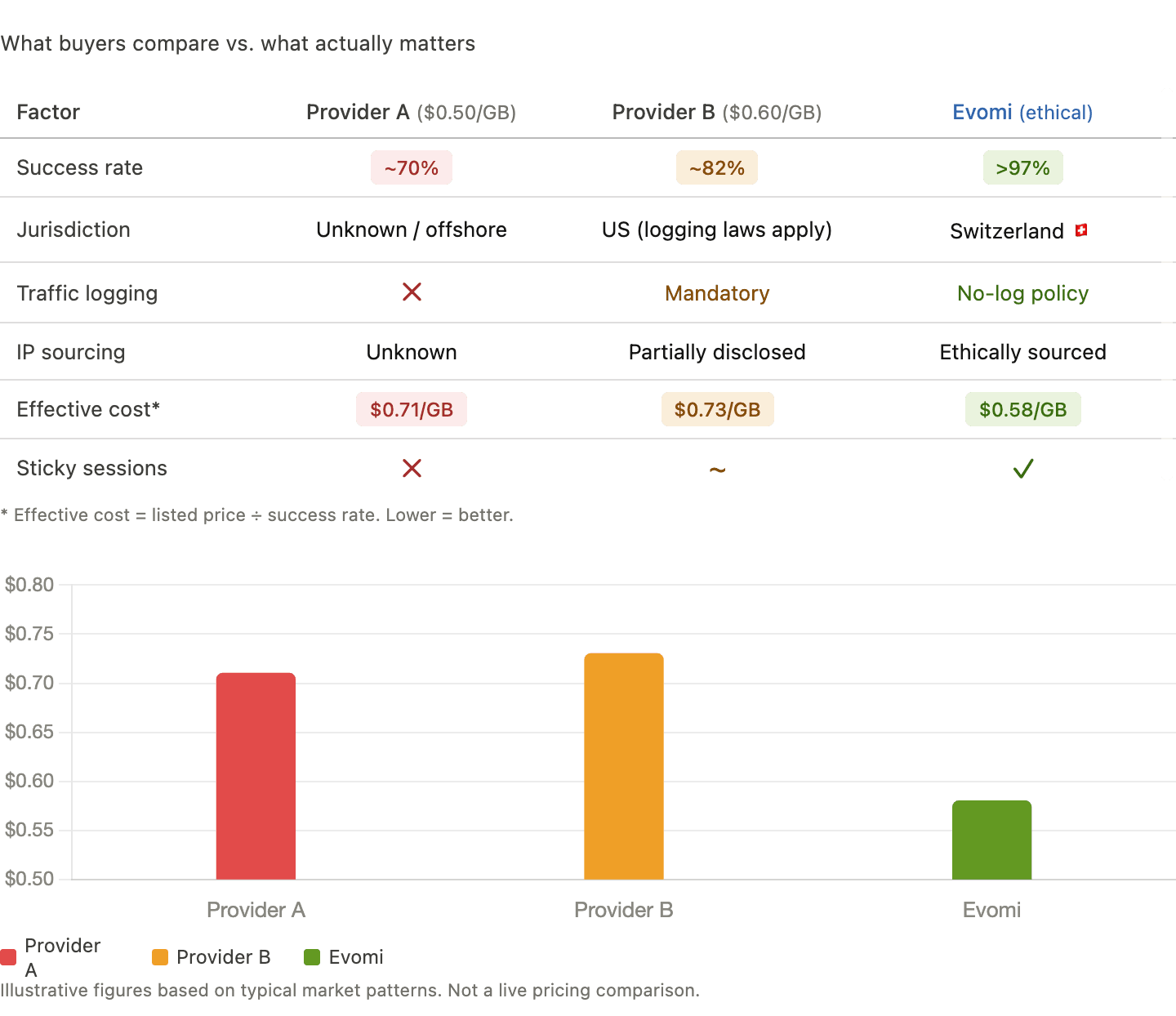
The most important conclusion we need to make from the chart is that the “cheaper” one with $0.50/GB is actually more expensive because of failed requests. 70% effectiveness leads to spending money on 30% of bandwidth, which doesn’t bring anything; in total, the price is $0.71/GB.
The table adds several components that are not taken into account by customers and cannot be measured by GB—those are jurisdiction rules, logging restrictions, IP sources, and session management.
For Teams That Have Compliance Considerations
Data collection sits in a legal grey area in many industries. Finance, healthcare, legal research, and public policy work all involve sensitivity around where data comes from and how it’s handled. Choosing infrastructure grounded in a high-standard legal environment is one way to reduce exposure.
Evomi’s Swiss base isn’t marketing decoration. For the right buyer, it’s one of the most concrete reasons to choose this provider over a competitor with a similar product at a marginally lower rate.