
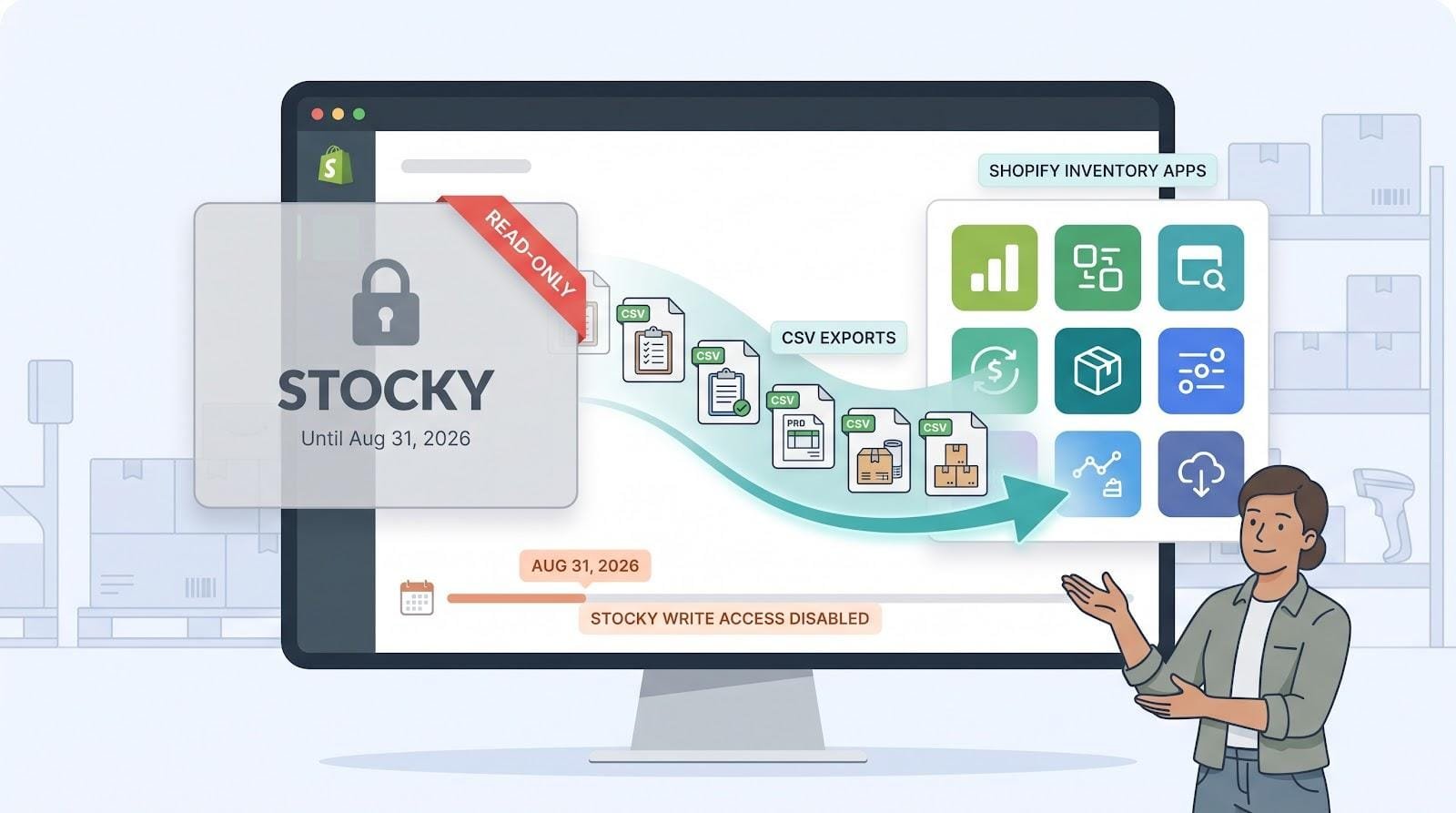
Stocky stopped accepting edits on August 31, 2026. Since that cutoff, you can only pull CSV exports, no fresh purchase orders or supplier syncs.
That read-only limbo endangers years of purchasing history. Shopify’s native inventory lets you create suppliers, POs and partial receipts, but it can’t resurrect what Stocky already captured.
This guide spotlights eight Shopify-ready apps that:
- import closed and open Stocky POs
- rebuild a full purchasing workflow, and
- stay under US $300 a month
so you can safeguard your data before those exports vanish.
Why you can trust this guide
We closed our research on September 21, 2026 and logged every source we used.
- Shopify’s help pages, including the transition guide confirming that Stocky’s API stopped on August 31, 2026, and only read-only exports remain
- Every shortlisted app’s Shopify App Store listing: captured plan prices, review counts and screenshots that confirm or debunk “one-click” Stocky imports
- Every shortlisted app’s own pricing page, checked against its App Store listing
- Shopify App Store reviews: merchants’ accounts of imports, cost shock and missing PO history shaped our scoring
If a field was uncertain (for example, whether an app keeps receipt dates), we marked it as “partial” rather than guessing. No vendor previewed this draft or paid for placement.
In short, the rankings ahead rest on time-stamped data, not marketing copy.
How we evaluated the alternatives
Shopify’s upgraded inventory suite (suppliers, purchase orders, partial receipts) serves as our control. Any paid app must outperform that free baseline.
Our eight-point scorecard
| Criterion | Weight |
|---|---|
| Post-shutdown Stocky migration | 25 percent |
| Live Shopify integration depth | 20 percent |
| Core Stocky workflows (suppliers, POs, counts) | 15 percent |
| Forecasting and replenishment | 10 percent |
| Multi-location and warehouse support | 10 percent |
| Manufacturing / assembly | 5 percent |
| Price-to-value under US $300 per month | 10 percent |
| Evidence and support confidence | 5 percent |
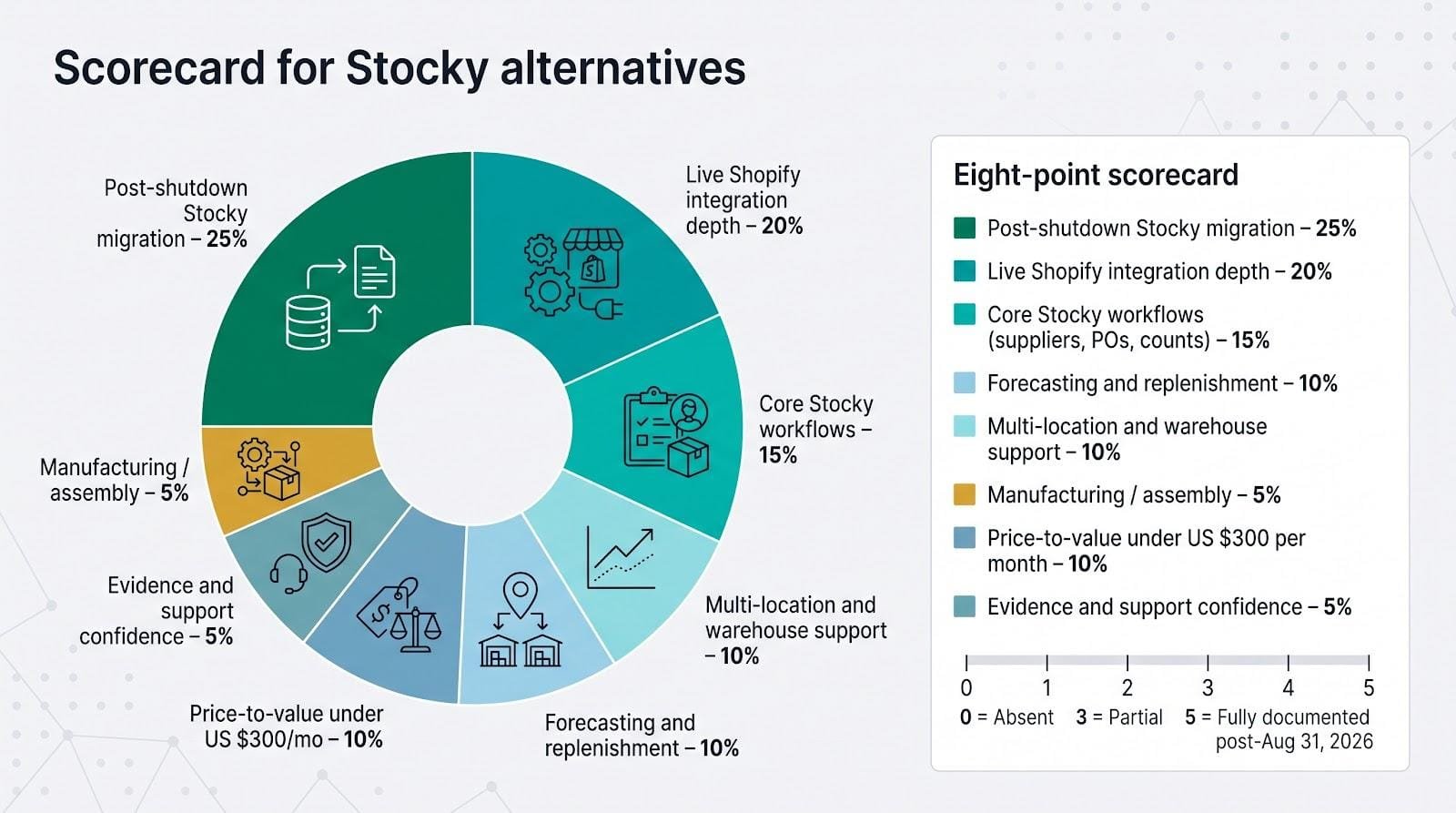
Each app earned 0–5 points per line:
0 = absent, 3 = partially documented, 5 = fully documented and working after the August 31 shutdown. We scored unknowns conservatively (1 or 2). Marketing claims counted only when backed by public docs or user reviews.
Totals produced the ranking you will see next, and the numbers stay tied to context so you can judge where each tool fits your workflow.
Organizely: best-value all-in-one for small teams
Branded as an inventory brain for small teams, Organizely (organizely.io/) offers a single workspace that covers purchasing, forecasting, warehouse tasks and light manufacturing, while letting you skip the Shopify POS Pro fee. Inventory writes back to Shopify in real time, so receipts and finished work orders update stock immediately.
Why it’s on the shortlist
- Pricing: starts at US $13 per month for the Stocky Plan. The Pro tier with BOM, work orders and the AI assistant is US $50 per month during the launch promotion.
- Feature depth: suppliers, purchase orders, mobile counts, BOMs and simple work orders live in one tab.
- Shopify fit: works on any Shopify plan; no nightly sync jobs.
Migration workflow
Organizely imports open and historical purchase orders (line items, suppliers, dates and costs), stocktakes as historical records, suppliers with contacts and payment terms, and stock adjustments with reasons. Products and variants come from the Shopify sync, and transfers remain in Shopify.
Watch-outs
- Only two Shopify App Store reviews so far, so the rating carries little weight yet. Request a sandbox demo and a field-level import map before committing.
- Confirm whether the promotion locks in long term. Regular rates list the tiers at US $26 (Stocky Plan), US $99 (Pro) and US $250 (Scale).
With its comprehensive importer, Organizely is the cheapest paid path to a full Stocky replacement for small Shopify-first teams that also want forecasting and light manufacturing.
Prediko: best for AI forecasting and assisted migration
Prediko (prediko.io) turns seasons, promotions and supplier lead times into daily buy suggestions. A color-coded dashboard flags SKUs at risk of stock-out, and two clicks launch a purchase order, so you can skip spreadsheets.
Migration proof
Support will import suppliers and PO history from your Stocky CSV exports. Reviewers confirm suppliers and PO history arrive intact; whether receipt events carry over is not documented.
Pricing and reviews (September 21, 2026)
- Starter: US $49 per month
- Scale-up: US $119 per month
- Growth: US $199 per month
All tiers include unlimited users. Prediko holds a 4.9 / 5 rating from 253 Shopify reviews.
Good fit for
Brands that rely on tight forecasting and need their historical PO trail intact, especially for teams that would otherwise pay per user.
Watchpoint
Ask support for a sample import that shows receipt events before you commit if those timestamps matter for audits.
Stockroom: closest Stocky replacement at the lowest current price
Stockroom (stockroom.app) keeps Stocky’s familiar flow: build a PO, print a barcode label, scan receipts and then sync inventory to Shopify within seconds. No hidden modules or POS Pro requirement.
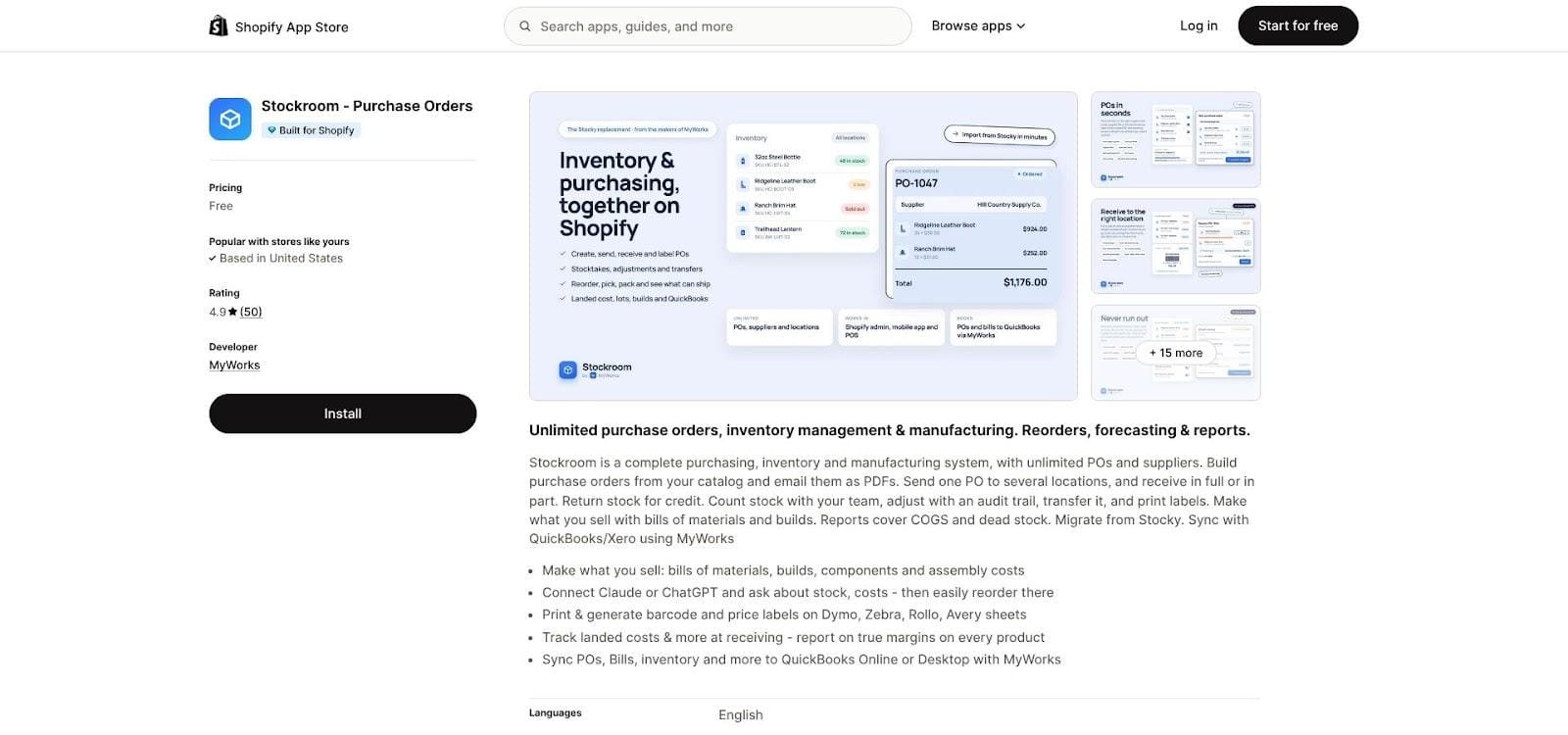
Stockroom Shopify app listing screenshot as free Stocky replacement.
Migration evidence
An August 28, 2026 Shopify review says the store imported 2,000+ Stocky purchase orders from the past couple of years in under ten minutes. Open POs arrive as live documents you can receive against, so your historic trail stays intact.
Pricing and rating (captured September 21, 2026)
- Plan: Free on the Shopify App Store
- Rating: 4.9 of 5 from 50 reviews
Key features
- Multi-location inventory, transfers and mobile cycle counts
- Barcode and price-label printing
- Lightweight manufacturing: bills of materials and simple builds
- Forecasting and dead-stock reports
Stockroom skips AI extras, yet if you want a no-cost, PO-centric tool that feels like Stocky and migrates your history in minutes, it remains the strongest fit today.
Sumtracker: best for multichannel sellers who need CSV-backed PO imports
Sumtracker (sumtracker.com) keeps Amazon, Walmart, eBay, Etsy and Shopify in sync from one dashboard, preventing the oversell penalties that plague marketplace sellers.
Migration workflow
Sumtracker documents bulk CSV import for historical purchase orders and cost prices. Ask support for the current template, then recreate your suppliers first so every imported order links to a real vendor record.
Pricing and rating (captured September 21, 2026)
- Manage: US $59 per month for up to 2 500 orders per year
- Replenish: US $119 per month adds purchase orders, transfers and twelve-month forecasting
- Rating: 4.8 of 5 from 125 Shopify reviews
Feature highlights
- Real-time inventory sync across Amazon, eBay, Etsy, Walmart and Shopify
- Bundles and kits that explode into components
- Mobile cycle counts, location transfers, landed-cost tracking
- Pricing scales by order volume, not users, saving high-SKU, low-order brands from per-seat fees
If your catalog sprawls across marketplaces and you need a documented CSV bridge from Stocky, Sumtracker delivers the sanity check your channels, and your auditors, expect.
Stockie: best established low-cost replacement for retail workflows
Stockie (stockie.app) brings Stocky’s retail essentials into one clean dashboard: suppliers, lead times, minimum–maximum levels, weighted-average costs and barcode receiving. Scanner-driven teams feel at home on day one.
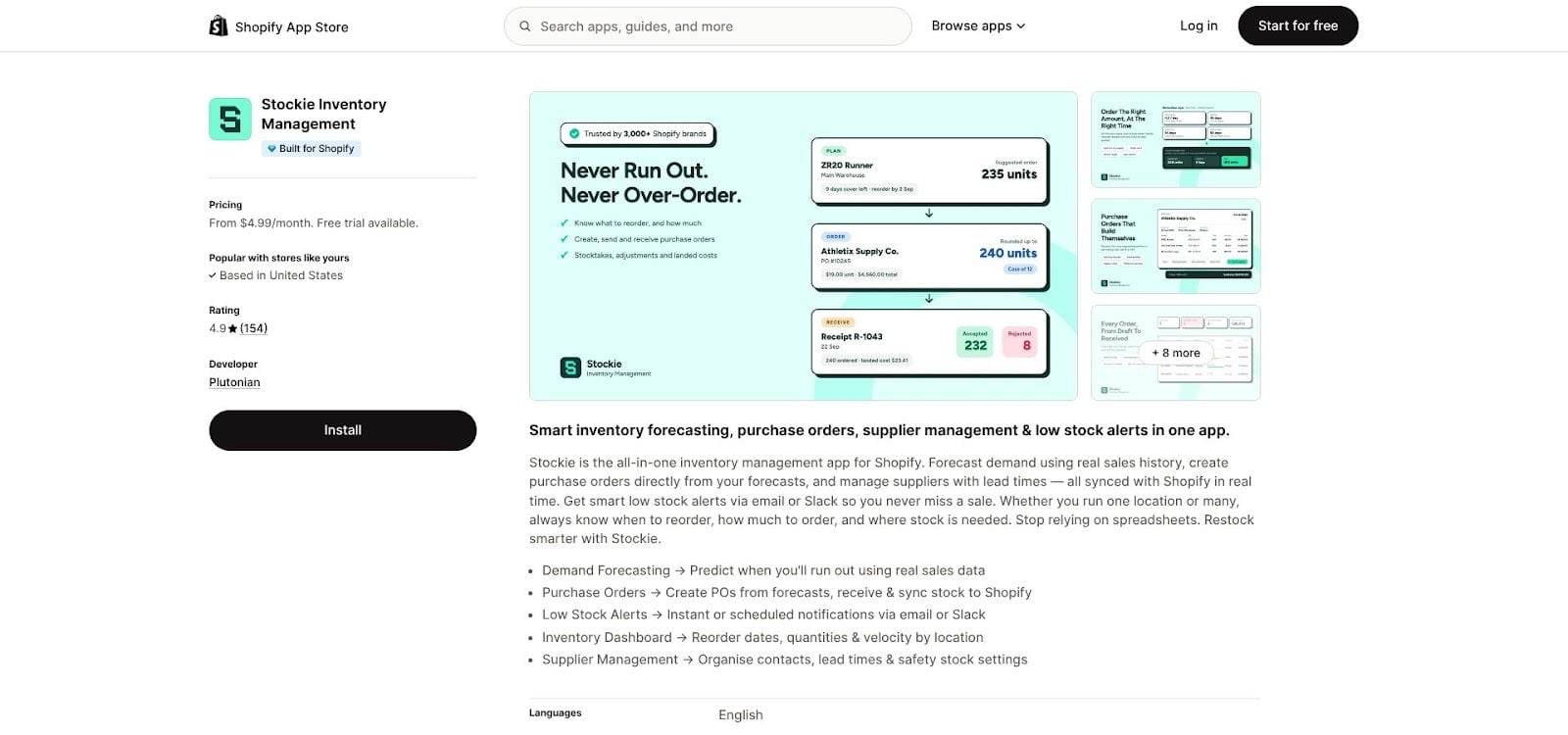
Stockie Shopify app listing screenshot for retail inventory workflows.
Migration workflow
- A member of the Stockie team runs the import of your closed and open Stocky purchase orders; open orders arrive as drafts.
- Confirm before you commit whether dates, unit costs and supplier contacts carry over, because Stockie does not document those fields.
Pricing and rating (captured September 21, 2026)
- Pro (forecasting): US $29.99 per month
- Pro Plus (POs, receiving, counts, landed cost): US $59.99 per month
- Rating: 4.9 of 5 from 154 Shopify reviews
Unlimited locations on every plan.
Fit and limits
Stockie covers the retail loop (buy, receive, count, repeat) without ERP overhead. It doesn’t handle manufacturing, so makers should choose Katana or Organizely instead. Brief staff on the name similarity to the retired “Stocky” app to prevent mix-ups.
For brick-and-mortar stores that need full PO history, barcode receiving and tidy costs without a big bill, Stockie is the proven, low-friction choice.
Katana: best for brands that build what they sell
Katana (katanamrp.com) adds full manufacturing control to Shopify: multi-level BOMs, work orders that back-flush components and a live timeline that shows which ingredient is delaying tomorrow’s shipment.
Migration reality
Products and current stock sync from Shopify in minutes. Katana publishes no Stocky import path, so plan on building your own CSV or asking about onboarding help. Assume receipt events and unit costs will need manual work until Katana confirms otherwise, and budget time if audit-ready history is essential.
Pricing and rating (captured September 21, 2026)
- Free plan: up to 30 SKUs, unlimited users
- Core: US $299 per month for one location; extra sites and add-ons raise the bill
- Rating: 4.2 of 5 from 134 Shopify reviews
Fit and cautions
Katana is overkill for a single-store boutique that just wants reorder points, but it is ideal for makers tracking raw materials, labour and finished goods in one place. Verify total cost: lot tracking, bin locations or extra warehouses are paid add-ons. Ask for a sample PO import before you commit.
Fabrikatör: best for AI-driven replenishment and back-order control
Fabrikatör (fabrikator.io) helps DTC brands avoid sell-outs and cash-draining overstocks with machine-learning forecasts. Each SKU shows days of cover and a reorder deadline; one click generates a PO with quantities and due dates. If demand outpaces supply, the back-order module converts oversells into pipeline stock, so customers can still check out.
Migration snapshot
Products and sales sync from Shopify in minutes. Fabrikatör’s listing promises to replace sunsetting systems like Stocky but publishes no field-level import map, so confirm whether historical POs, supplier contacts, costs and receipt events migrate before you sign up.
Pricing and rating (captured September 21, 2026)
- Stores under US $500 K annual revenue: US $79 per month when billed annually
- Fees rise with revenue, not users; unlimited SKUs and users on every tier
- Shopify App Store rating: 4.8 of 5 from 111 reviews
Good fit for
Fast-moving DTC catalogs where timing is everything and back-orders are acceptable. Brands that need a full PO audit trail should ask for a sample import before signing up.
Inventory Planner by Sage: best for large catalogs that need deep forecasting
Inventory Planner (inventory-planner.com), now part of Sage, handles catalogs in the tens of thousands of SKUs with demand forecasting and open-to-buy budgets that align finance, planning and merchandising.
Strengths
- Turns your sales history into location-level reorder suggestions.
- Widgets flag capital tied up in slow movers; export recommendations to CSV or push them to connected systems like QuickBooks and NetSuite.
Migration caveat
Live sales and stock sync from Shopify, but Inventory Planner publishes no Stocky import path. Ask for a field map and timeline during onboarding if you need receipt-level history.
Pricing and rating (captured September 21, 2026)
- Quote based: fees scale with order volume and connected channels.
- Shopify App Store rating: 4.5 of 5 from 153 reviews
Expect enterprise-style onboarding costs. Inventory Planner suits high-SKU retailers who value granular forecasting more than a turnkey Stocky clone and who have the budget for a premium planning engine.
How the eight apps stack up at a glance
Need the short version for vendor calls? Start here. Each entry price is the lowest plan that includes purchase orders.
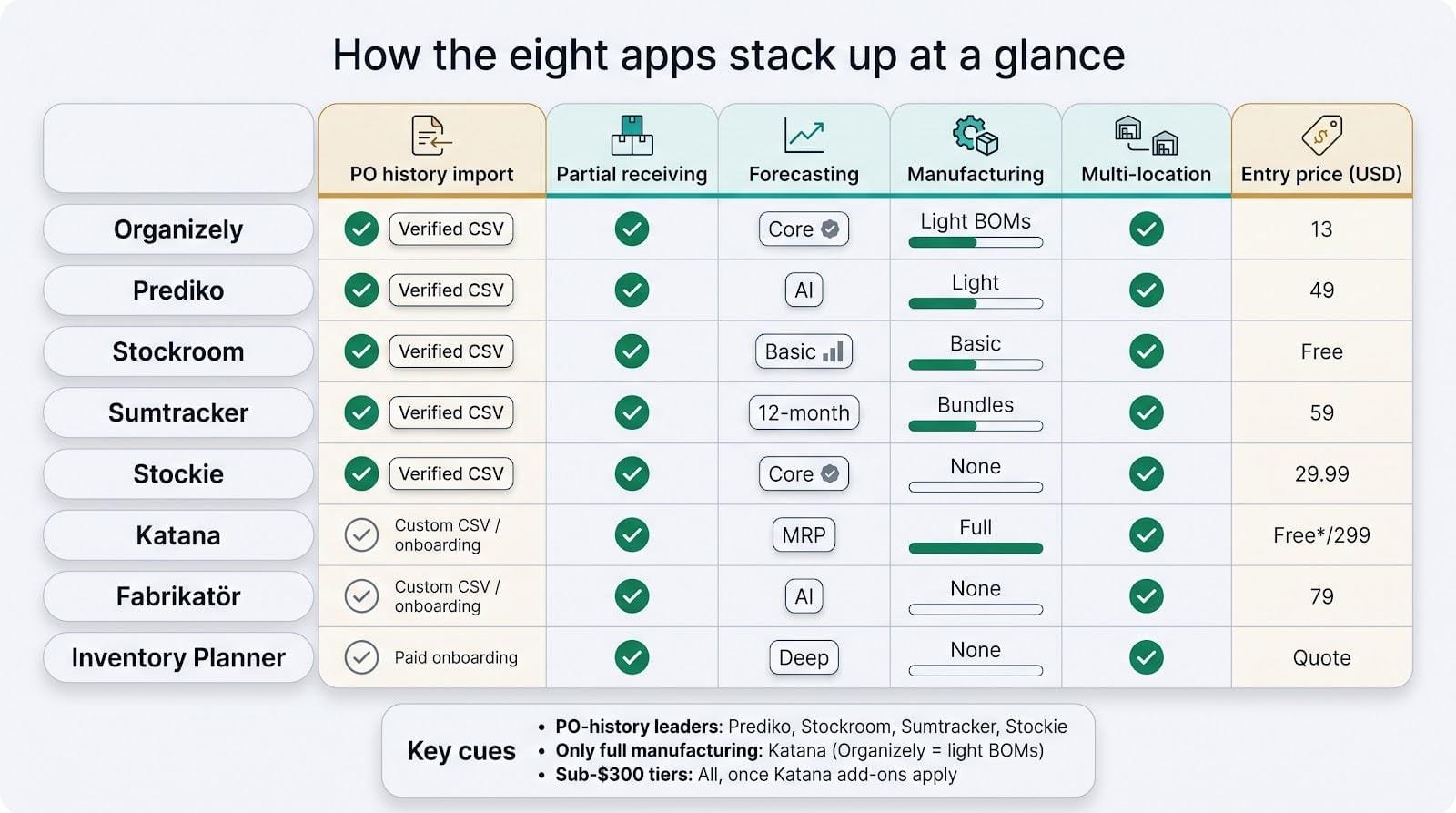
| App | Historic PO import (post-Aug 31) | Partial receiving | Forecasting | Manufacturing | Multi-location | Entry price (US dollars) |
|---|---|---|---|---|---|---|
| Organizely | API key import, CSV fallback | ✔︎ | ✔︎ | Light BOMs | ✔︎ | 13 |
| Prediko | Assisted CSV | ✔︎ | AI | Light | ✔︎ | 49 |
| Stockroom | Wizard (2,000+ POs per merchant review) | ✔︎ | Basic | Basic | ✔︎ | Free |
| Sumtracker | Bulk CSV | ✔︎ | 12-month | Bundles | ✔︎ | 59 |
| Stockie | Assisted import | ✔︎ | ✔︎ | None | ✔︎ | 29.99 |
| Katana | No documented path | ✔︎ | MRP | Full | ✔︎ | Free (≤30 SKUs) / 299 Core |
| Fabrikatör | Ask vendor | ✔︎ | AI | None | ✔︎ | 79 |
| Inventory Planner | Ask vendor | ✔︎ | Deep | None | ✔︎ | Quote |
Monthly price captured September 21, 2026. Seventy-nine dollars reflects the annual-billing equivalent for stores under US $500 K revenue; pricing scales with revenue.
Key cues:
- PO-history leaders: Prediko, Stockroom, Sumtracker, Stockie
- Only full manufacturing: Katana; Organizely offers light BOMs
- Sub-300 tiers: All except Inventory Planner (quote) and Katana Core once add-ons apply
Use the table to shortlist apps, then review the detailed sections for field-level migration notes and hidden costs.
Which path fits your store?
Start with your biggest headache, then pick the app that fixes it fast.
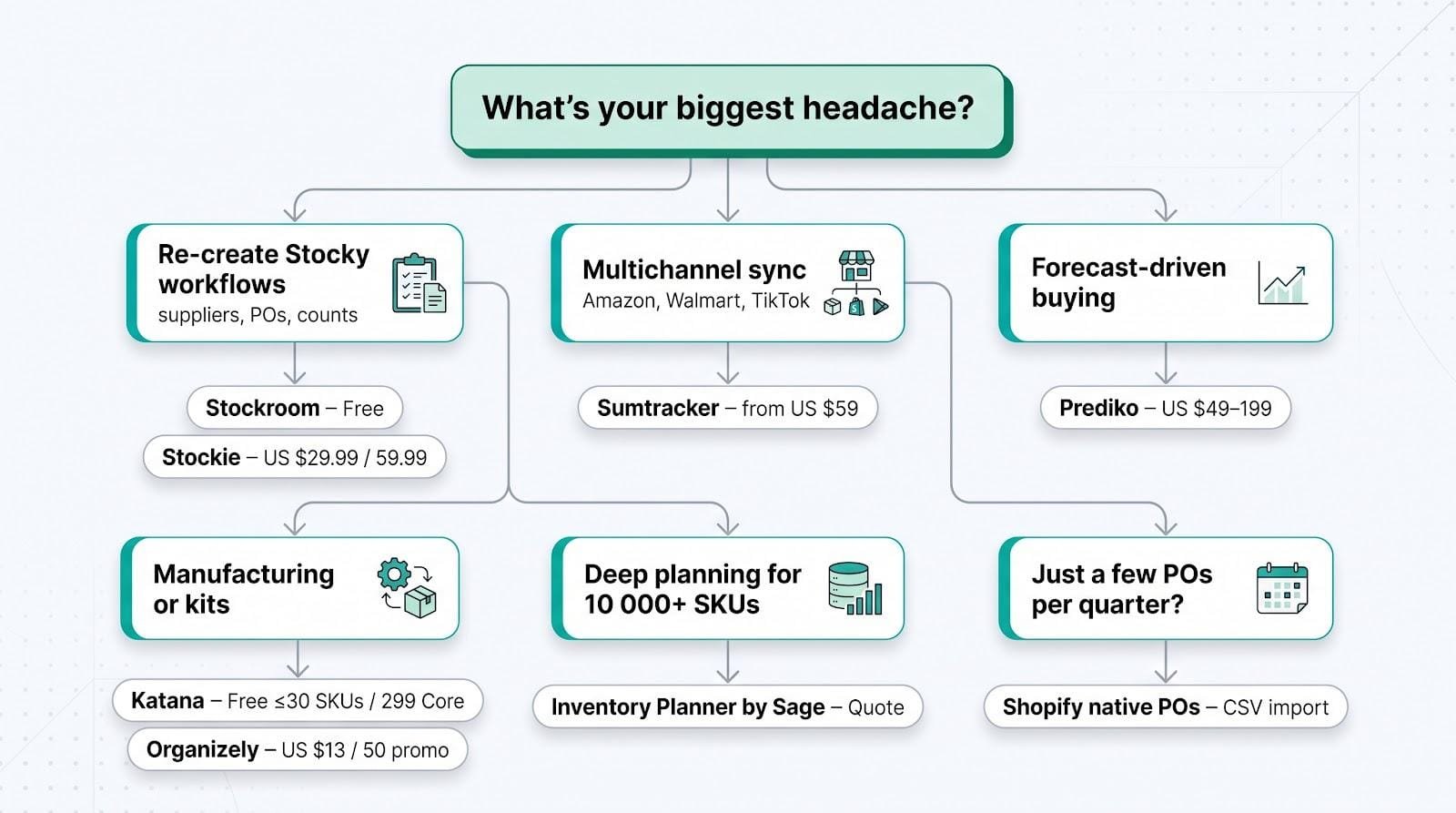
- Re-create Stocky workflows (suppliers, POs, counts) – try Stockroom (free) or Stockie (US $29.99 or 59.99 per month). Both import historic POs and feel like Stocky from day one.
- Multichannel sync (Amazon, Walmart, eBay) – Sumtracker (from US $59 per month) keeps every channel on the same stock ticker and back-loads your Stocky POs via CSV.
- Forecast-driven buying – Prediko (US $49 to 199 per month) layers machine learning over lead times and manages CSV migrations for you.
- Manufacturing or kits – Katana (free for up to 30 SKUs, Core US $299 per month) for full MRP. Organizely (US $13 per month or 50 during the launch promotion) for light BOMs.
- Deep planning for 10 000+ SKUs – Inventory Planner by Sage (quote) trades higher fees for granular, location-level forecasts.
- Just a few POs per quarter? Test Shopify’s native purchase-order CSV import before adding another subscription.
Pick the lane that matches today’s workload, not the shiniest feature list. The right fit can cut hours of admin time and thousands in carrying costs within the first cycle count.
Your post-Stocky migration checklist
Export everything before you install a new app, because once Shopify removes read-only access, the data is gone. Follow the 23 tasks below in order to avoid the two classic errors: missing suppliers and double-counted stock.
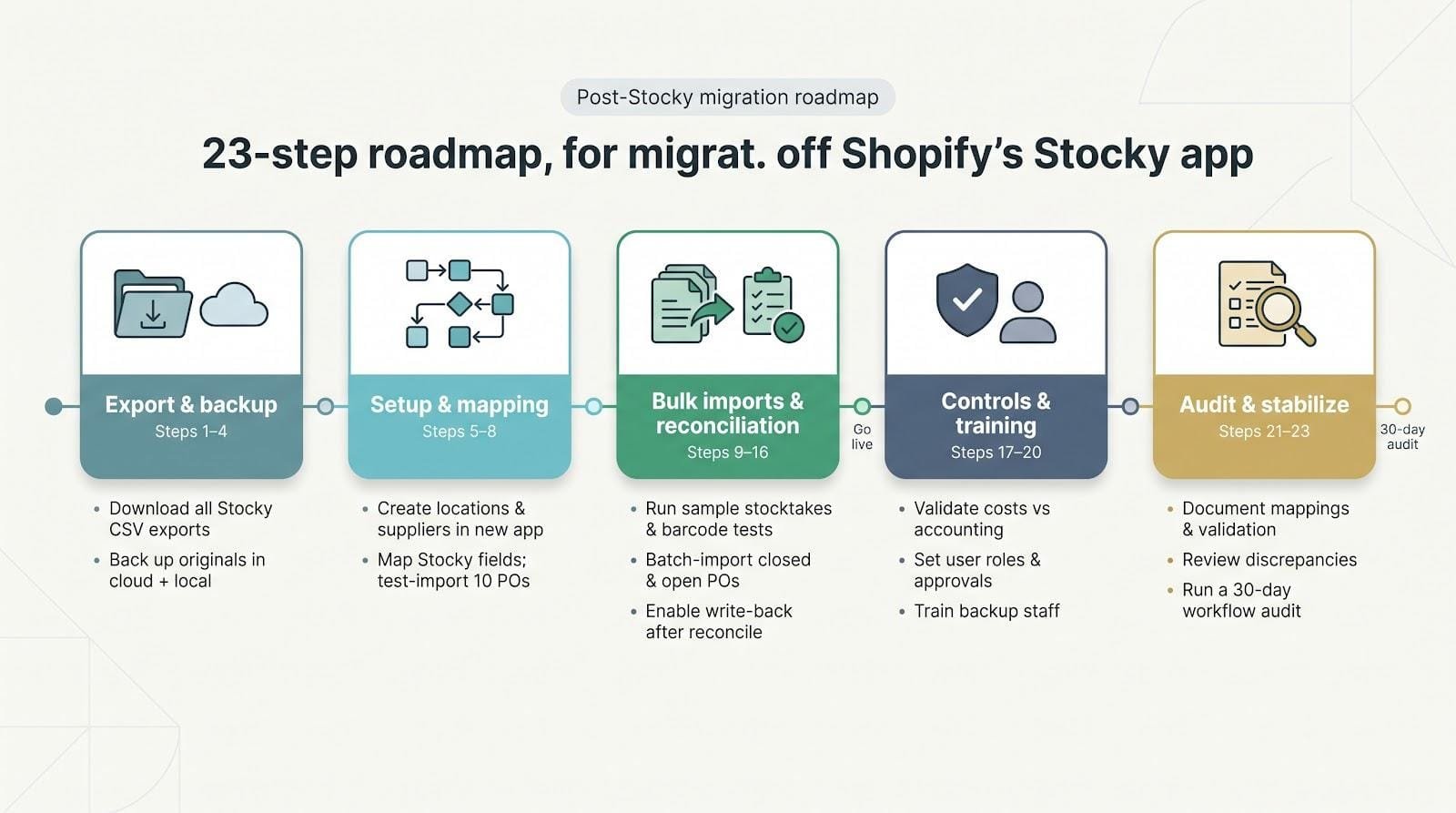
- Download every Stocky export: closed POs, open POs, stocktakes, adjustments, cost history.
- Back up the files in two locations (cloud and local); keep originals untouched.
- Export a fresh product and inventory CSV from Shopify to serve as the item master.
- Build a supplier sheet (contacts, addresses, terms, lead times, MOQs) from invoices or screenshots.
- Create locations and suppliers in the new app.
- Map every Stocky field to a destination; record any field you must drop.
- Test-import ten closed POs; verify date, SKU, ordered and received quantity, and unit cost.
- Import one open PO and part-receive it; check location and status.
- Run a sample stocktake on twenty SKUs; reconcile against Shopify on-hand counts.
- Print and scan barcode or price labels to confirm end-to-end accuracy.
- Batch-import the remaining closed POs, validating totals after each upload.
- Load the rest of the open POs; match outstanding quantities.
- Import historical adjustments and reasons (if supported).
- Enable write-back to Shopify only when quantities reconcile fully.
- Receive one live delivery; confirm costs, taxes and landed-cost allocation.
- Transfer stock between two locations; inspect committed, in-transit and available counts.
- Spot-check weighted-average or FIFO costs against accounting software.
- Assign user roles and approvals to block rogue edits.
- Train a backup staffer to complete a PO receipt and a cycle count.
- Archive or uninstall Stocky to avoid accidental edits.
- Document every mapping and validation step for auditors.
- Review discrepancies after seven days; fix root causes, not just numbers.
- Schedule a thirty-day audit to ensure the workflow sticks.
Frequently asked questions
Is Stocky really gone for good?
Yes. Shopify disabled Stocky write access on August 31, 2026. A read-only export link remains for now, but you cannot create new POs or extend the app.
Can Shopify import my old purchase orders?
Its CSV uploader only makes new draft POs. Received quantities, statuses and supplier links are lost. Use an app with a documented historical-import workflow if those fields matter.
Which app has the best post-shutdown import record?
As of September 21, 2026 we see merchant-reviewed imports from Prediko and Stockroom, and vendor-documented importers from Organizely, Sumtracker and Stockie.
Do I pay extra for barcode receiving?
No in Stockroom, where scanning is free. In Stockie, receiving and scanning sit on the Pro Plus tier at US $59.99 per month. Prediko and Sumtracker rely on Shopify’s built-in scanner unless you add a WMS.
What’s the lowest monthly price that still handles POs?
Stockroom: Free
Organizely Stocky Plan: US $13 per month
Always check the App Store on install day, because free tiers can disappear.
Which tool suits manufacturers?
Katana. It supports multi-level BOMs, work orders and component back-flush while syncing with Shopify orders in real time.
How long should I store Stocky CSV exports?
Indefinitely. Treat them like financial records and keep unedited originals plus your mapping notes in two secure locations.
Does AI forecasting guarantee fewer stock-outs?
No. AI speeds calculations but still relies on clean history, accurate lead times and human review.
Can I mix native Shopify POs with an external app?
Yes, but choose a single source of truth for on-hand quantities or you risk double-receiving and cost overwrites.
What happens if I miss the read-only window?
You will lose direct Stocky access. Recovery then means mining PDFs, emails or accounting data, a costly exercise. Export today.
Conclusion
Stocky’s retirement leaves a gap, but it also opens the door to tools that do more than keep the lights on. Choose the replacement that maps cleanly to your workflow, import your history before it disappears and you will step into 2027 with stronger purchasing controls than ever.