
How Translation Errors Turn Global Opportunities Into Lost Revenue
Every leader who has taken a business, a brand, or an idea across a border has felt a particular kind of doubt. It arrives right after you send the translated contract, the press release, or the pitch deck: a quiet uncertainty about whether the words actually said what you meant them to say. You cannot read the language yourself. You are trusting a process you cannot see.
In 2009, one of the most sophisticated marketing organizations in the world learned exactly how expensive that doubt can be. HSBC had spent years building its “Assume Nothing” campaign into a confident, globally recognized message about financial open-mindedness. When the tagline moved into new markets, it did not travel intact. In several countries, it read closer to “Do Nothing,” the exact opposite of the message the bank had built its brand around. Trade press covering the fallout at the time put the cost of the resulting rebrand at roughly $10 million, a bill for a mistake nobody caught before it went live.
HSBC is the famous example, but it is not the unusual one. Research from CSA Research has found that 57 percent of online shoppers abandon a purchase outright when they cannot understand a website’s language, and that as many as three-quarters of consumers prefer to buy only from sites written in their own language. On the other side of that same coin, Unbabel’s Global Multilingual CX Report found that companies that actively communicate with customers in their own language are 2.67 times more likely to report increased revenue. Put those two findings side by side and the picture is clear: the outcome of a global expansion is not decided by whether a company translates its message. It is decided by whether that translation is accurate enough to be trusted.
That is the part leadership teams tend to underestimate. There is substantial research on how translation affects international business, and nearly all of it points to the same conclusion: language is not a formality bolted onto an international strategy. It is one of the variables that decides whether the strategy works at all.
Where the risk actually lives today
Most global organizations no longer rely purely on human translators for their day-to-day multilingual output. Artificial intelligence now handles a large share of that volume, and for good reason: it is fast, inexpensive, and, for straightforward content, often good enough. But speed and cost were never the source of leadership’s original worry about translation. Accuracy was. And a single AI model, however capable, has a structural weak point that most executives never see: it fails silently. It does not flag its own mistakes. If the tone is wrong, or a date is misrendered, or a term of address is off, the output still looks polished. Nothing about it announces the error.
An internal test run by Tomedes, a professional translation company, put that weak point on display. The same set of complex, multilingual legal contracts was translated by three separate leading AI models, each working independently with no cross-checking. Each model failed, but in a different place. One model showed a 12 percent error rate handling honorifics in Asian-language clauses. A second hallucinated numerical dates when rendering Romance-language sections, inventing figures rather than translating them. A third missed the formal register required for German corporate filings entirely, a subtle failure that would be invisible to anyone who does not read German fluently.
“The mistake most leadership teams make is assuming an AI error would look like an error,” says Ofer Tirosh, the company’s CEO. “It doesn’t. It looks like a finished sentence. The only way to catch a mistake that confident is to stop trusting any single source and start checking it against others, the same way you would with any decision that carries real consequences.”
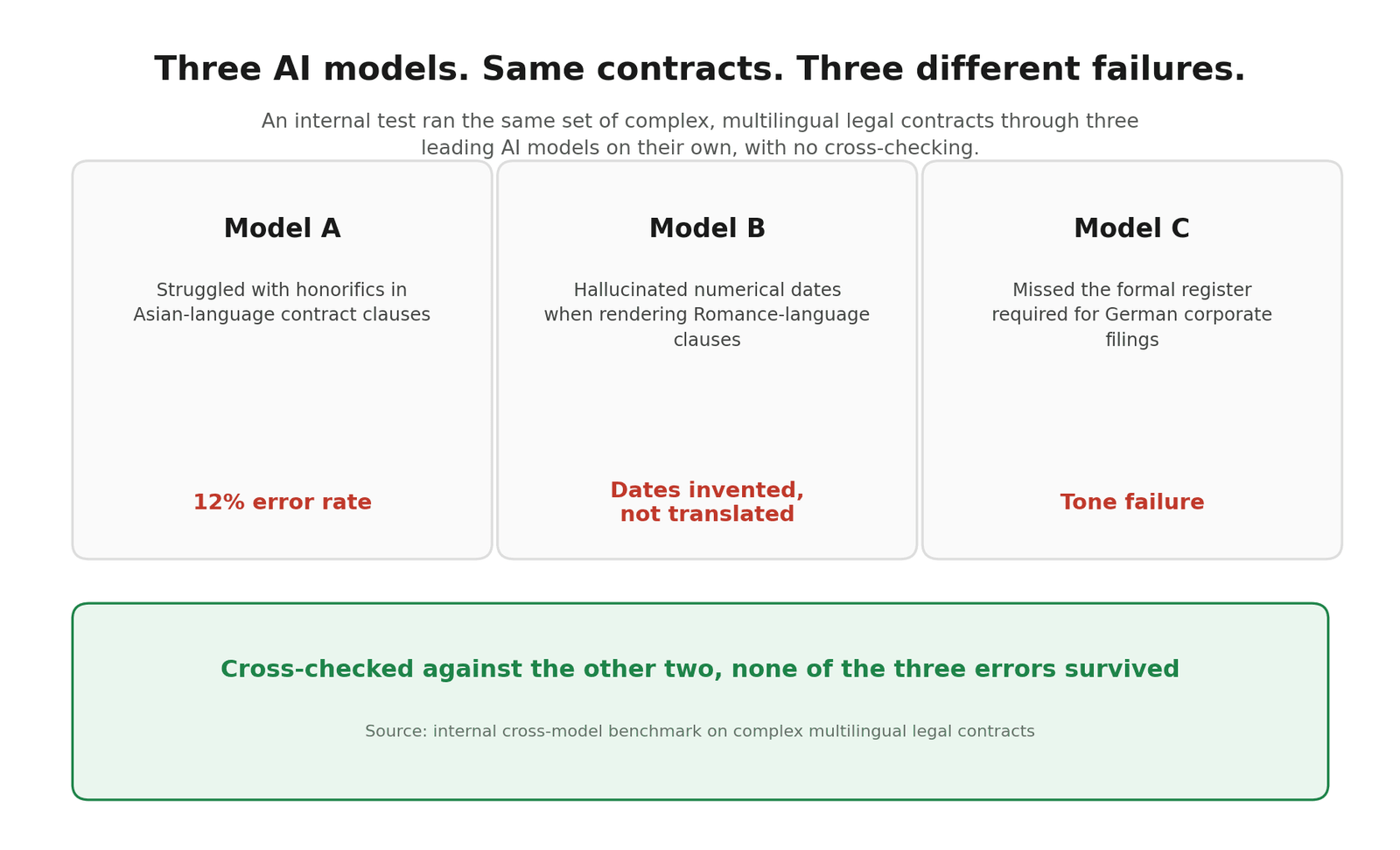
No single one of those models would have told its user something was wrong. Each output would have gone out looking finished. The only reason the errors surfaced at all was that they were compared against each other. As Rachelle Garcia, the AI lead who oversaw the test, put it when describing why cross-model comparison changes the outcome: “When you see independent AI systems lining up behind the same segments, you get one outcome that’s genuinely dependable. It turns the old routine of ‘compare every candidate output manually’ into simply ‘scan what actually matters.’”
What this means for leaders, not just linguists
Translation quality has typically been treated as an operational detail, something delegated to a vendor, a plugin, or whichever AI tool is already open in a browser tab. The HSBC case, and the quieter version of it that plays out inside contracts, product listings, and investor communications every day, argues for a different framing. Translation accuracy is a business risk decision, and it belongs in the same category of judgment leaders already apply to financial controls or data security: not something you personally execute, but something you make sure has a real check built in before consequences reach a client, a regulator, or a market.
The practical shift already underway across careful global organizations is straightforward. Instead of trusting the first fluent-looking output from a single AI system, teams are increasingly running high-stakes content through a verification layer, cross-checking multiple models against each other, or adding a qualified human reviewer for anything that carries legal, financial, or reputational weight. None of this slows an organization down in any way that matters. It simply moves the moment of doubt from after the message has already reached the client to before it ever leaves the building.
The real cost of being misunderstood
A mistranslated tagline is memorable because it is public and quantifiable: a rebrand with a dollar figure attached. Most translation failures are neither. They are a contract clause a partner interprets differently than intended, a compliance filing that reads as vague to a regulator, a customer support reply that lands as cold rather than reassuring. These do not make headlines. They show up later, as a deal that stalls, a relationship that cools, or a market entry that never quite takes off, and by then it is difficult to trace the cause back to a single mistranslated line.
Global ambition has never been the hard part for most leadership teams. Communicating that ambition accurately, at scale, across languages the leadership team cannot personally verify, is the harder and less visible discipline. The organizations that treat translation accuracy as a leadership priority rather than an afterthought are the ones whose global opportunities actually convert into revenue, rather than becoming the next quietly expensive lesson in what happens when nobody caught the error in time.