

Recruiting teams are under pressure that isn’t going away. Roles stay open longer, candidate pipelines are harder to fill. And the administrative load like screening, scheduling, and communicating keeps growing while headcount doesn’t.
The average time to hire is now 52 days. In a market where the best candidates are off the table in days, that gap is costly.
AI adoption in recruiting has jumped from 26% to 43% of organizations in a single year, according to SHRM. Some of this is hype. But a lot is driven by teams that ran the numbers and realized the status quo was more expensive than the alternative — and the results are starting to show. Surveys of recruiters using AI screening tools suggest that the time-to-hire can drop from 52 to 14 days and cost per hire can fall by 23%.
This article breaks down the five areas where AI delivers the clearest ROI in recruiting, from sourcing to bias reduction, along with data and an action plan for each:
- AI tools used in talent acquisition
- HR areas where the AI business case is strongest
- Candidate sourcing
- AI interview agents
- Resume screening
- Interview scheduling
- Bias reduction
Types of AI tools used in talent acquisition
| Tool type | Description |
| Resume screening and parsing | Scans applications against predefined criteria — skills, experience, keywords — and ranks or filters candidates automatically |
| AI-powered sourcing | Proactively searches LinkedIn, GitHub, Stack Overflow and other platforms to identify passive candidates who match role criteria |
| Conversational AI and chatbots | Handles early-stage candidate engagement: answering role questions, collecting information, scheduling interviews |
| AI interview agents | Conducts screening interviews autonomously — asking role-specific questions, adapting follow-ups in real time, delivering a structured scoring report |
| Skills assessment platforms | Presents candidates with technical or cognitive challenges — coding tests, logic problems, situational judgment — and scores results automatically |
| Predictive analytics tools | Uses historical hiring data to model which candidate profiles correlate with strong performance in similar roles |
| Candidate engagement and CRM | Manages talent pipelines over time — tracking warm candidates, automating follow-ups, flagging previously rejected candidates for new openings |
| Interview intelligence platforms | Records and transcribes live interviews, surfaces structured summaries, and helps interviewers compare candidates on consistent criteria |
In practice, most organizations combine two or three of these across different funnel stages rather than relying on a single tool.
5 areas where the business case for AI in talent acquisition is strongest
1. Candidate sourcing
Benefit: no waiting for applications
Most recruiting teams are reactive: if a role opens, a post goes live, and they simply wait. The problem is, though, that strong candidates often aren’t browsing job boards. AI sourcing tools proactively scan LinkedIn, GitHub, and similar platforms to build a longlist of matching passive candidates before anyone has applied.
According to LinkedIn’s 2025 report, companies using AI-assisted outreach are 9% more likely to make a quality hire. While that figure sounds modest, it compounds across every role you fill in a year—and over half of talent acquisition professionals believe the technology can help:
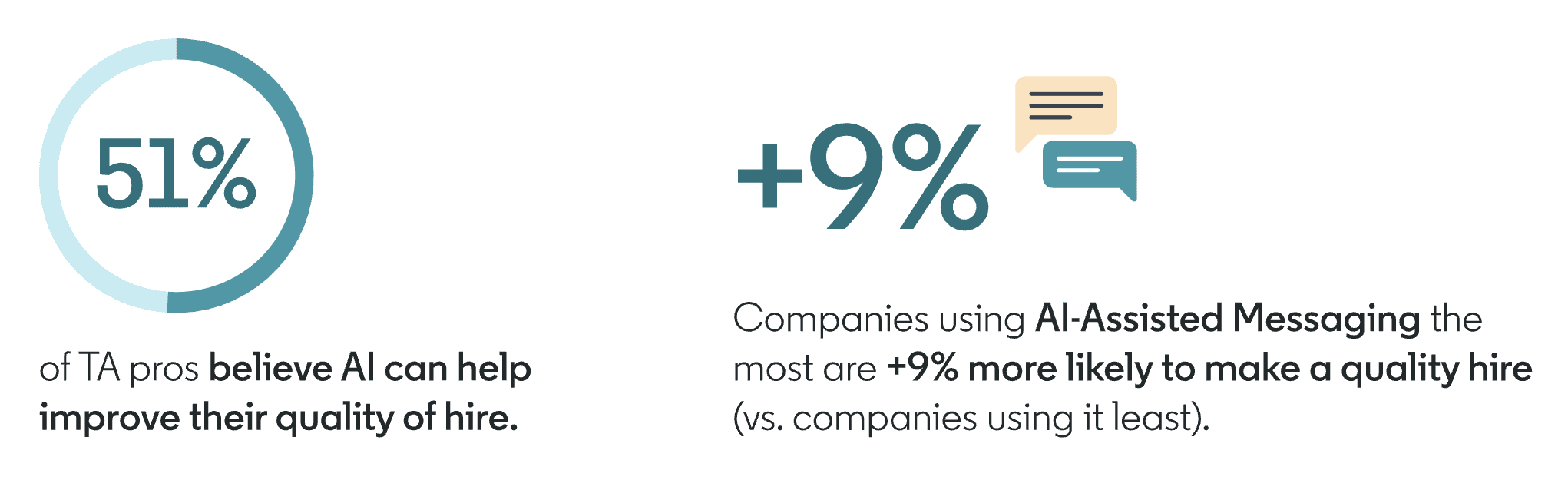
AI’s potential to improve their ability to source and hire the best candidates. Source: Linkedin
Where to start:
- Pull your last 5-10 hires and tag each by source (inbound application, referral, recruiter outreach, agency, etc). If fewer than 3 came from proactive outreach, you may have a sourcing gap worth fixing
- Pick one role that’s been open more than 30 days and run an AI sourcing tool on it for two weeks — tools like LinkedIn Recruiter’s AI recommendations or Fetcher are reasonable starting points
- Compare the AI-generated list against whoever applied organically: look at seniority match, years of relevant experience, and how many you’d actually shortlist
| Related: |
2. AI interview agents
Benefit: structured screening at scale
Phone screens are time-consuming and inconsistent. Outcomes vary based on who runs the call, what questions they ask, and how they’re feeling that day. Two candidates with identical qualifications can walk away with completely different assessments.
The cost adds up fast. Hiring a single software engineer takes approximately 38 hours of engineering team time — and that’s an optimistic estimate. With senior software engineers averaging $62/hour, that’s roughly $2,350 in engineering time per hire, before you’ve even made an offer. Multiply that across multiple open roles and it becomes a significant drain on your most expensive headcount.
AI interview agents conduct structured first-round interviews autonomously. Tools like Genia ask role-specific questions, adapt follow-ups in real time, and deliver a scored report hiring managers can actually compare. Every candidate gets the same interview. 74% of hiring managers say AI can help assess whether applicant skills match the position and recruiter time shifts to the stages where relationships and judgment matter.
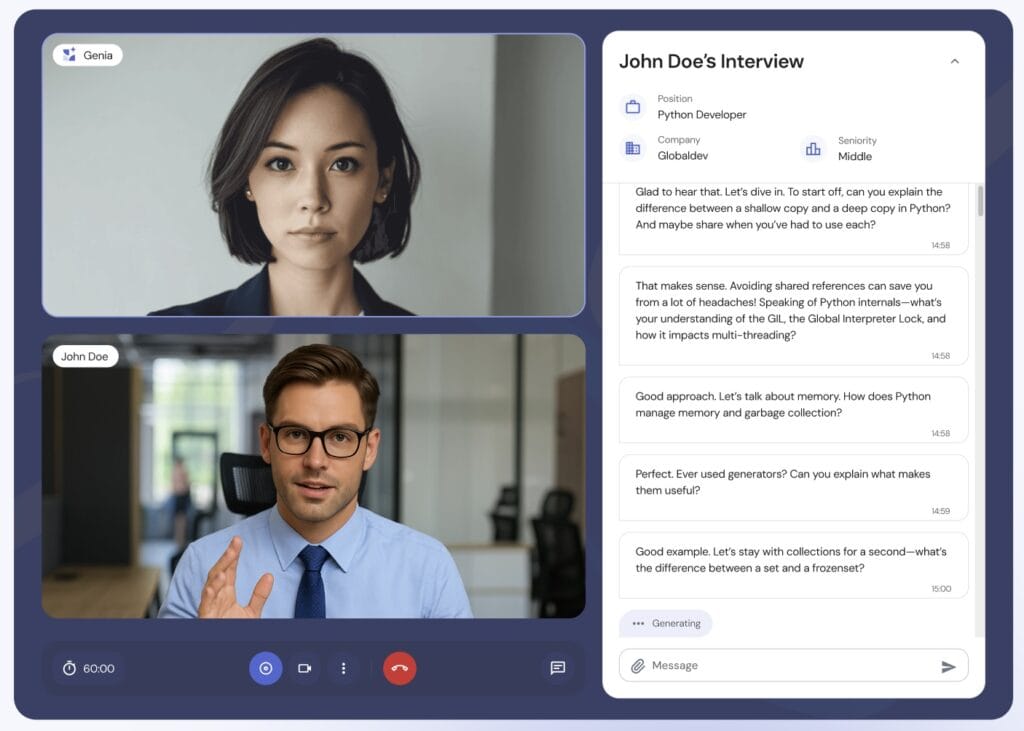
AI interviewing avatar. Source: Genia
Where to start:
- Pick the role where you run the most first-round screens per hire — that’s your highest-leverage starting point
- Define 4–6 screening questions that reflect what actually matters in that role, not generic competency questions. The AI interview is only as good as the brief you give it
- Run it in parallel with your normal process for one cohort: send half to AI screening, half to a recruiter screen, then compare how each group performed in hiring manager interviews
| Related: The Science of Hiring: Unveiling the Power of Talent Assessment Software |
3. Resume screening
Benefit: Faster resume evaluation regardless of volume
Reviewing 200 applications at two minutes each is about 7 hours of work, even for one role. Across a full requisition list, the hours don’t exist.
AI screening works by parsing each resume against a structured set of criteria you define upfront (like specific qualifications) and ranking or filtering candidates based on how closely they match.
What used to take 10–13 hours manually gets done in 15–20 minutes. That’s not an incremental improvement but a different category of speed. The result is a ranked shortlist, ready for review, while the rest of the pile is already filtered out.
Beyond speed, the consistency matters: a recruiter on resume 180 isn’t doing the same job as on resume 10; and AI doesn’t have that problem.
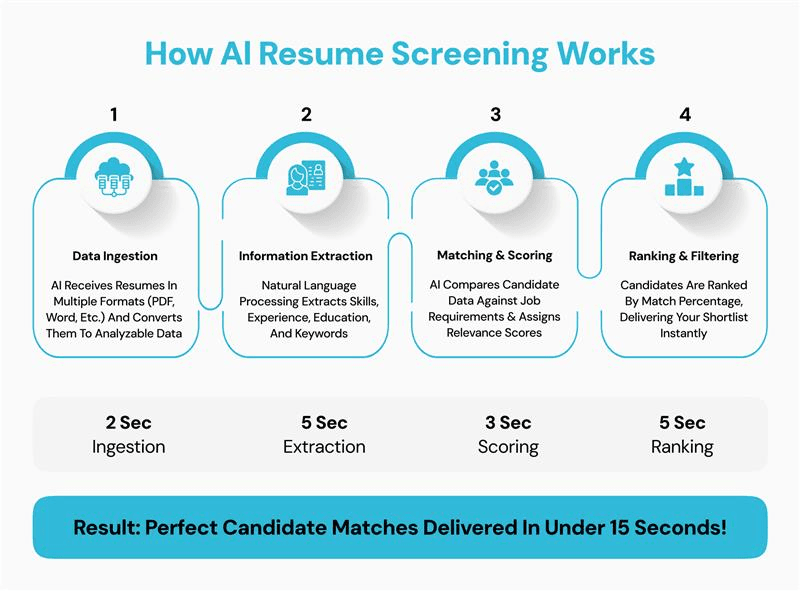
Where to start:
- Audit your current screening criteria: separate filters that predict job performance from those that are just credential proxies
- Build AI screening around performance predictors only
- Review your first shortlist carefully; adjust criteria based on what hiring managers push back on
4. Interview scheduling
Benefit: automated scheduling that prevents top candidates from forming commitments elsewhere
Every additional day a role stays open costs hundreds in compounding cost-per-hire, and scheduling delays routinely add days to a process already averaging tens of days to fill.
Over 40% of candidates dropped out of the hiring process because scheduling interviews took too long. The best candidates aren’t waiting around and could be off the market as quick as 10 days. By removing the 24–48 hour email back-and-forth, AI scheduling keeps momentum high when candidate interest is at its peak.
The time saved goes directly into work that requires a human: building relationships, evaluating cultural fit, and closing strong candidates on the offer.
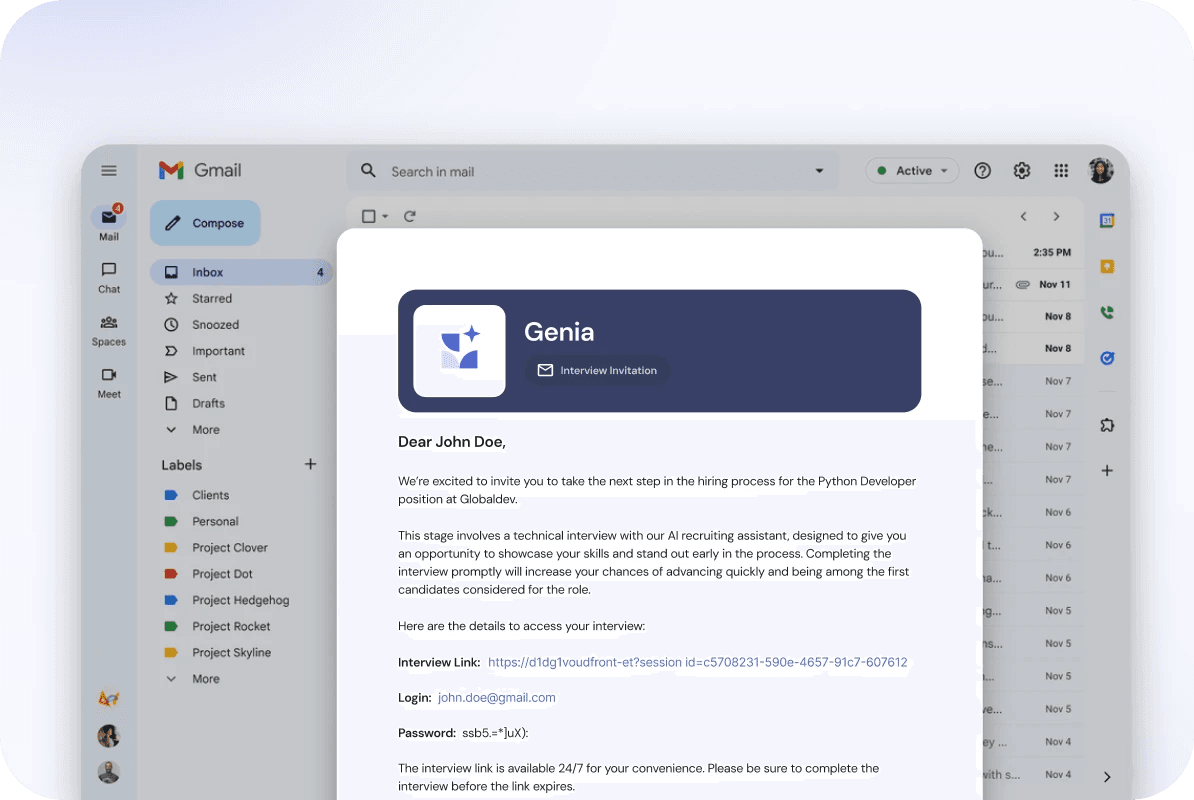
Source: Genia
Where to start:
- Calculate how many hours per week your team spends on scheduling coordination
- Cost that time against available automation tools — for most teams the ROI case closes in the first month
- Start here before tackling AI implementations
5. Bias reduction
Benefit: minimize bias in hiring
Bias in hiring is a quality problem as much as a fairness one. Decisions influenced by factors unrelated to job performance produce worse hires. And as regulatory scrutiny increases — in the EU, New York City, and elsewhere — the legal exposure is growing.
AI doesn’t eliminate bias, but it removes the inconsistency that amplifies it. About 43% of organizations using AI in recruiting cite bias reduction as a direct benefit. If screening criteria already encode bias, AI will apply them at scale.
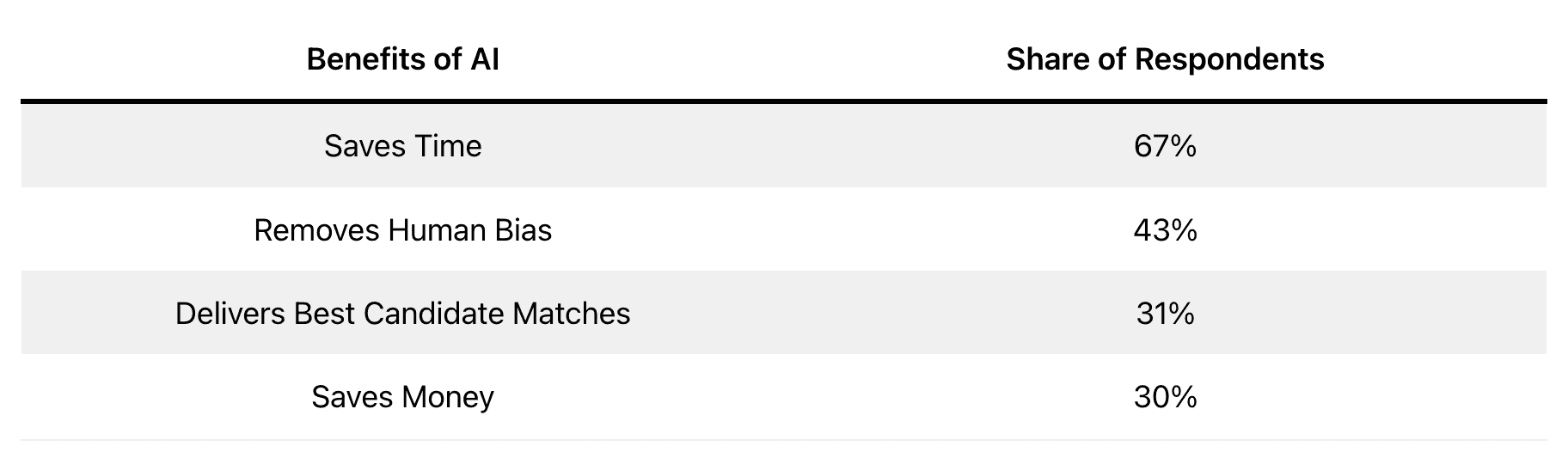
Source: demandsage
Where to start:
- For each screening filter, ask: does this predict job performance, or does it predict similarity to past hires?
- Remove filters that fail that test before configuring any AI tool
- Schedule quarterly reviews to catch drift in how criteria are being applied
The bottom line
AI adoption in HR nearly doubled in a single year. That’s not a gradual shift; it’s recruiting teams realizing the gap between manual processes and what competitors are doing with AI is already costing them candidates, time, and money.
The math is hard to ignore. The average recruiter spends 52% of their time on administrative work and only 28% on actual recruiting. That ratio is backwards. And the teams fixing it are seeing real results: time-to-hire drops from 52 to 14 days, cost per hire falls by 23%, and 56% of teams save 10+ hours a week on screening alone.
AI doesn’t replace recruiters. It removes the work that was never a good use of their time in the first place — so they can spend it on the decisions, relationships, and judgment calls that actually determine who you hire.
The question isn’t whether AI belongs in talent acquisition. It’s how long it makes sense to wait.