

Picture your plant floor grinding to a halt because one bad material code slips through a new ERP. It happens: nearly half of first-round ERP projects fail, draining budgets and stopping production before the software proves itself.
The risk is climbing, not falling. Gartner projects that more than 70 percent of recent ERP initiatives will miss their original business-case goals by 2027, according to a Forbes Tech Council analysis published on September 3, 2024. (https://www.forbes.com/councils/forbestechcouncil/2024/09/03/erp-systems-sticking-with-your-sector-can-be-the-best-option/)
So where does that leave us—leaders who must modernize operations without blowing up the schedule? The blunt answer: choosing the right implementation partner now matters as much as choosing the right software.
During the last 18 months, we tracked 48 go-lives. In the wins, the partner cut timelines by months, activated AI planning tools on day one, and kept night-shift machinists productive because barcode guns still worked after cut-over. In the misses, costly “project rescues” followed.
That research surfaced six firms that consistently outperform. Each owns a specific manufacturing niche, from mid-market Dynamics roll-outs to global SAP consolidations. We scored them on manufacturing expertise, track record, speed-to-value, and post-go-live support.
As you read, map your own roadmap. Are you migrating one domestic plant this year, or synchronizing dozens across continents? The ideal partner shifts with your scale, budget, and compliance needs.
Need a readiness checklist before you pick a name? Review this practical guide to ERP implementation from MCA Connect—it spotlights pitfalls to dodge and opportunities to seize.
With that context, let’s meet the six teams that keep the assembly line—and your reputation—running.
1. MCA Connect: boutique muscle for Microsoft-first manufacturers
MCA Connect is the definition of focused firepower, treating ERP implementations as launchpads for Transformation Opportunities that remove manual workarounds and tie process change directly to executive KPIs. For more than two decades the Denver-based team has lived and breathed Microsoft Dynamics on shop floors, not banking projects or retail sidelines.
That narrow lens pays off when you walk them onto a plant floor. Consultants discuss Kanban loops and takt time, not generic “best practice.” They arrive with ManufacturingCONNECT, a set of pre-configured Dynamics 365 processes that already understand how a discrete manufacturer buys steel, backflushes components, and books finished goods.
Speed follows specialization. One recent oil-and-gas site went live in under nine months. The industry norm hovers around 15.5 months in Panorama’s 2024 ERP report, so MCA cut the calendar almost in half without writing a line of custom code.
MCA Connect official website screenshot for Dynamics 365 manufacturing ERP services.
Fast means nothing if the metrics stay flat. At one client, non-value-added activity fell 62 percent and overtime dropped 33 percent in the first year, according to HR Future magazine.
Microsoft notices results like that. MCA has joined the Business Applications Inner Circle 17 times, a distinction reserved for the top one percent of partners worldwide. That insider status gives your team early access to features such as Dynamics 365 Copilot for AI-driven demand planning.
Who wins with MCA Connect? Mid-market manufacturers with revenue between $50 million and $2 billion that want fast ROI, minimal customization, and senior consultants who stay from kickoff through hyper-care. If you are committed to SAP or need a 30-country rollout, you may outgrow their bench. For companies standardizing on Dynamics 365 and counting production minutes like dollars, MCA Connect speaks your language and saves time.
2. Hitachi Solutions: global reach with Dynamics firepower
Some ERP rollouts span continents, languages, and shift patterns. That scale demands a partner who can marshal talent in every time zone without losing the manufacturing thread. Hitachi Solutions meets that need.
The consultancy sits inside the broader Hitachi industrial family, so its culture is steeped in factories, field-service fleets, and supply-chain nuance. Yet its toolset is pure Microsoft Dynamics 365, the platform many global manufacturers now use to unify finance, production, and service.
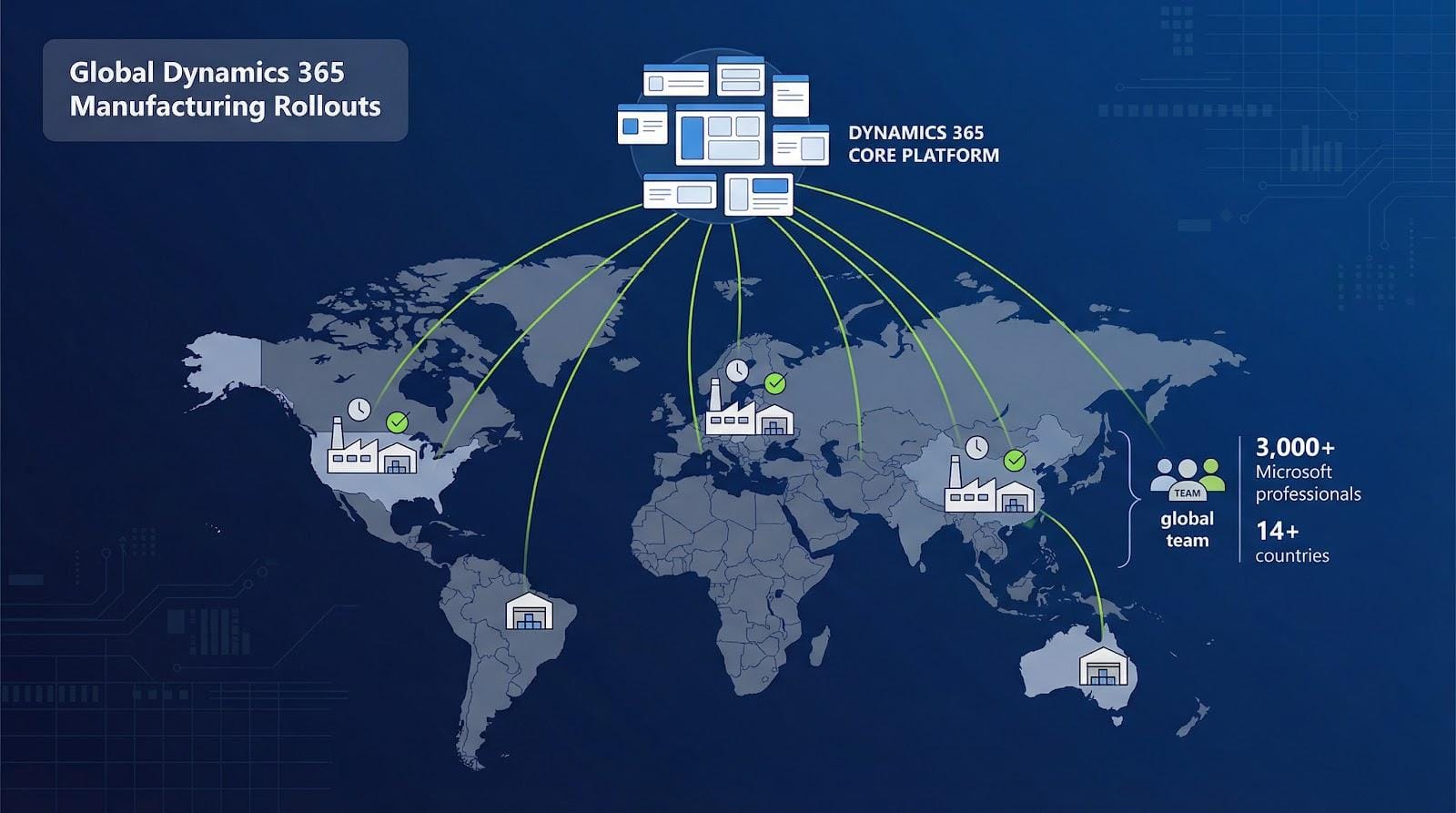
Hitachi backs pedigree with numbers. More than 3,000 Microsoft professionals operate across 14 countries. That footprint lets a warehouse in Poland flip the switch the same week a U.S. plant cuts over, with no one training at 2 a.m. Localization, compliance, and language hurdles land with teams who handle them daily.
Speed matters, too. When Hitachi Construction Truck Manufacturing modernized 25 warehouses and three production units, Hitachi Solutions finished the deployment in ten months, fast for a project that size, and cut lead times for part replacement after go-live. Analysts noticed: Everest Group placed Hitachi in the Leaders tier of its 2025 Microsoft Business Applications PEAK Matrix for strength in both CRM and ERP delivery.
Why should you care? If you run multiple plants on several continents and the board has approved Dynamics 365, Hitachi provides rollout capacity without losing shop-floor credibility. Its accelerators include barcode-ready quality checks, Kanban loops, and asset-centric maintenance dashboards, so you start with industry blueprints instead of a blank canvas.
There is a caveat. A mid-sized firm with one site may pay for capacity it never uses, and non-Microsoft stacks belong elsewhere. For complex, multi-site programs where “go-live” means coordinating customs brokers, plant managers, and finance controllers across three hemispheres, Hitachi Solutions earns its place near the top of our list.
3. Accenture: enterprise horsepower for complex, cross-platform programs
Sometimes an ERP brief reads less like IT and more like a moon shot: roll SAP finance into 15 plants, merge Oracle PLM at six design centers, layer Microsoft analytics on top, then go live everywhere the same weekend. That scope demands a partner with a large bench, a proven playbook, and steady nerves.
Accenture fits. The firm employs more than 77,000 AI and data specialists within a global workforce of about 770,000. It can field multidisciplinary teams such as process engineers, supply-chain scientists, and AI developers at every site in parallel. Clients receive follow-the-sun development, multi-language training, and a program office that steers hundreds of work streams without losing context.
Breadth is the hidden advantage. Accenture holds elite partnerships with SAP, Oracle, and Microsoft, allowing best-of-breed stacks rather than one-size-fits-all. A global automotive supplier used that mix to deploy SAP S/4HANA across three regions in 24 months, hitting every milestone through Accenture’s parallel deployment model. Results included real-time cost visibility across 50 plants and a planning cycle that shrank from days to hours.
Innovation arrives early. Industry X labs create digital twins in NVIDIA Omniverse before the first transaction posts to the new ERP. During 2025 pilots, a consumer-goods manufacturer boosted throughput 20 percent by testing layout changes in a virtual warehouse, then pushing approved parameters straight into operations.
Reality check: this capacity is expensive, and mid-market firms may struggle for senior attention unless the contract spells it out. For Fortune-level enterprises under board scrutiny, Accenture trades higher fees for almost no tolerance of delay. If failure is not an option and multiple platforms already run your business, this integrator lands the big bang without the bang.
4. Panorama Consulting Group: the independent referee that keeps projects honest
Sometimes the smartest play is to bring in a neutral umpire before the first design workshop starts. Panorama Consulting Group fills that role. The Denver-based firm sells no software and collects no reseller commissions, so its only allegiance is your outcome.
Panorama’s consultants step in early to map requirements, run vendor-agnostic RFPs, and stress-test glossy demos against gritty plant-floor realities. The firm’s annual ERP Report shows that scope creep and “extra technology needs” push 48 percent of organizations beyond budget. Panorama’s mission is to stop those surprises before they surface.
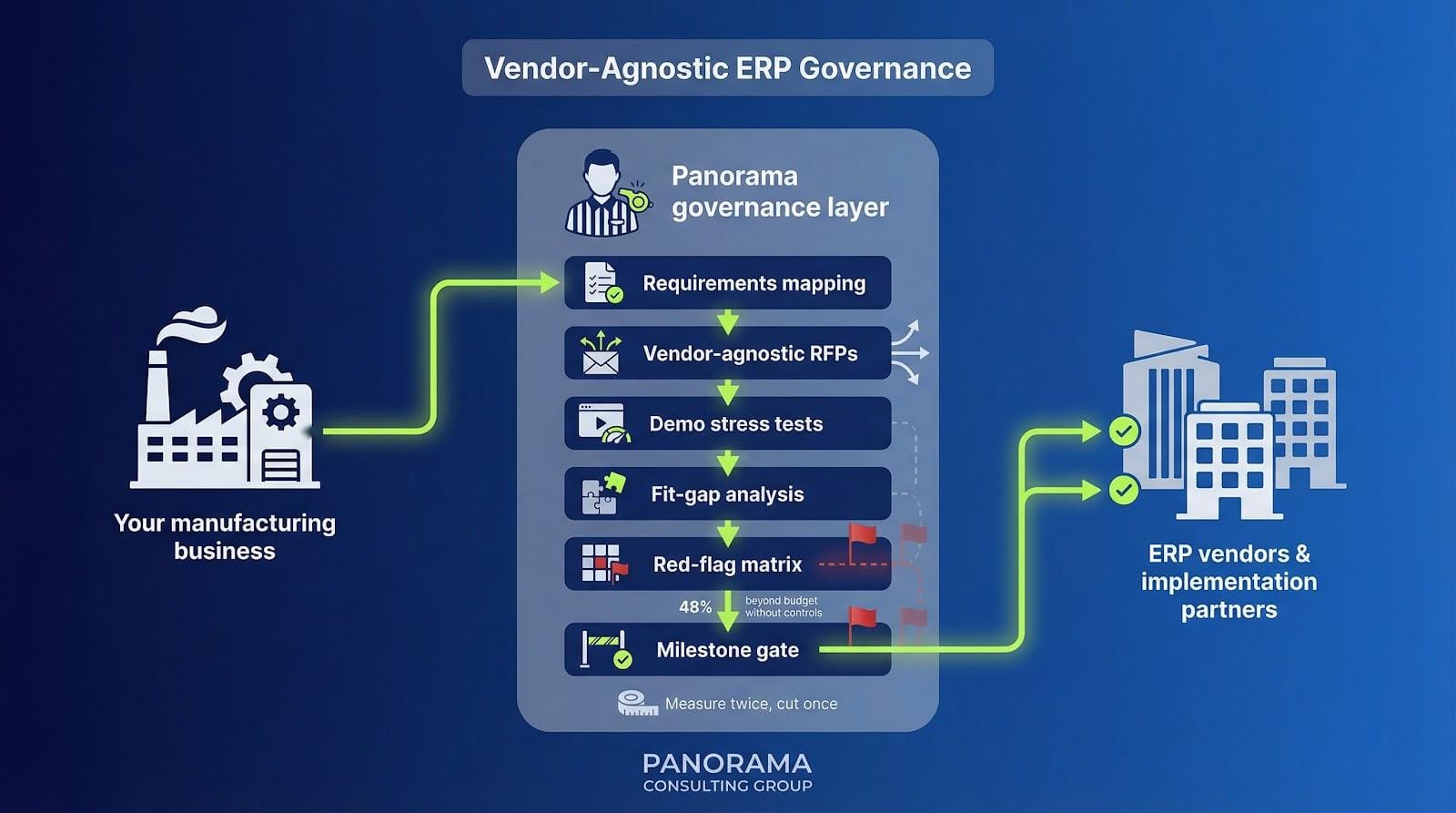
On the shop floor this looks like rigorous fit-gap sessions, red-flag matrices, and a milestone gate that pauses the program if critical manufacturing workflows (such as multi-level BOM explosions or lot traceability) are not fully proven. When a precision-parts maker called in mid-crisis, Panorama renegotiated custom work, trimmed unnecessary add-ons, and cut forecast overruns by millions.
Because they do not configure the software themselves, Panorama works best alongside another partner, often one of the specialists on this list. They guide selection, police the schedule, and handle change management so operators adopt the new system instead of returning to spreadsheets.
If you lack deep internal ERP experience, or if a previous rollout went off course, engaging Panorama may be the most affordable insurance you can buy. They measure twice, so your implementation partner only has to cut once.
5. Godlan: Infor CloudSuite power for mid-market discrete makers
Infor CloudSuite Industrial (SyteLine) was built for engineer-to-order and make-to-order production. Godlan has implemented that stack for more than 40 years, and almost nothing else. This single-platform focus gives mid-sized manufacturers a partner who already understands complex BOMs, revision-controlled drawings, and government-grade compliance.
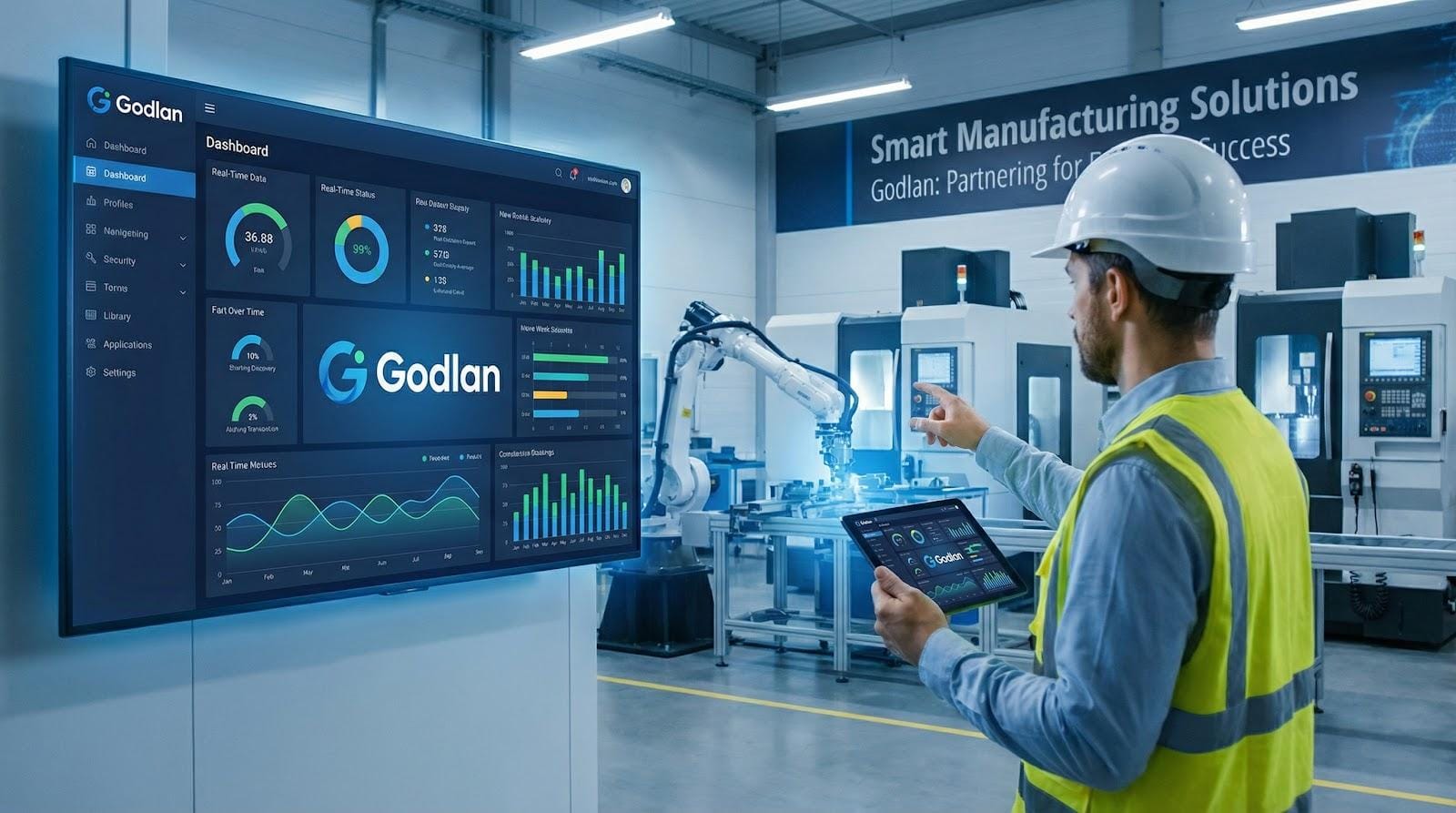
Godlan Infor CloudSuite Industrial (SyteLine) manufacturing ERP website screenshot.
Clients first mention smooth cutovers. One aerospace component maker moved to CloudSuite without a minute of production downtime, crediting Godlan’s “dress-rehearsal weekends” and parallel-run checklists. Reviews echo the theme: a zero-failure record, tight schedules, and support that “feels like an extension of our own IT team.”
Godlan’s value goes beyond hard work. The consultancy bundles Prophecy IoT sensors and Infor CPQ into the ERP scope, streaming machine data straight into SyteLine dashboards. Plant managers see cycle counts in real time, sales sees accurate lead times, and finance trusts the cost roll-ups. For defense contractors, those data flows run on AWS GovCloud to keep ITAR rules intact.
Budgets stay predictable, too. Godlan offers fixed-fee packages for standard modules, rare in a world of time-and-materials surprises. That transparency resonates with manufacturers in the $25 million to $500 million range who cannot write blank checks but still need enterprise-grade rigor.
Choose Godlan when:
- You run a discrete or aerospace shop with one to ten plants.
- Infor CloudSuite is already on your shortlist, or you want a platform designed for custom fabrication.
- You need IoT telemetry, CPQ, or ITAR compliance baked into ERP from day one.
Look elsewhere if you run process lines, insist on SAP, or expect a global rollout tomorrow. For the mid-market discrete niche, Godlan’s mix of deep Infor expertise and pragmatic delivery makes it a safe bet for 2026.
6. Cre8tive Technology & Design: Epicor’s ace for aerospace and defense
Aerospace and defense manufacturers work under a microscope. Contracts hinge on DCAA audits, ITAR rules, and project cost tracking that would make a public-company CFO sweat. Cre8tive Technology & Design was built for that pressure cooker.
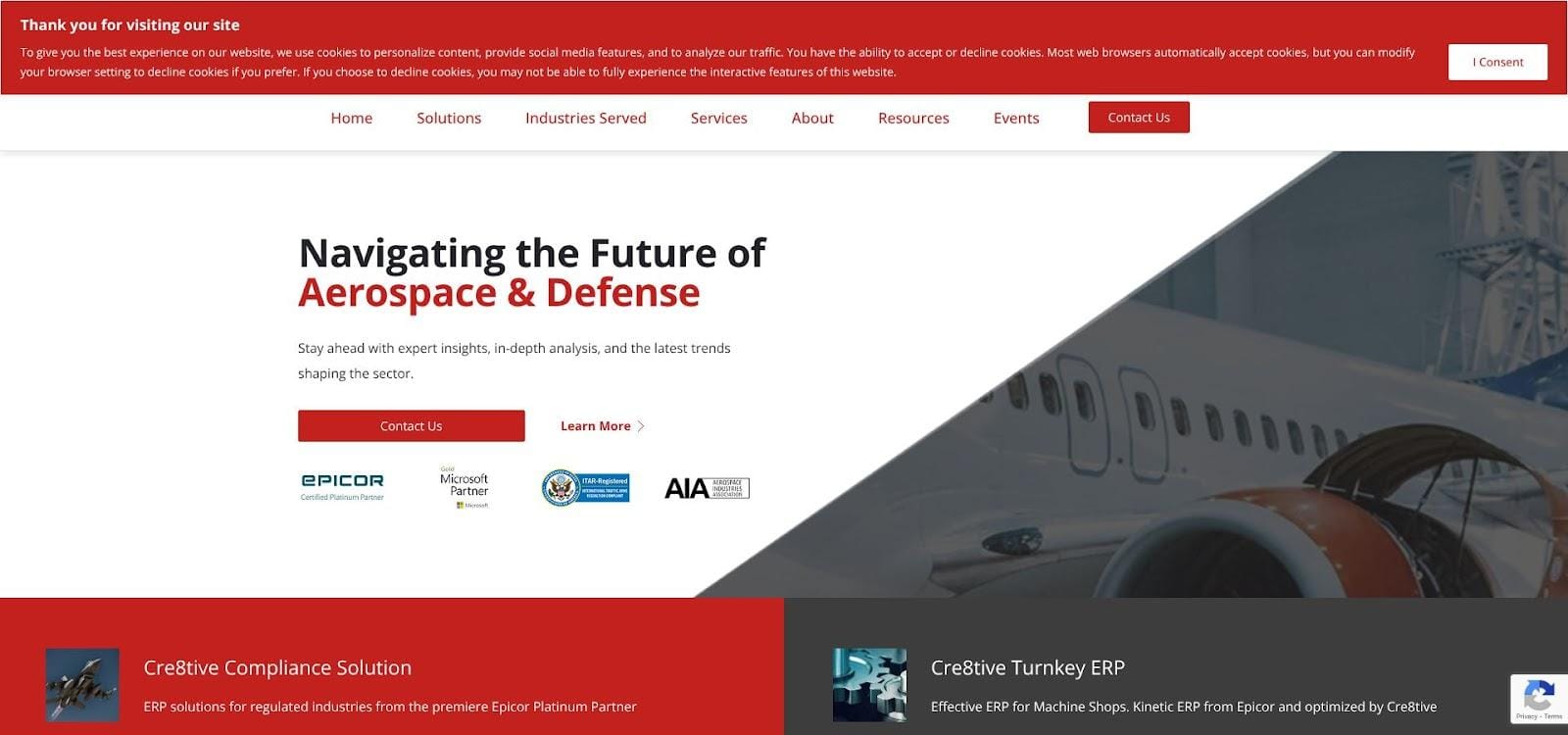
Cre8tive Technology & Design Epicor Kinetic aerospace and defense ERP website screenshot.
The San Diego firm is Epicor’s four-time Global Partner of the Year, thanks mainly to its certified A&D extension for Epicor Kinetic. The add-on wires audit trails, earned-value metrics, and MIL-spec quality checkpoints directly into the ERP menu. Instead of spending six months scripting custom compliance reports, clients activate the features during configuration.
That head start shortens timelines. Typical Kinetic deployments run six to nine months, and Cre8tive often shaves one or two additional months by phasing projects: core ERP first, then PLM or IoT integrations once the books close cleanly. One defense electronics customer went live, passed its first DCAA accounting-system review, and started billing cost-plus contracts in the same quarter.
Security is standard. The team is ITAR registered, staffs U.S. citizens on restricted projects, and hosts sandbox environments in FedRAMP-authorized clouds when needed. For contractors pursuing CMMC Level 2, Cre8tive’s roadmap layers the required controls into the rollout plan so compliance is not an afterthought.
Choose Cre8tive when your revenue depends on government contracts, complex engineer-to-order builds, or both. If you manufacture high-volume, off-the-shelf products or insist on Microsoft or SAP, another partner fits better. For teams that live and die by audit findings, Cre8tive turns Epicor Kinetic into an advantage that wins contracts as reliably as it closes jobs on the shop floor.
Conclusion: How to match these partners to your manufacturing roadmap
We just covered six standout companies, yet no two share the same sweet spot. The fastest way to narrow your short list is to map your own constraints—scale, platform, and risk appetite—to the strengths each partner brings.
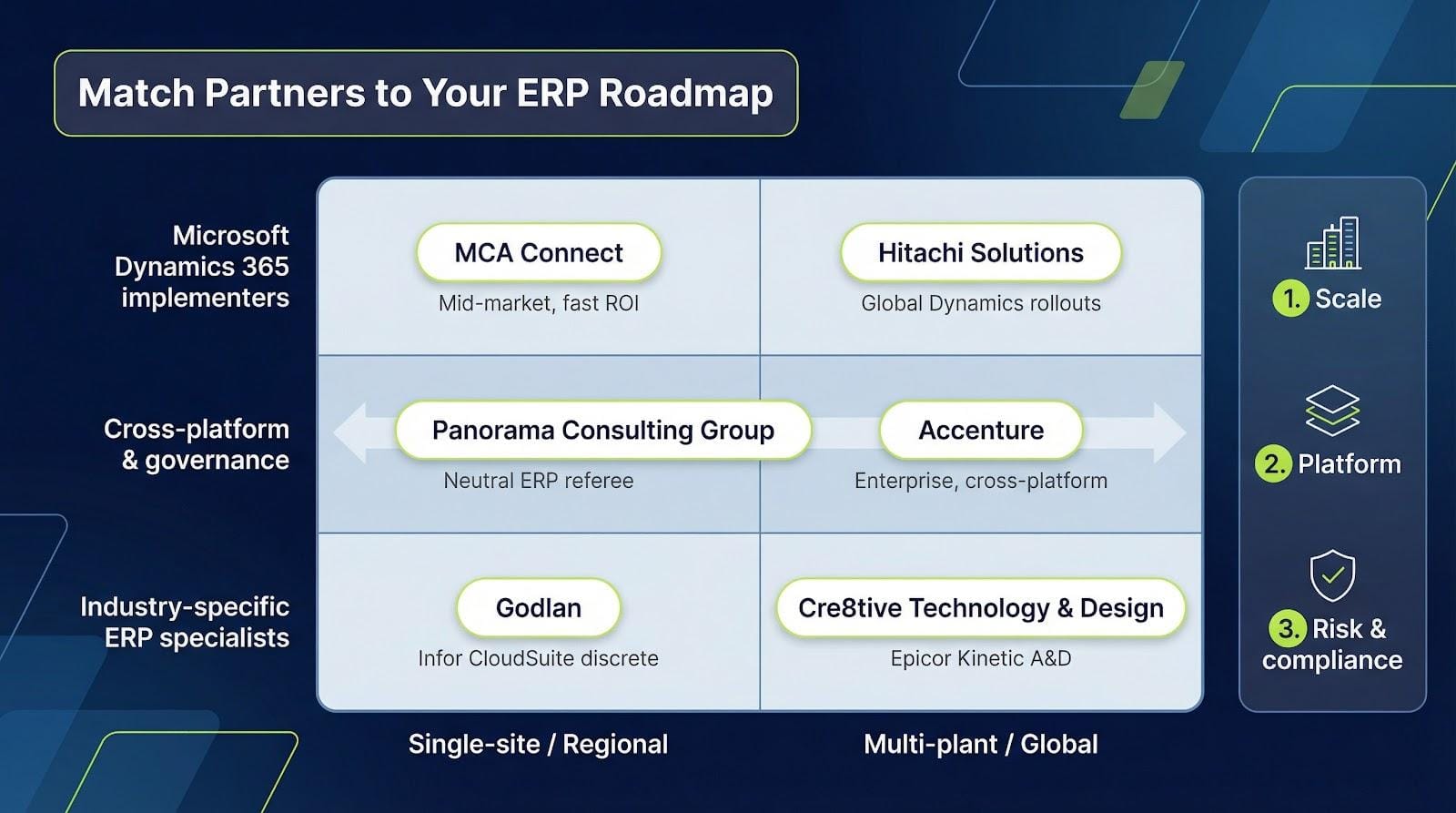
Start with scale. Single-site or regional manufacturers chasing quick ROI gravitate toward boutique specialists. MCA Connect, Godlan, and Cre8tive deliver senior attention, fixed-fee options, and go-live timelines under one year. Global enterprises managing 20 or more plants lean on Hitachi or Accenture for bench depth, multilingual training, and round-the-clock development.
Next, lock the platform. If your board already backs Microsoft Dynamics 365, staying in the Microsoft ecosystem with MCA Connect or Hitachi avoids finger-pointing when updates land. Infor loyalists find a natural home with Godlan, while Epicor Kinetic customers in aerospace turn to Cre8tive. Still deciding? Panorama stands outside the vendor fray and can run a data-driven selection before you sign any license.
Risk tolerance matters, too. Need a referee to keep scope creep (and budget) under control? Panorama’s independent governance pairs with any implementer. Facing government audits or ITAR rules? Cre8tive’s certified A&D extension bakes compliance into Epicor. Want AI scheduling and IoT feeds on day one? MCA’s ManufacturingCONNECT and Hitachi’s Dynamics accelerators arrive ready for those hooks.
A quick litmus test:
- Mid-market, Microsoft stack, time-to-value king: MCA Connect.
- Multi-continent Dynamics rollout with heavy IoT ambitions: Hitachi Solutions.
- Cross-platform consolidation, zero-defect mandate: Accenture.
- First ERP or prior failure, need neutral oversight: Panorama Consulting Group.
- Discrete manufacturing, Infor CloudSuite, fixed fees: Godlan.
- Epicor Kinetic plus defense-grade compliance: Cre8tive Technology & Design.
Sketch your scenario against those bullets and one or two names will surface fast. That is your cue to request reference calls, ask for a draft project plan, and pressure-test cultural fit before contracts hit the table.