
Hospitals win or lose patient trust in the first five to seven minutes after arrival. Studies show that brief window shapes compliance, satisfaction, and HCAHPS reimbursements. A warm greeting and clear way-finding protect revenue; a cold greeting turns into a leak.
That’s why many hospitals now borrow from hotels: dedicated concierge teams who park cars, escort families, and fetch forgotten chargers so clinicians can focus on care. This guide compares the leading hospital concierge vendors, showing you what matters and how to match the right partner to your goals—so every first impression becomes lasting loyalty.
Research & methodology
Before naming any “best,” we ran every contender through the same bright light.
We gathered more than 20 independent sources, from Advisory Board briefs and vendor whitepapers to the latest patient-experience headlines. We skipped paid ads and generic “concierge medicine” pages, focusing only on companies that deliver non-clinical guest services inside hospitals.
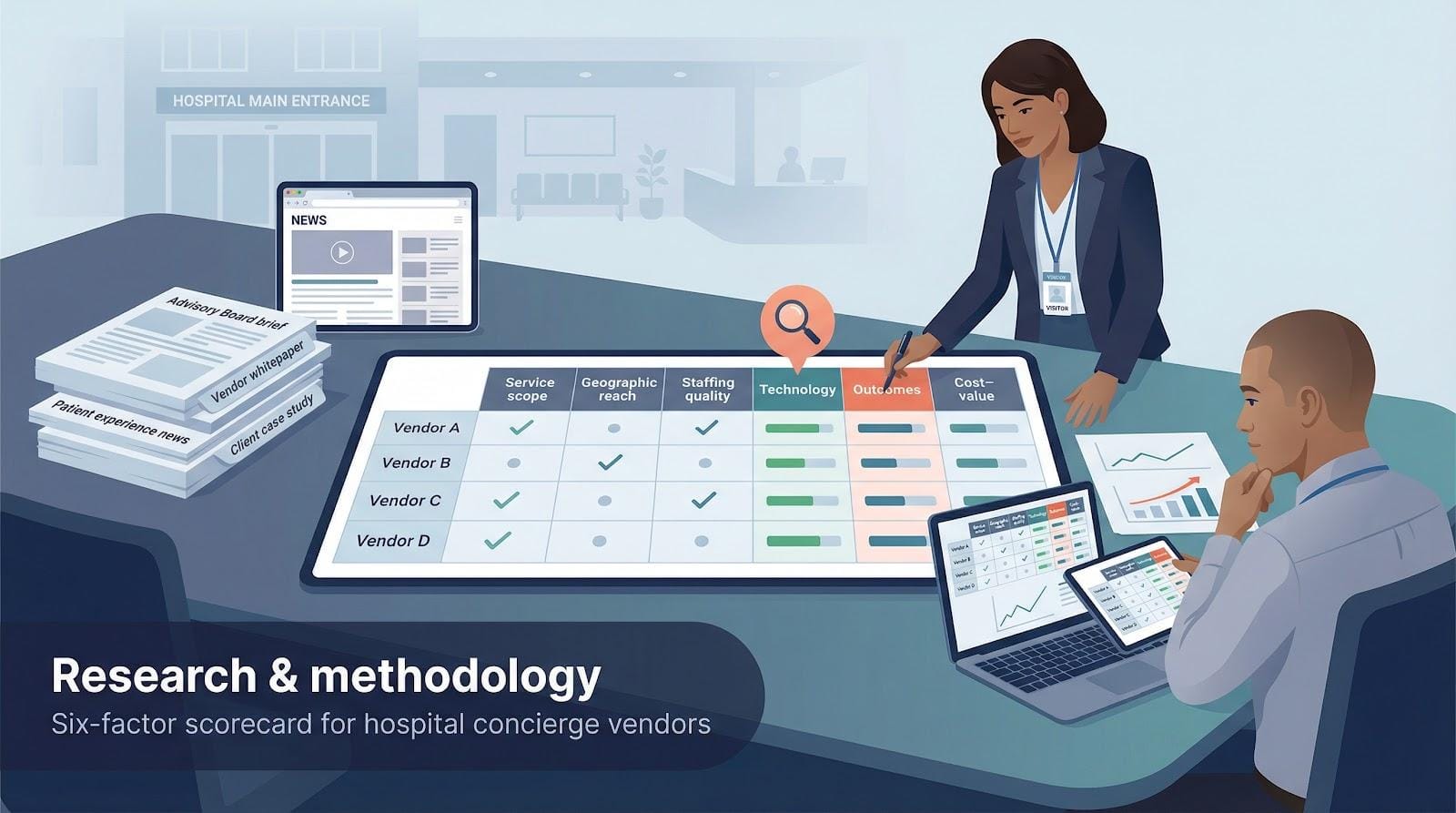
Next, we built a six-factor scorecard: service scope, geographic reach, staffing quality, technology, proven outcomes, and cost–value. Each vendor earned points in every column, so a valet specialist with smart tech could outrank a full-service firm that skimps on training.
We cross-checked marketing claims against case studies, client press releases, and industry benchmarks. When data were thin, we rewarded transparency; vendors who shared real numbers climbed the list.
Finally, two hospital CX leaders reviewed our draft ranking to confirm it made sense in day-to-day operations.
The sections that follow show the results of that process, with no gut feel and no sponsored placements.
Evaluation criteria: what really matters
Choosing a concierge vendor is like hiring a new department, so clear standards matter. We trimmed the scorecard to six essentials and explain each below so you can see how it shapes the patient experience.
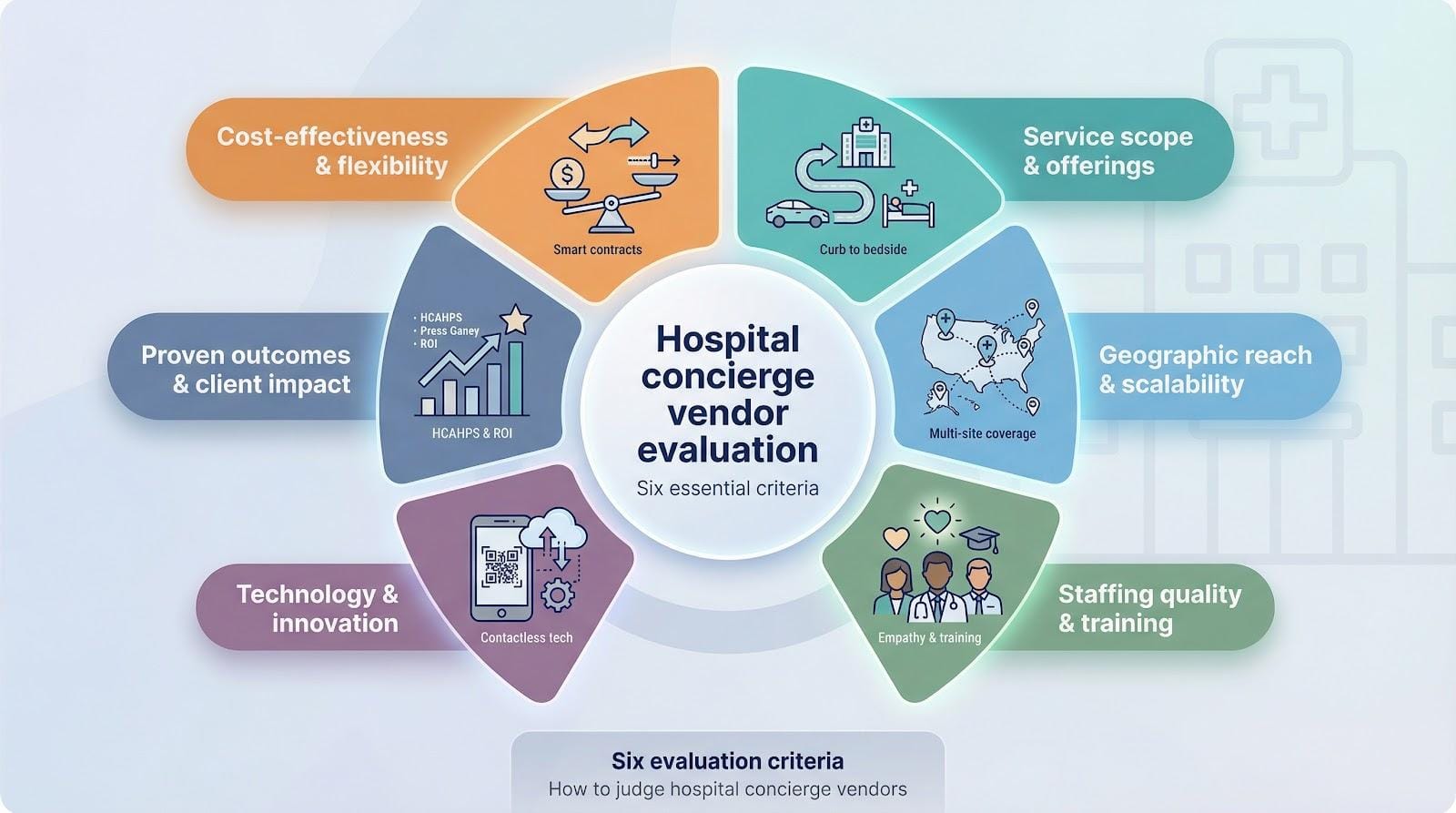
1. Service scope & offerings
First, range. A true hospital concierge partner covers every non-clinical touch-point from curb to bedside. That means valets who welcome anxious drivers, lobby guides who read body language, wheelchair escorts who know the fastest route to radiology, and in-room concierges who can fetch a phone charger or arrange pet care without hesitation.
Breadth matters because patients experience journeys, not departments. When one friendly face can solve parking, directions, a coffee request, and a pharmacy run, trust compounds and clinical workloads shrink. Hospitals with tight budgets can start at the entrance—valet plus lobby help—then add in-room service once ROI appears in HCAHPS comments.
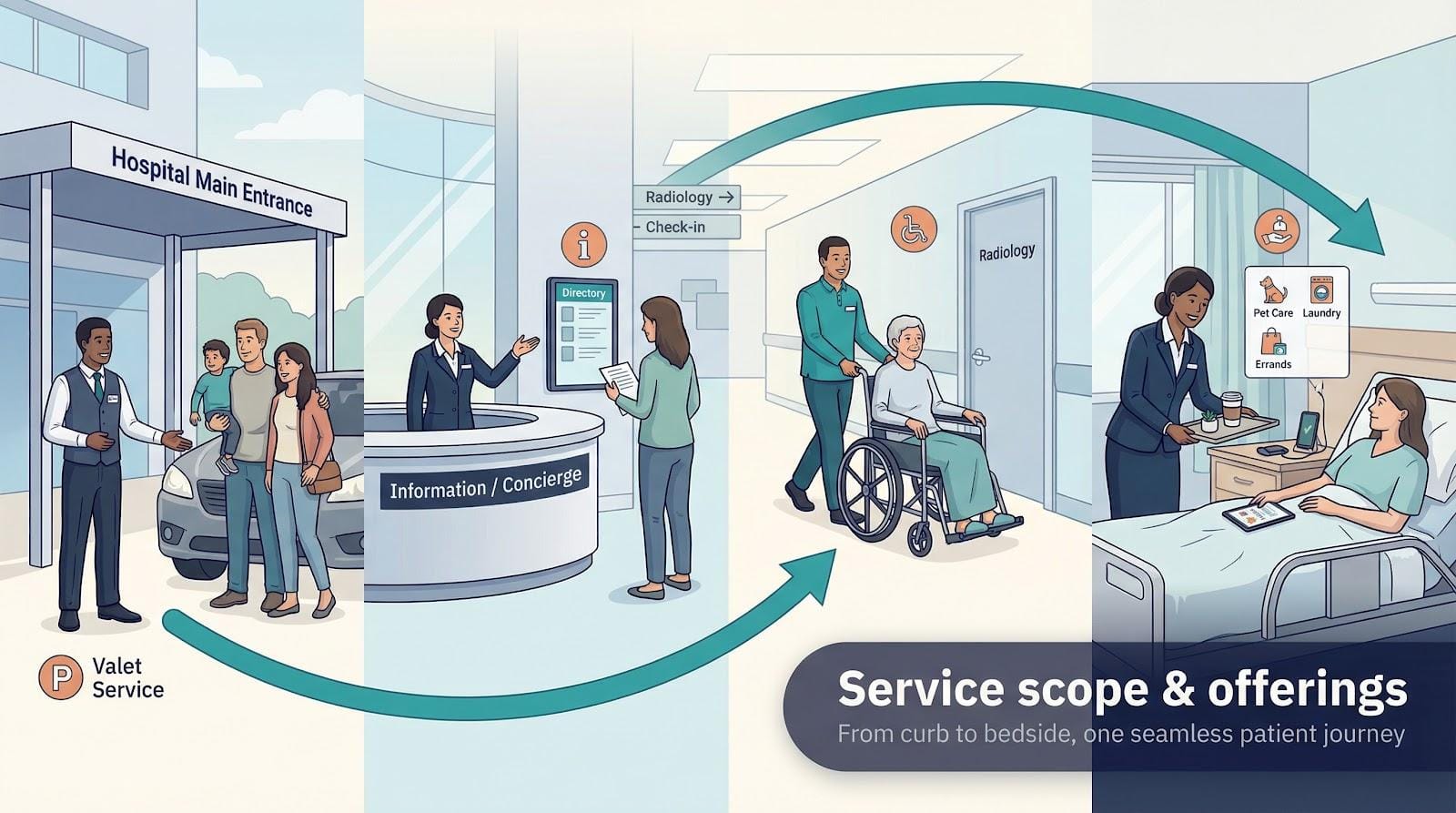
Vendors offering a single, integrated program scored highest. Niche providers still made the list when they dominated a lane, but a narrow menu lowered their aggregate rank.
Next up: geographic reach and scalability. How far, how fast, and how consistently can a vendor repeat that welcome across your network?
2. Geographic reach & scalability
A great lobby team in one hospital is impressive; repeating that warmth across 10 campuses is transformative.
Health systems grow through acquisitions, joint ventures, and satellites. Your concierge partner must keep pace without diluting culture. We looked for firms with staff in multiple regions, strong recruiter pipelines, and playbooks that transplant best practices quickly.
National giants earned points for launching full entrance operations within weeks and covering sick calls from nearby sites. Regional specialists still scored well when they showed mastery of their territory and proved they could scale from a flagship hospital to affiliates down the highway.
Consistency beats charisma. Patients should feel the same calm welcome whether they enter your main tower or a rural clinic.
Now, staffing quality—the human factor that delights or derails every script.
3. Staffing quality & training
Technology helps, signage guides, but people close the gap. A concierge’s smile carries more weight than a marble lobby.
Great vendors hire for empathy first, skill second. They run background checks, test soft skills, and pass on applicants who lack genuine warmth. New associates attend hospitality boot camps covering HIPAA basics, pain-scale awareness, wheelchair safety, and compassionate language.
Ongoing coaching matters as much. We favored companies that mystery-shop their teams, track turnover, and highlight five-star interactions in real time. Low churn keeps greeters familiar, so returning patients see known faces instead of constant trainees.
If a vendor skimps on training or cycles through staff, experience scores dip faster than you can say “Press Ganey.” Choose partners who invest in their people; patients will notice before they reach the front desk.
Next, technology and innovation, the quiet engines that keep those smiles efficient and transparent.
4. Technology & innovation
Behind every gracious hello sits a quiet stack of code.
Contact-free valet tickets, SMS car retrieval, and mobile requests cut wait times and document every touch. They also prove value when finance wants numbers, not anecdotes.
We looked for tech that feels effortless: scan a QR code, request a wheelchair, track your vehicle in a browser tab. Back-office dashboards should show real-time volumes, satisfaction scores, and staffing hot spots. Partners still reliant on clipboards landed near the bottom.
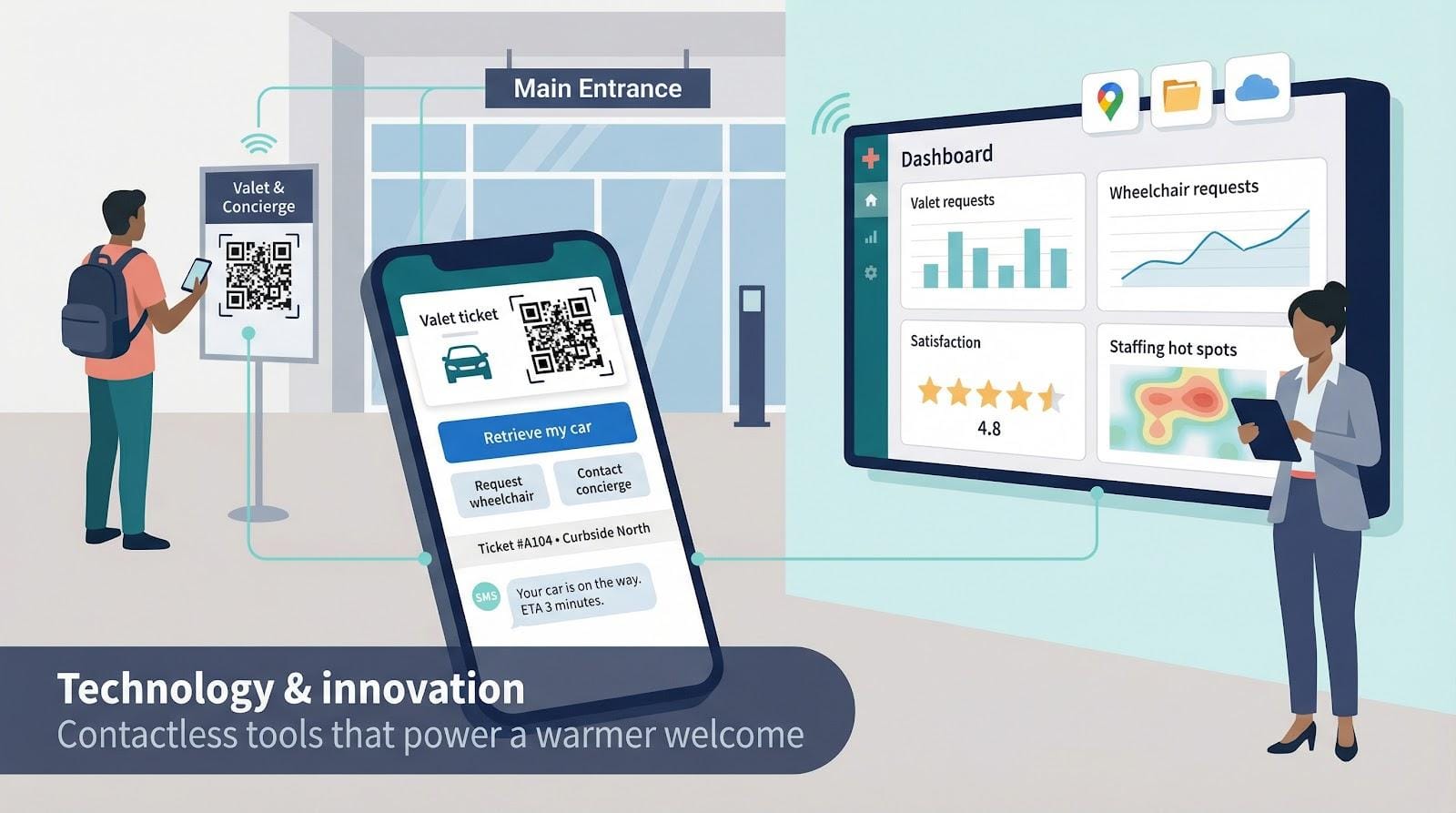
Integration seals the deal. The best firms plug into your way-finding app or EHR so patients enjoy one digital journey. That approach keeps IT happy and spares guests from juggling logins.
Innovation is friction removal. The fewer clicks, the warmer the smile.
Next, proven outcomes. Tech and training matter only if they move loyalty and throughput.
5. Proven outcomes & client impact
Good intentions do not sway CFOs; numbers do.
We hunted for hard evidence: Press Ganey lifts, HCAHPS jumps, throughput gains. Vendors that share case studies or before-and-after dashboards climbed our list. Best Upon Request, for example, reports that 99 percent of surveyed patients felt the concierge made their stay less stressful, and 97 percent would recommend the hospital. Feedback like that resonates in boardrooms.
Qualitative proof counts too. A heartfelt patient letter crediting a valet for easing pre-surgery nerves carries real weight, especially when such stories appear across sites.
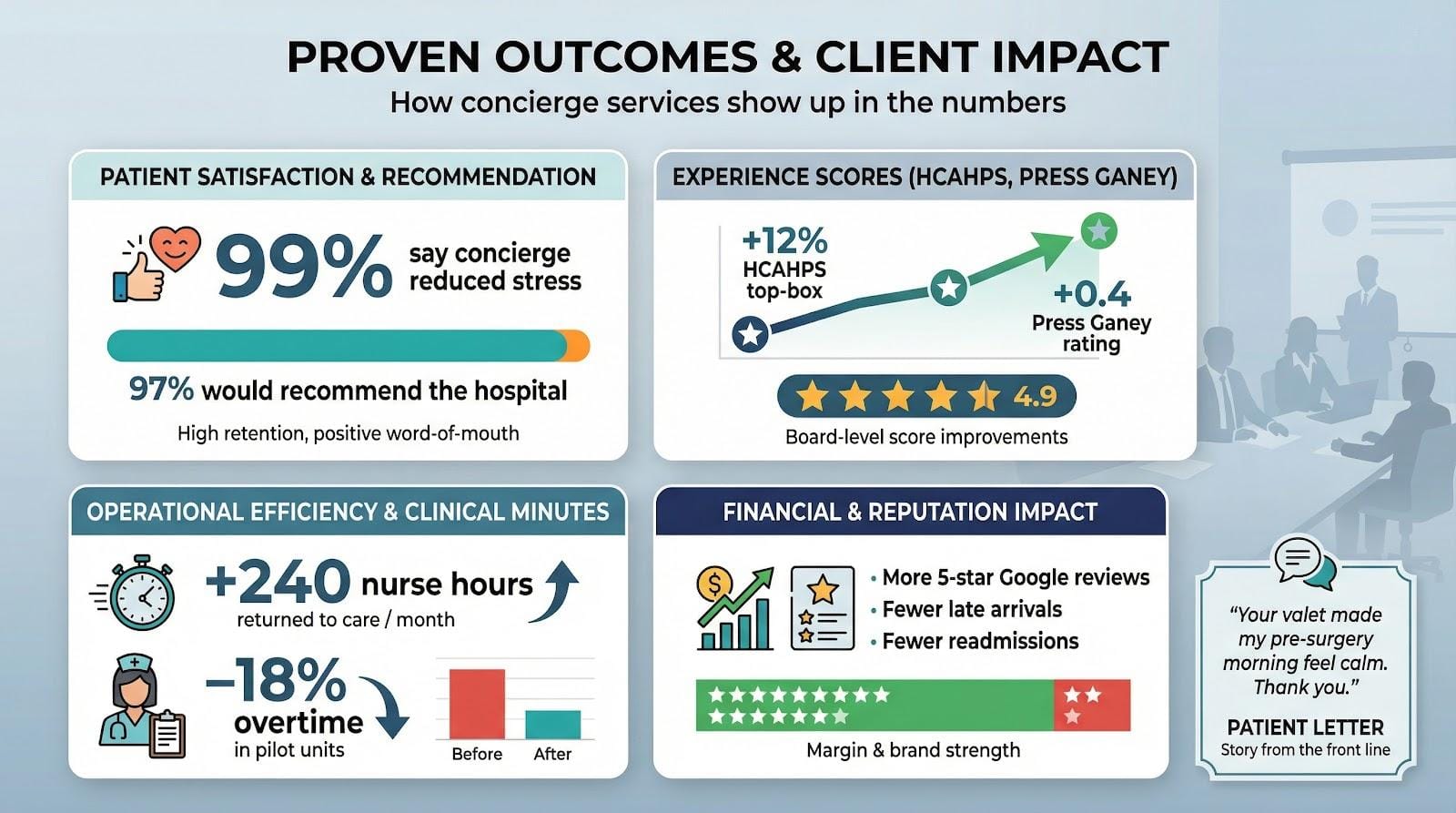
Impact reaches beyond patients. When concierges run errands and transport tasks, nurses reclaim clinical minutes and overtime dips. Systems linking those gains to reduced readmissions or quicker discharges turn hospitality into margin.
If a vendor cannot show proof—data or stories—keep shopping.
Last, cost-effectiveness and flexibility. Even the brightest program fails if it drains the budget or locks you into rigid terms.
6. Cost-effectiveness & flexibility
Every hospital watches two dashboards: patient experience and operating margin. A concierge program must lift the first without denting the second.
Strong vendors match fees to volume, flex staffing up during flu season and down in summer, and bill only for hours worked. Many cover recruiting, payroll, and benefits so finance sees one predictable line item, not dozens of hidden costs.
We also looked for transparent pilots. A month-to-month trial or single-entrance rollout lets you prove ROI before signing a multi-year deal. Vendors who refused flexibility sank on our list; partners who co-create phased roadmaps climbed fast.
Lowest bid rarely equals best value. The real bargain is a service that trims nursing overtime, prevents parking-lot mishaps, and earns five-star Google reviews. When those savings show up, the contract pays for itself.
Top hospital concierge service companies
We sifted dozens of contenders through the six-point lens. Ten vendors cleared the bar, each excelling in a different mix of scope, scale, and service DNA. We list them in the order their aggregate scores landed, though your priorities may reshuffle the deck. Here is the leader.
4.1 FC Parking: integrated valet and concierge solutions
FC Parking earned its reputation in parking operations; today it covers every step from car door to patient room. Its healthcare concierge services welcome families at the curb, park vehicles, guide visitors through winding corridors, and handle errands that would otherwise pull nurses away from care.
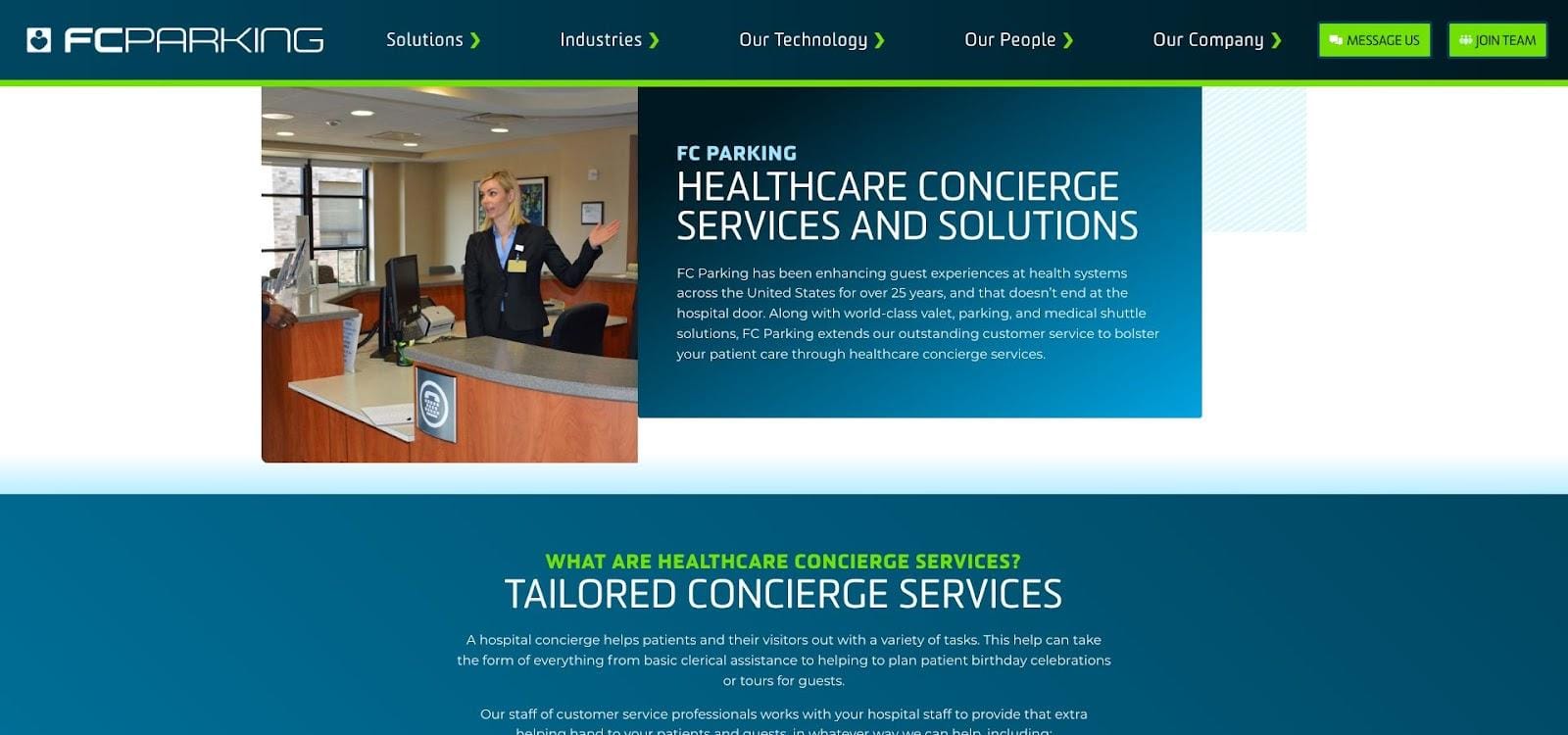
FC Parking healthcare concierge services website screenshot
The company screens for compassion first, then adds hospital-specific training so associates fit smoothly into clinical teams. Hospitals receive one vendor, one invoice, and a workforce that flexes between valet and concierge roles without missing a step. For organizations that want to unite parking logistics and guest experience under one roof, FC Parking provides a practical answer.
Next: Best Upon Request, the pioneer that turned concierge care into measurable ROI.
4.2 Best Upon Request: concierge care with measurable lift
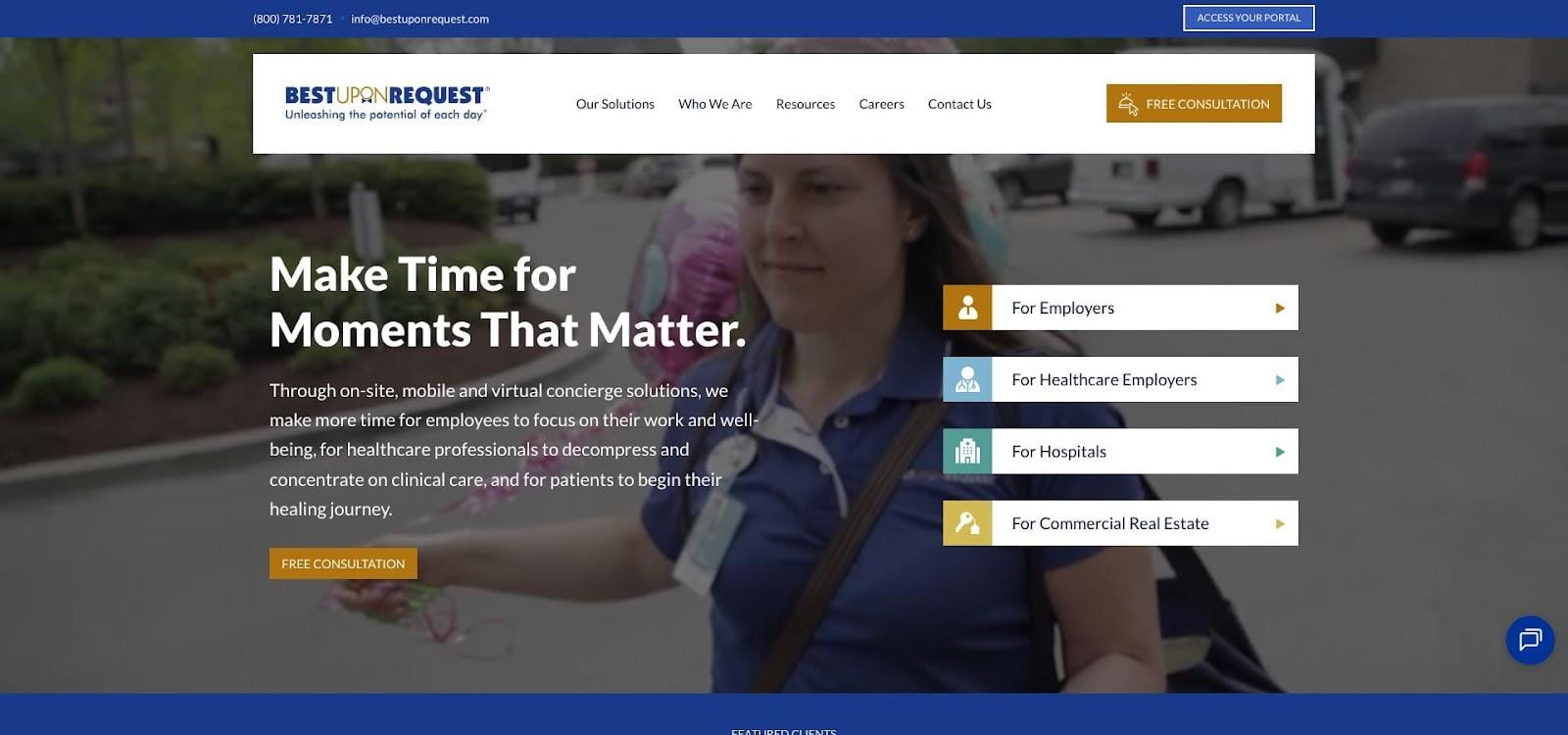
Best Upon Request (BEST) introduced hospital concierge culture in 1989. Today its specialists cover every non-clinical need: prescription pickups, dry-cleaning runs, birthday cupcakes, and travel plans for visiting relatives.
Best Upon Request hospital concierge services website screenshot
Internal surveys show 99 percent of patients say the concierge made their stay more pleasant, and 97 percent would recommend the hospital. That lift gets attention in boardrooms.
BEST distinguishes itself with data discipline. Each client receives monthly dashboards that chart request volumes, satisfaction scores, and clinical hours saved. Leaders see exactly how many nurse hours return to patient care and how many five-star comments reach Press Ganey.
While many vendors focus on parking or transport, BEST stays in the concierge lane. That focus drives thoughtful touches, such as a mobile app for caregiver requests or proactive rounding where concierges knock on doors before the call light flashes.
Hospitals facing staff burnout often pilot BEST’s employee program first, then expand to patients once the value is clear. Longevity, openness, and a dual focus on guests and caregivers keep BEST popular among systems chasing proven ROI from hospitality.
Next up: HealthPark Hospitality, the healthcare-only firm that pairs valet precision with empathy training.
4.3 HealthPark Hospitality: every entrance feels clinical-grade
HealthPark Hospitality lives and breathes healthcare. Unlike valet firms that moonlight in airports or stadiums, HPH serves hospitals exclusively, so every policy, script, and safety drill aligns with clinical realities.
The company’s “HealthPark University” trains attendants on HIPAA basics, pain-scale empathy, and wheelchair etiquette before they park a single car. Touchless valet tickets and text-to-retrieve technology shave minutes off discharge time while keeping germ-conscious families at ease.
Beyond the curb, HPH supplies greeters, patient escorts, and internal transport teams through its HPH Transport arm. That smooth handoff means a visitor sees one coordinated crew from driveway to bedside instead of three disconnected vendors.
Hospitals that choose HPH often cite two wins: arrival scores jump in Press Ganey, and labor costs dip as HealthPark’s demand-based scheduling trims idle shifts. For systems seeking healthcare-specific polish without managing another department, HPH provides a complete front-door upgrade.
4.4 Towne Park (Towne Health): scale meets Swiss-Army staffing
Towne Park is the volume leader in this space. Its healthcare arm, Towne Health, runs non-clinical services at more than 300 hospitals across 40 states, a reach that matters when a system wants identical valet, transport, and sitter coverage from flagship academic centers to rural clinics.
Scale is only half the story. Towne Flex cross-trains associates so one teammate can greet early-morning surgery arrivals, shuttle visitors at lunch, and sit with a fall-risk patient after dinner. This approach trims idle time and spares managers from juggling three separate rosters.
Technology backs the effort. Digital valet tickets ping patients when cars approach, while transport dashboards spotlight demand spikes so supervisors can redeploy staff before queues form. Executives see the same data in weekly scorecards, turning “great service” into measurable throughput gains.
Towne’s sweet spot is speed. If you operate a multi-state network and need a ready-to-deploy hospitality layer tomorrow, few partners can field a trained team faster.
4.5 LAZ Parking Healthcare Services: logistics with a heart
LAZ Parking manages more than a million parking spaces nationwide, yet its healthcare division still feels personal. The team starts where stress peaks—finding a spot—and turns that friction point into a warm welcome.
Concierge desks, roaming ambassadors, and patient companions build on the valet core. Families arrive at the entrance, receive clear directions, and soon learn that the same friendly face can arrange hotel rooms or walk a nervous grandparent to imaging.
LAZ relies on deep operational data. Years of parking analytics guide dynamic staffing, so arrival surges get extra valets before lines form. Hospitals already using LAZ for garages often add concierge and ambassador roles under one contract, which lightens vendor management.
If you need parking flow fixed quickly and plan to add hospitality touches next, LAZ provides a smooth path from asphalt to empathy.
4.6 HHS: valet efficiency backed by facility know-how
HHS built its reputation in environmental services, nutrition, and security. That foundation matters because the same process discipline that speeds room turns also trims parking waits.
HHS valets greet drivers, help guests into wheelchairs, and hand off to lobby concierges trained in wayfinding and empathy. Since the company already manages other support lines at many hospitals, leaders gain one escalation point and one bundled invoice.
Technology keeps costs predictable. Digital time stamps log every valet handoff and feed staffing algorithms that right-size shifts. Finance teams see the metrics, and supervisors adjust coverage before queues form.
Hospitals seeking an all-in-one facilities partner who can add hospitality under an existing master agreement often choose HHS for its budget-friendly fit.
4.7 Omega Concierge Services: boutique hospitality at the bedside
Omega trades scale for intimacy, and does so by design. Based in New Orleans, the firm stations concierges on patient floors, where they round like hotel staff checking suite preferences.
Need the thermostat lowered, a pet-sitter arranged, or a surprise anniversary cake delivered to the room? Omega handles each request quietly, freeing nurses for clinical tasks and lifting patient spirits in ways no call light can.
Because the team is small, every hire meets a high bar for warmth and adaptability. Many come from luxury hotels and carry an instinct for anticipating needs before they surface. Hospitals see that care reflected in thank-you notes and glowing discharge surveys.
If your facility values high-touch service over national coverage—think boutique women’s centers or long-stay rehab units—Omega delivers tailored hospitality with a personal touch.
4.8 Texas Parking Services: valet roots with concierge range
Everything is bigger in Texas, including patient expectations. Texas Parking Services (TPS) meets them with a combined strength: curbside valet finesse and an expansive concierge menu that covers in-room spa treatments, hotel blocks for anxious families, and more.
Staff greet newcomers, escort them to units, field the steady flow of “where do I go now?” questions, and coordinate birthday surprises for long-stay kids. Because TPS controls the parking workflow, transitions feel smooth; guests never juggle multiple phone numbers or departments.
Local ownership powers quick pivots. Need extended hours during rodeo season or a Spanish-speaking concierge tomorrow? Decision makers are a short drive away, not in a distant corporate tower. Hospitals praise TPS managers for genuine warmth and fast answers that carry Texas hospitality DNA.
Regional facilities that want valet mastery plus personal flourishes—without the red tape of a national conglomerate—often find TPS the right fit.
4.9 Valet Park of America: New England reliability, hospital-caliber courtesy
For more than 30 years, Valet Park of America (VPA) has managed the arrival moment from Boston to Buffalo. The approach is simple: recruit courteous locals, train them to hospital standards, and keep managers close enough to shake hands with every client.
VPA’s core remains valet and shuttle operations, but greeters also serve as wayfinding guides, making sure patients step off the curb already pointed in the right direction. By smoothing traffic flow and cutting late arrivals, departments stay on schedule and satisfaction scores rise.
Hospitals value VPA’s transparency. Regional supervisors visit sites weekly, share performance snapshots, and adjust staffing before issues surface. The company is large enough to send replacements during a snowstorm yet small enough that you can reach the CEO when needed.
Facilities in the Northeast that want dependable curbside care without the cost of a national giant often choose VPA.
4.10 Honorable mentions: niche partners for specific gaps
A few additional players merit a quick nod. Sodexo’s Circles Concierge centers on employee perks such as errand running, travel planning, and gift sourcing, which can lift morale when staff burnout rises. SP+ Hospitality Solutions builds on deep parking expertise and adds lobby ambassadors in hospitals where it already manages garages. Allied Universal Guest Services extends its security services to information desks and entrance checkpoints, a smart choice when safety and hospitality must align.
These providers did not make the top ten because their service scope is narrow or public outcomes data are limited, yet each can excel when the match is right. If your need aligns closely with their specialty, consider reaching out.
Conclusion
These providers did not make the top ten because their service scope is narrow or public outcomes data are limited, yet each can excel when the match is right. If your need aligns closely with their specialty, consider reaching out.