

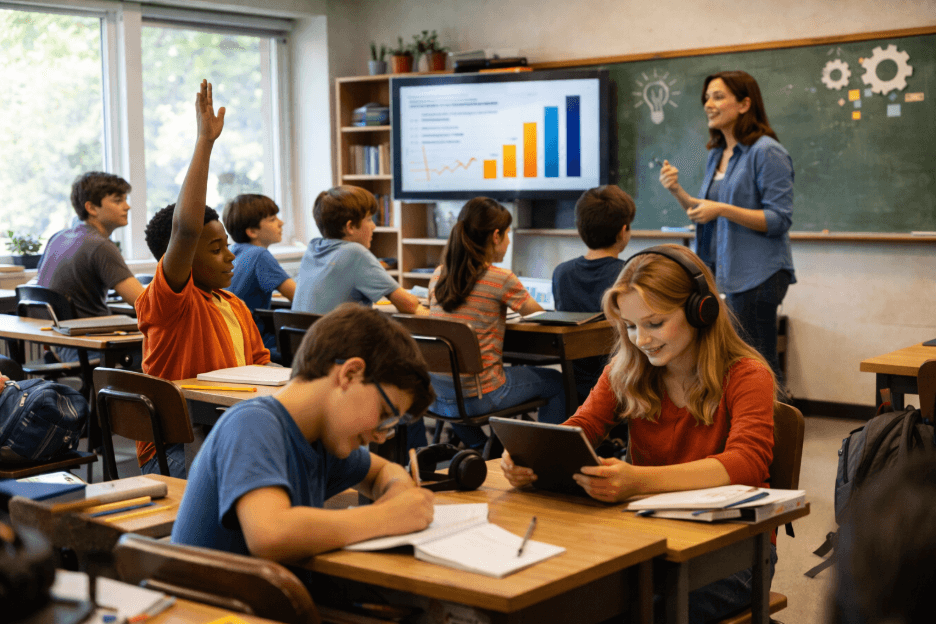
 Student engagement separates classrooms where real learning happens from classrooms where students just go through the motions. The difference shows up everywhere, from test scores to whether anyone remembers a damn thing six months after finals.
Let’s see how.
How Technology Adapts to Keep Students Involved
Digital platforms changed how schools teach because they can actually respond to what individual students need. Savvas builds systems that watch how students interact with lessons and adjust on the fly.
If someone’s breezing through material, the difficulty ramps up. If they’re stuck, the platform breaks concepts down differently or adds practice problems. Traditional textbooks can’t do that, which is why half the class sits bored while the other half drowns.
Think about any classroom: one student flies through algebra but hits a wall with geometry, and another struggles with reading comprehension but crushes visual problem-solving. When everyone moves at the same pace, nobody wins. The fast kids zone out. The slower ones fall behind early and spend the rest of the year faking it, copying homework and hoping not to get called on.
Students who genuinely engage with coursework perform 2.5 times better academically. But that advantage doesn’t stop at grades. An engaged freshman builds thinking skills and study habits that stick around for years, through college and into whatever career they chase.
What Destroys Interest in the Classroom
Relevance kills engagement faster than anything else. Tell a teenager to memorize quadratic equations without explaining why they’d ever use them, and watch their eyes glaze over. History class becomes torture when it’s just disconnected dates and dead people’s names. Even great teachers lose students when they can’t answer the “why do I need to know this” question.
Kids know when adults are shoving information at them “for their own good” without proving its value. Once students sense that disconnect, they check out. Sure, they’ll complete assignments to avoid failing, but that’s not learning. That’s going through motions to keep parents and administrators off their backs.
Schools crawl for advanced students and sprint for struggling ones. The fast learners sit there bored, unchallenged, waiting for everyone else to catch up. The slow learners panic, fall behind in week two, and spend months nodding along while understanding absolutely nothing. When content doesn’t match where a student actually is, they tune out.
Then there’s the autonomy problem. Students who never choose anything feel like prisoners serving time. They can’t pick topics, can’t decide how to show what they learned, can’t pursue projects that actually interest them. Show up, take notes, fill out worksheets, forget everything by summer. Rinse and repeat.
What Actually Works in Real Classrooms
Some teachers figure out how to make lessons click. Take geometry. Most students see triangles as pointless shapes to memorize. But explain that construction workers depend on them to frame houses that won’t collapse, and suddenly those angles mean something.
History works the same way. Connect a revolution from 200 years ago to protests happening right now, and students stop zoning out. They’re not memorizing dates anymore. They’re seeing how people keep making the same moves.
Giving students choices shifts their entire approach to learning. When they can select essay topics or decide which historical period to explore, the quality of their work improves because they own the outcome. Nobody’s going through the motions to check boxes on a rubric. Freedom has limits, though. Teachers who get it right provide choices without losing control.
Teachers who build real connections with students get better results. When a teacher remembers your name, asks how your weekend went, and notices when you’re struggling, students respond differently. That personal attention creates motivation no app or platform can match. You don’t want to blow off homework for a teacher who treats you as a person instead of just another student in a crowded classroom.
Immediate feedback keeps momentum going. Wait three weeks to return graded work, and students have mentally moved on. They don’t connect the feedback to what they were thinking when they did the assignment.
Tech platforms nail this part because they respond instantly. Answer a practice problem wrong, and the system flags the misconception right then, before it hardens into a permanent misunderstanding.
Students who participate in research projects, internships, and hands-on learning experiences report significantly better outcomes across the board. A student who checks out in middle school slides backward year after year, falling further behind while losing confidence.
An engaged student does the opposite. They build skills and habits that speed up their learning, which creates momentum through high school and college. Schools that make engagement a real priority aren’t just trying to boost test scores. They’re reshaping how students approach learning long after they graduate.