
Cyber attacks don’t wait for meetings. To stay ready, security teams are trading slide decks for live-fire drills inside cyber ranges—isolated, cloud-based replicas of production where mistakes stay contained.
According to a 2023 Ponemon study, 60 percent of companies already use simulation-based training, up from 36 percent in 2020.
This guide compares the five leading enterprise platforms and explains when a partner like TD SYNNEX can accelerate your rollout.
How we narrowed the field
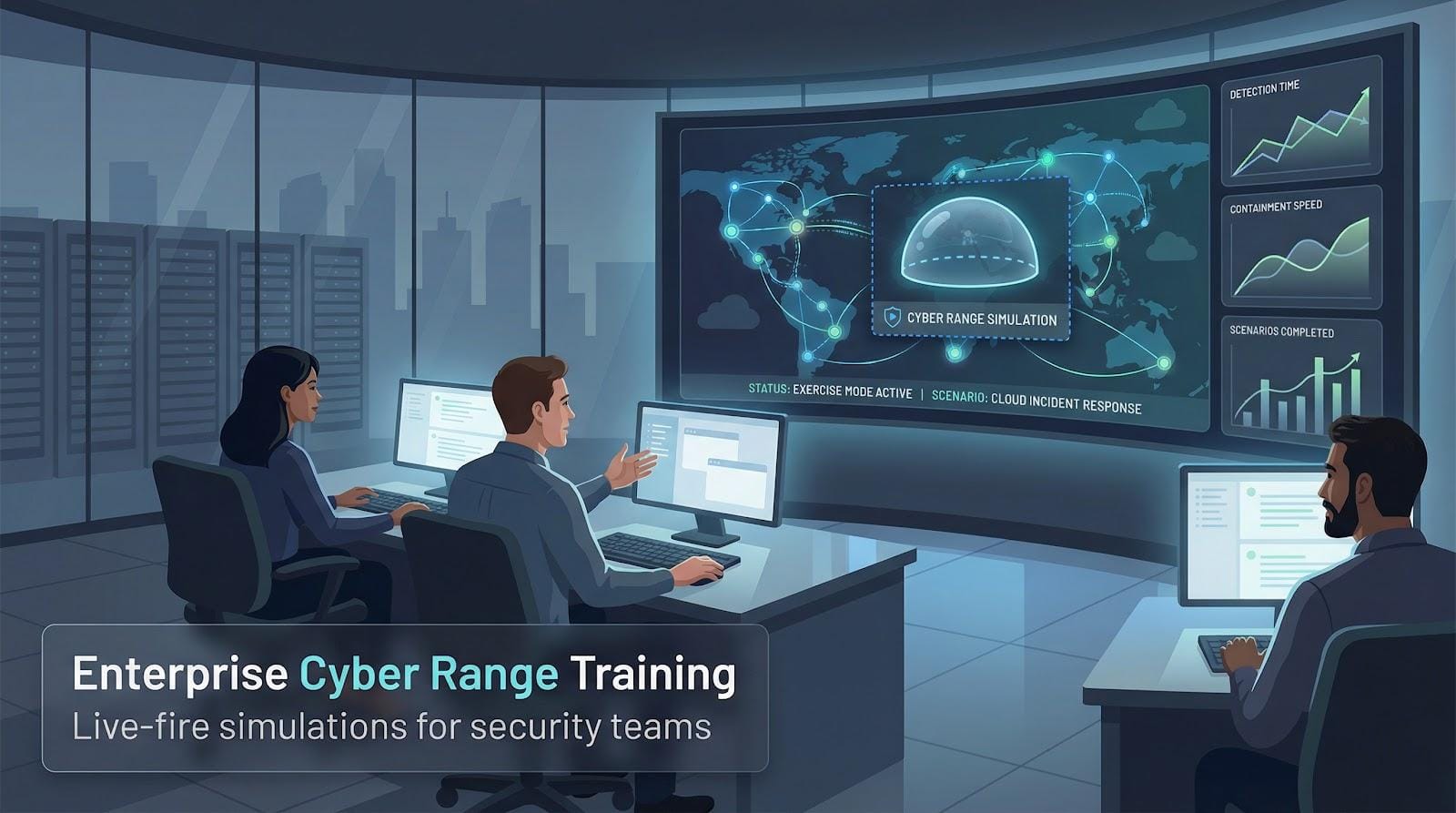
We asked one question: if you’re an enterprise security leader, which cyber range delivers the most real-world value?
To find out, we reviewed 24 comparison articles, vendor briefs, analyst notes, and customer case studies. We focused on updates from 2024 and 2025, because a platform can feel outdated after a single product cycle.
The research fed an eight-point scorecard that mirrors what buyers care about most. Realism and content depth, two factors that decide whether training sticks, carried extra weight.
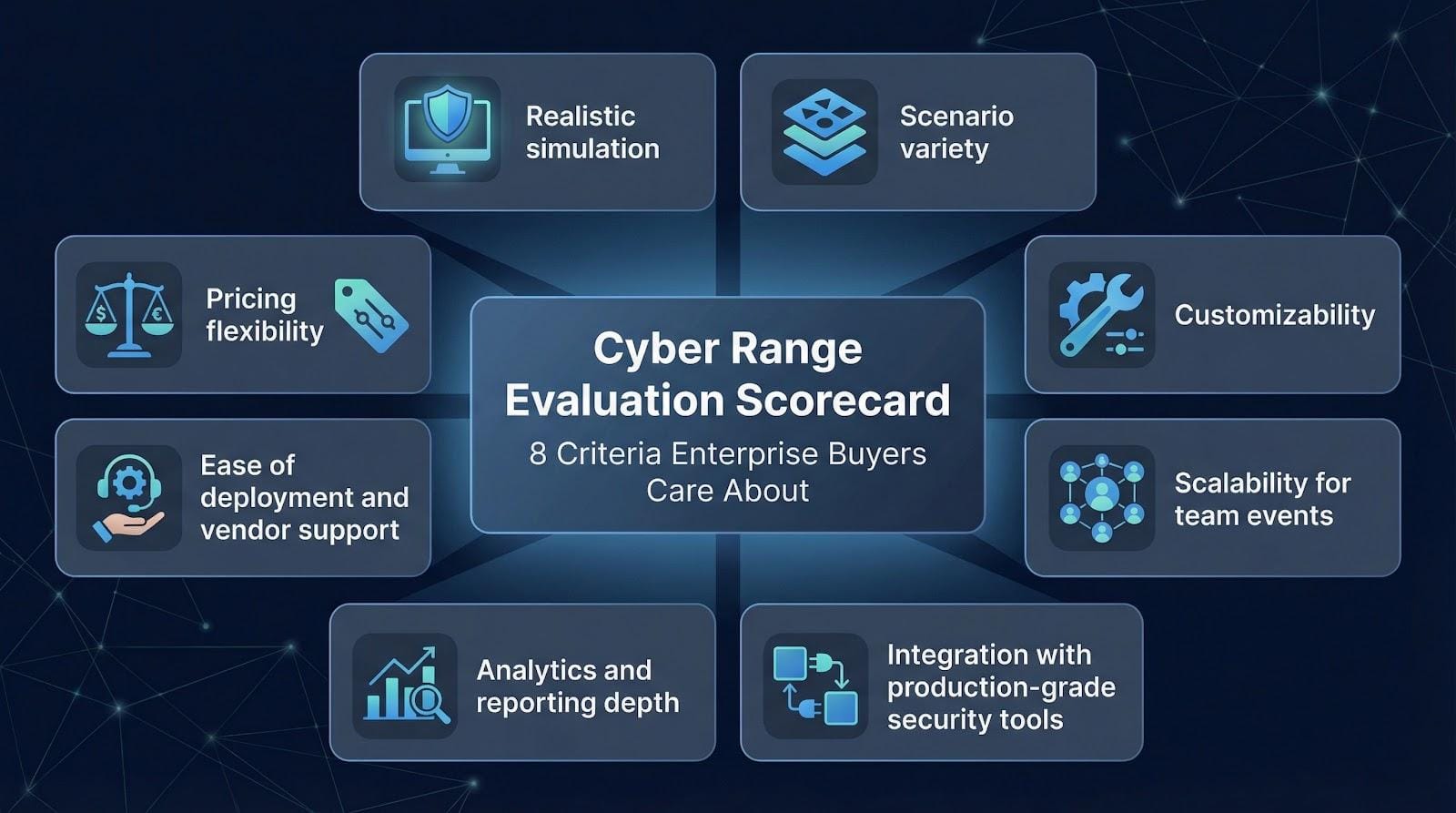
The criteria:
- Realistic simulation
- Scenario variety
- Customizability
- Scalability for team events
- Integration with production-grade security tools
- Analytics and reporting depth
- Ease of deployment and vendor support
- Pricing flexibility
To broaden the view, we interviewed engineers from the TD SYNNEX Cyber Range, an Authorized Training Center that runs official Palo Alto Networks courses alongside vendor-agnostic war games.
They noted that drills resonate most when they mirror the 100-plus products and 30-plus services in the wider TD Synnex Cybersecurity solutions portfolio that many enterprises already deploy in production.
Their insights grounded the scorecard in day-to-day cybersecurity realities, from identity and access management to data protection, incident response, and disaster recovery, ensuring the criteria mirrored the pain points they tackle across hundreds of enterprise engagements.
We rated ten well-known platforms against these benchmarks, combining published specs with hands-on feedback. A tool needed solid marks across every category and standout strength in at least three to reach the final list.
That filter left five clear winners. Each excels in a different way, giving you options whether you run a global SOC or a lean security crew.
The top cyber range platforms for enterprise teams
Here are the five platforms that scored highest on our eight-point rubric. Each excels in a different area, so you can align the choice with your specific goals.
1. Cyberbit Range (with RangeForce)
Cyberbit is widely regarded as the leader in large-scale, live-fire simulations. Its September 2025 acquisition of RangeForce added a library of bite-size labs and assessments, turning the range into a full-cycle skills platform.
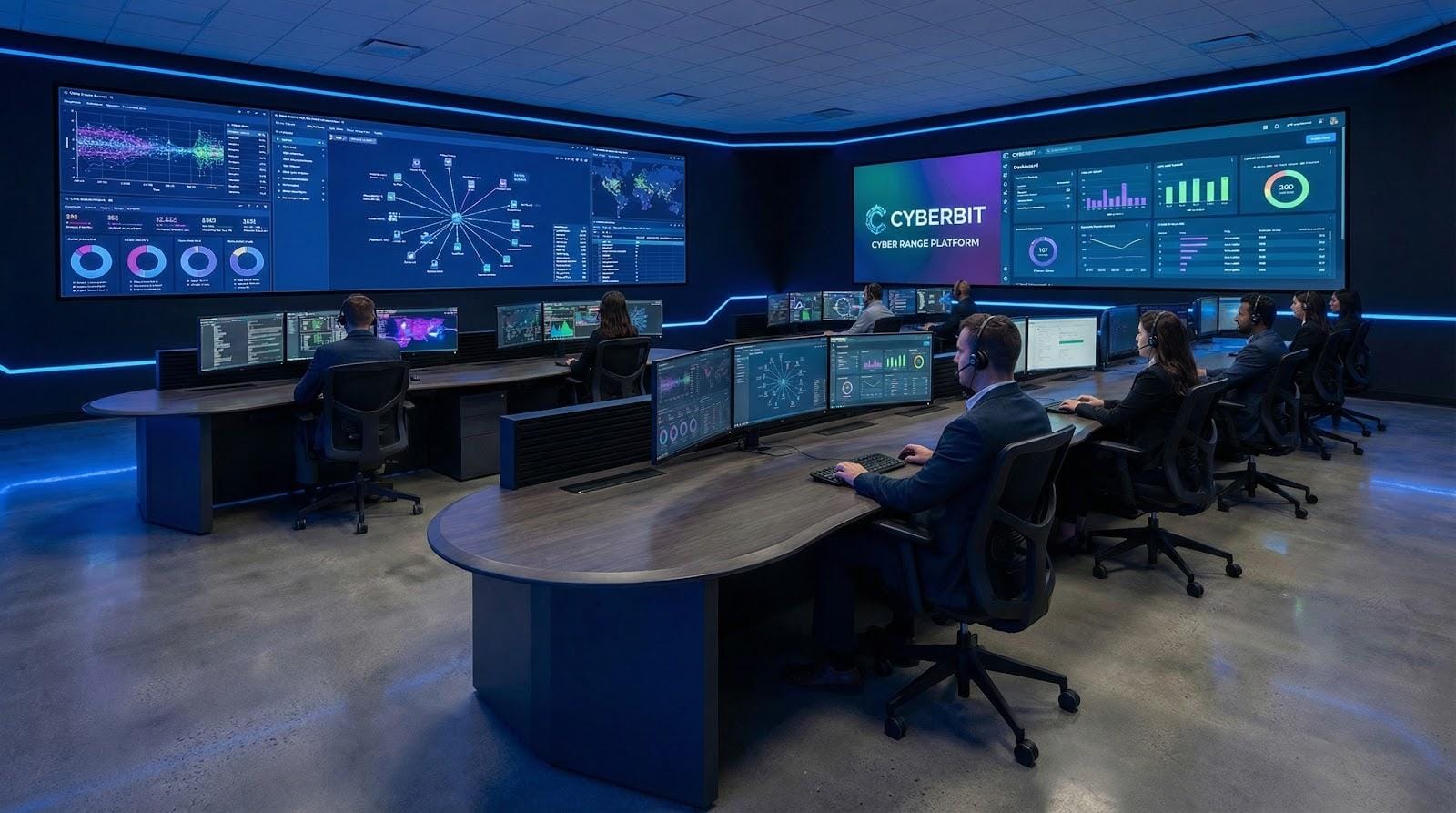
Cyberbit Range and RangeForce enterprise cyber range interface screenshot
Teams can spin up a replica Security Operations Center, stream realistic traffic, and guide analysts through malware, lateral movement, and crisis-communication drills complete with mock press calls. Deloitte’s global SOC relies on the platform for these pressure tests, a level of trust few vendors earn.
Breadth is the standout quality: schedule intensive team exercises one day and individual skill paths the next. Detailed after-action analytics measure dwell time, false positives, and communication gaps, so every session ends with a clear improvement plan.
A full deployment requires both budget and planning. If your aim is to train exactly as you fight, Cyberbit sets the benchmark.
2. CloudShare
CloudShare follows a different path. Instead of preloaded scenarios, it provides a blank, cloud-hosted canvas so you can build the exact environment your team needs, from operating systems and security tools to that quirky legacy app the business still relies on.
Spin up a full network in under five minutes, share a browser link, and place every participant in a safe sandbox that mirrors production. No hardware to rack, no VPN issues, no long provisioning cycles. Trainers appreciate the speed, and learners appreciate the realism.
Because CloudShare stays out of the spotlight, creativity flourishes. Consulting firms clone client networks for red-team engagements. Universities mirror data centers for semester-long cyber labs. Internal security teams replay last month’s incident so everyone can dissect and improve the response.
Analytics focus on environment use rather than player performance, so the platform works best when paired with an instructor, a playbook, or third-party attack scripts. That trade-off keeps pricing predictable and onboarding friction low, making CloudShare a smart choice when flexibility and speed outweigh built-in content.
If you want to build a “mini-internet” without managing servers, CloudShare is a strong fit.
3. Immersive Labs
Immersive Labs treats readiness like a gym membership for the mind. Team members can log in anytime, choose a lab that mirrors a current threat, and work through it at their own pace. The platform records each keystroke and converts activity into clear skill scores, a useful snapshot for weekly stand-ups or quarterly board reports.
Immersive Labs skills dashboard and cyber lab catalog screenshot
Breadth is the main draw. One morning you might reverse ransomware; that afternoon you could tackle a cloud misconfiguration or supply-chain exploit. New labs appear within days of headline vulnerabilities, so your team practices on material that reflects the latest news.
Gamified leaderboards fuel motivation. No analyst wants to stay at bronze while peers advance to silver and gold. Managers receive heat maps that surface collective blind spots. If “Linux forensics” lights up in red, schedule a focused sprint and watch the color shift to green.
The limitation is scale. Collaborative drills are possible, but the setting remains a sequence of structured tasks rather than an open network under sustained attack. Pair Immersive Labs with CloudShare or Cyberbit to add that missing realism and gain continuous micro-learning plus periodic high-pressure rehearsals.
For organizations that need visible skills growth every week and clear evidence for leadership, Immersive Labs delivers.
4. SimSpace
SimSpace is built for organizations that need to test security programs at full enterprise scale. Developed from MIT research and proven by defense agencies, the platform can recreate a Fortune 50 network with thousands of nodes, realistic user activity, and integrated security tooling. Teams then run multi-day assaults that feel close to a real breach.
These marathon exercises expose gaps no tabletop can catch: slow hand-offs between blue-team tiers, undocumented firewall rules, or a communication plan that falters once legal and public-relations staff join the call. When the exercise ends, SimSpace produces forensic-grade telemetry that shows every misstep, turning lessons into data-backed remediation tasks.
Because scenarios are custom-built, preparation time and cost are higher. Most customers run one or two major war games each year, treating the platform as a cyber stress test rather than a weekly drill. The payoff is depth of insight.
When executives want evidence that the entire organization can handle a headline-level incident, SimSpace provides it.
5. Hack The Box Enterprise
Hack The Box started as an online playground for aspiring penetration testers. Its Enterprise edition now channels that same hacker energy into structured programs any team can access.
Inside the portal you will find more than 2,500 vulnerable machines, web applications, and cloud misconfigurations ready for exploitation. Challenges cover every skill tier, so junior analysts practice on a basic Linux foothold while senior red-teamers chase advanced exploits.
Progress feels like a competition, with points, badges, and internal leaderboards. The impact is tangible. Defenders who understand attacker tradecraft spot anomalies faster. Developers who break an API in a lab often write sturdier code the next day. Some companies even run monthly Capture-the-Flag events to identify talent.
HTB remains cost-effective because it scales content, not hardware. Users attack sandbox images the vendor hosts, so rollout is as simple as adding seats. Reporting focuses on completion rates and skill matrices, so pair it with a defensive range if you need dwell-time metrics or incident timelines.
When your security culture wants hands-on offense without the legal risk of testing in production, Hack The Box turns curiosity into a measurable edge.
At-a-glance comparison
If you prefer a quick snapshot, the table below shows where each platform stands out. Scan the grid, then return to the detailed notes above before you make a decision.
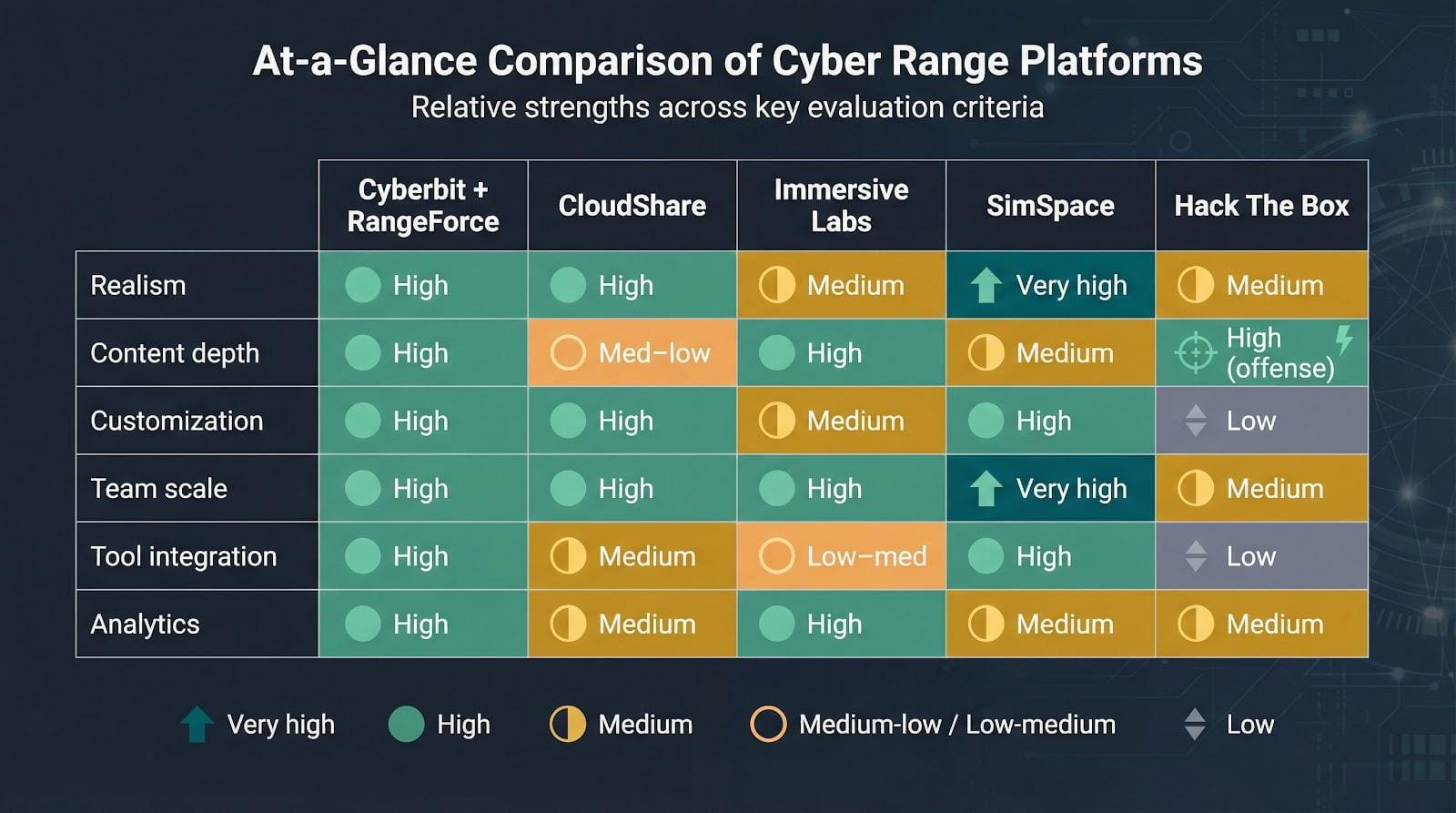
| Platform | Realism | Content depth | Customization | Team scale | Tool integration | Analytics |
|---|---|---|---|---|---|---|
| Cyberbit + RangeForce | High | High | High | High | High | High |
| CloudShare | High | Medium-low | High | High | Medium | Medium |
| Immersive Labs | Medium | High | Medium | High | Low-medium | High |
| SimSpace | Very high | Medium | High | Very high | High | Medium |
| Hack The Box | Medium | High (offense) | Low | Medium | Low | Medium |
High indicates a clear strength, Medium marks solid performance, and Low signals a relative gap. Treat any Low as a warning only if that capability is critical for your program.
Buyer’s guide: matching your needs to the right range
Before you sign a contract, picture where you want to be in 12 months. Are you aiming for sharper SOC reflexes, broader workforce skills, or a board-level war game that proves crisis readiness? Your answer points to a different platform.
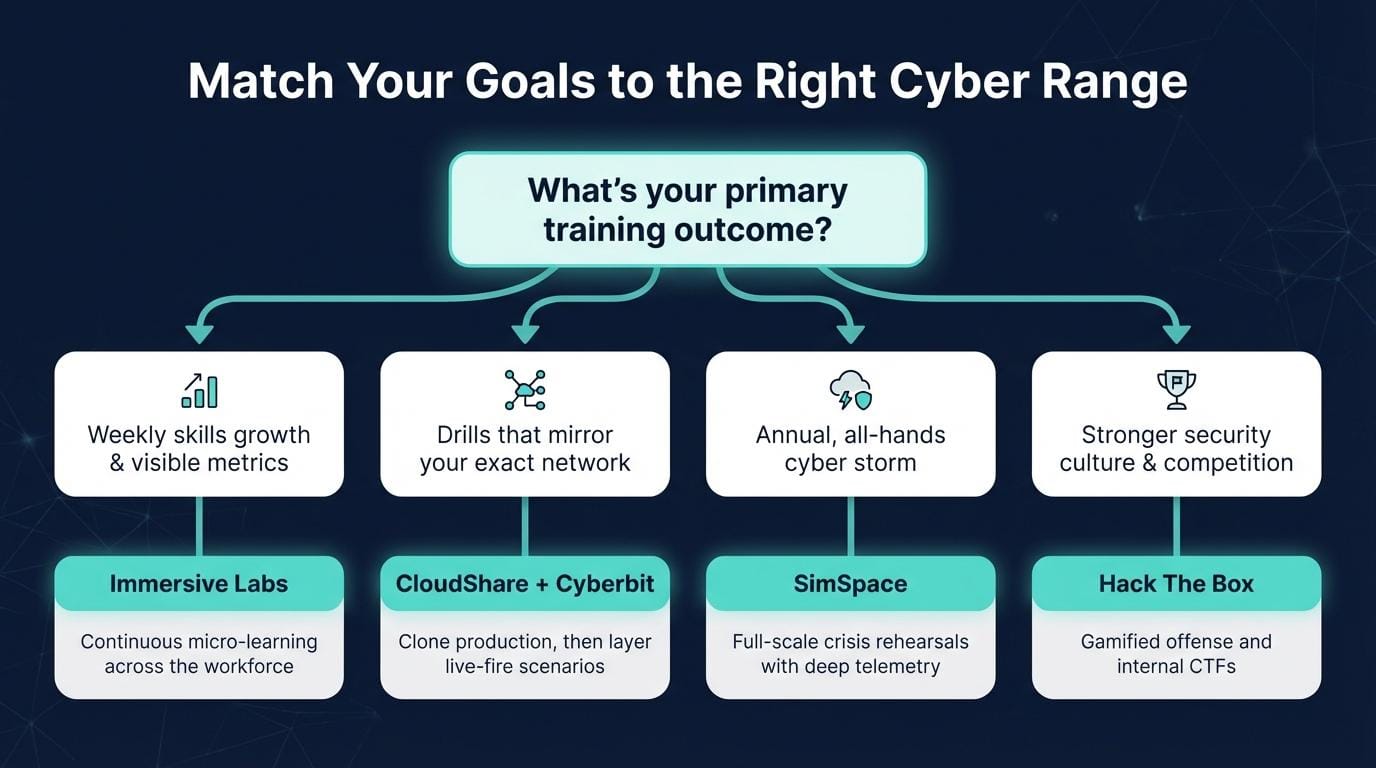
If weekly skill growth and visible metrics top the list, Immersive Labs fits the bill. Deploy it company-wide, schedule 30-minute labs during work hours, and track the improvement curve each quarter.
Need team drills that mirror your exact network? Clone production in CloudShare, then layer scripted attacks and rich post-mortems with Cyberbit.
Planning an annual, all-hands cyber storm (including legal, executives, and third-party vendors)? Budget for SimSpace. One intense exercise can reveal more process gaps than a year of smaller drills.
If culture is your guiding focus, Hack The Box turns training into a competition. Launch an internal Capture-the-Flag league, award monthly prizes, and watch participation rise.
Two quick tips as you evaluate:
- Always pilot with a real scenario. A proof-of-concept that solves yesterday’s outage provides more insight than any canned demo.
- Assign an internal owner. Without someone nudging colleagues onto the platform, even the best range gathers dust.
FAQ
What’s the difference between a cyber range and a breach-and-attack simulation tool?
A cyber range trains people, while BAS tools test technology. In a range, humans make decisions inside a safe, replica network. In BAS, software launches scripted attacks against live controls to verify they respond correctly. Many security programs use both.
How often should we schedule range exercises?
Run self-paced labs every week and larger team drills each quarter. This rhythm keeps skills current without overloading calendars.
Will a range disrupt production systems?
No. Training occurs in isolated sandboxes or cloned networks, so your live environment stays untouched.
Who benefits most from this training?
Everyone from tier-one analysts to executives on the crisis-communication line. The best platforms adjust content to each role.
How do we measure success?
Track time to detect, time to contain, and scenario scores inside the platform. Over time, you should see faster responses, fewer missed steps, and higher composite scores.
Is this only for large enterprises?
No. Cloud-hosted ranges and per-seat pricing allow mid-market teams to start small and expand as value becomes clear.
Conclusion
Cyber ranges turn security theory into hands-on readiness. Choose the platform that aligns with your goals, run a realistic pilot, and assign a champion to keep the program moving. With the right approach, simulation-based training will elevate skills, confidence, and resilience across your organization.