The training industry in India has a problem most insiders will admit privately and almost no one says aloud: workshops produce energy on day one and almost no behavior change by week three. Companies pay for the workshop, employees walk out inspired, and the operating reality of the office quietly absorbs them back into the patterns they walked in with.
Rajiv Sharma watched this happen across his two decades of corporate career, in conference rooms from Delhi to Lagos to Dubai. By 2013 he stopped accepting it as a fact of the industry and started designing for it.
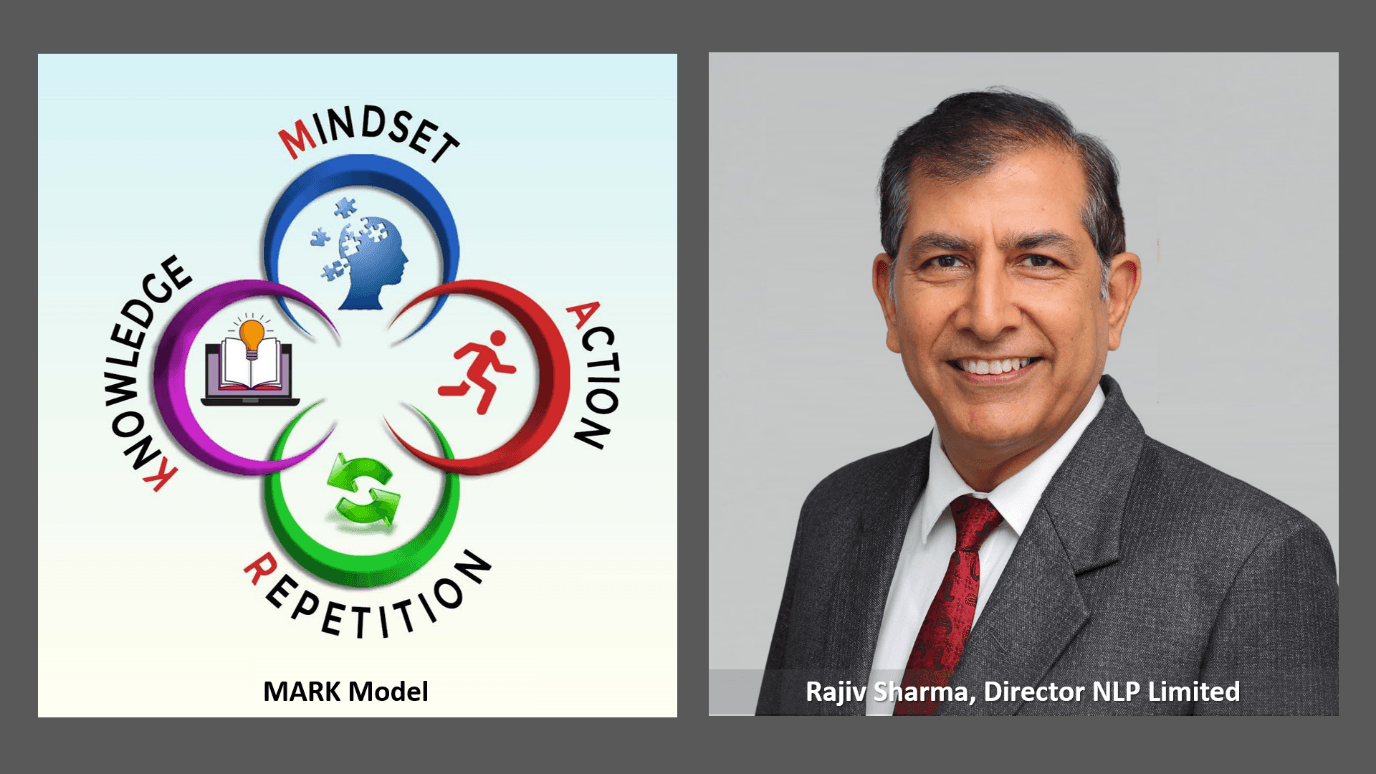
What he built is now a registered trademark, a published book, and the operating method behind training programs delivered to Google, Microsoft, Mercedes-Benz, NTT DATA, Dangote Group, Olam, and TotalEnergies. He calls it the MARK Model. The acronym reads simply: Mindset, Action, Repetition, Knowledge. The implications run deeper than the four words suggest.
The Lineage Matters More Than Most People Realize
NLP in the world has a discoverability problem. The category is full, the credentials are inconsistent, and most participants cannot tell from a website whether the trainer in front of them learned from a primary source or from someone three steps removed.
Rajiv learned from Dr. Richard Bandler. The man who co-created Neuro-Linguistic Programming in California in the 1970s. Bandler and John still runs the Society of NLP in the United States. Rajiv holds Licensed NLP Coach and Trainer status from Bandler, alongside the Professional Certified Coach credential from the International Coaching Federation.
That direct lineage does not happen by accident. It requires showing up, sustaining the relationship across years, and earning the right to teach the work in the form the originators recognize. Most NLP trainers in India trace their training to second-generation or third-generation lines. Rajiv is rare on this measure.
Corporates Love The MARK Model Because Mindset is Not Everything
Mindset is not everything. It is only the beginning. Repeated action is what changes it.
The conventional structure of a corporate training day looks like this: state the framework, run a few exercises, pull stories from the room, send everyone home with a workbook. The energy curve peaks around 4 PM on day one. By the third Monday after the program ends, most participants have lost the new vocabulary, defaulted to old habits, and started referring to the workshop in past tense.
What Rajiv noticed early was that mindset shifts on their own do not survive contact with the office. A participant might leave a program genuinely committed to a new approach to feedback conversations. The first time their direct report misses a deadline three weeks later, the old reaction fires before the new framework has time to load. The shift was real. The repetition machinery to make it permanent was not built.
The MARK Model addresses this by treating behavior change as a four-stage problem rather than a one-stage problem.
Treat mindset as the entry point. The mental and emotional frame the professional carries into the moment of action. NLP gives the tools to surface and change it. This is the layer most training programs touch.
Action is the deliberate behavior that converts the new mindset into something visible. A senior leader who decides to listen more in meetings has changed nothing until the first meeting where they actually do it. The action is where most workshops stop.
Repetition is the layer most workshops skip because it is the unglamorous part. New behavior becomes new habit only through deliberate cycles of practice, with feedback, over enough weeks for the pattern to encode. Rajiv builds repetition mechanics into his programs as structured 30-to-90-day post-workshop work, not as a bonus.
Knowledge is the final element. The accumulated insight the practitioner gains by living the new pattern long enough to develop real expertise about it. Knowledge is what compounds across the other three.
Forbes India has covered the model in a feature article describing it as a tool that can transform businesses.
What makes the work distinctly Indian, and why that matters globally
Rajiv runs his Indian programs out of New Delhi, with regular cohorts in Mumbai, Pune, Bengaluru, Hyderabad, Chennai, Kolkata, and Chandigarh. The participants are mostly Indian working professionals navigating Indian corporate realities: hierarchical decision-making structures, multi-generational family business culture that shapes much of the mid-market, the communication challenges of working across English and Hindi inside the same office, and the negotiation styles that prevail in Indian sales environments.
The MARK Model was built inside this context. The pacing of the work, the kinds of resistance that come up in the room, the examples used to illustrate each stage, all come from working with Indian corporates rather than being imported from American workshops and translated.
The model has scaled beyond India. Rajiv’s programs have run in 57 countries since 2000, and the framework now has an estimated 100,000 active practitioners worldwide. But the original design environment was Indian, and that gives the work a quality American-built frameworks rarely have when they show up in Mumbai: it does not need translation.
What this means for the global NLP industry
The center of gravity in NLP has been shifting. The classic curriculum was designed in California fifty years ago for an American context, taught primarily by American trainers, and exported. The next generation of the work is being designed inside the markets where it is most needed, by trainers who understand both the source material and the cultural realities of their participants.
Rajiv represents that shift in India. His direct lineage to Bandler anchors the work in the original transmission. The frameworks he has built on top of that foundation address problems that look different from the inside of a Mumbai conference room than they do from the inside of a Palo Alto one. The fact that his work has scaled across 57 countries while remaining recognizably Indian in its sensibility suggests the global NLP industry has more to learn from regional adaptation than from continued export of the original American curriculum.
Whether the rest of the industry follows is a separate question. What is no longer a question is whether Indian corporate training can produce work that competes at the top tier of global rankings. Rajiv’s #5 NLP and #3 Sales positions on the 2026 Global Gurus lists answer that.
About the work
Rajiv Sharma is the founder and Director of NLP Limited, headquartered in Dubai with offices in India, Nigeria, the United States, and South Africa. He is the creator of the MARK Model, LeadFORTH, AI-ENABLE, and SCOPE frameworks, and the author of Make a MARK in Life: Connecting Effectiveness, AI-Powered Sales Success: Outsmart The Competition, NLP for Excellence, and LeadFORTH.